
Missed Call Text Back for Roofers: Setup, Scripts, Rules
Missed call text back is an automation that sends a text to a caller within seconds when nobody picks up, so a homeowner with a leaking roof gets a reply from you instead of dialing the next name on the list. For a roofing company it works best as one piece of a faster response system: the text opens the conversation, a person or a workflow qualifies it, and the lead lands in your CRM. This guide covers how it works, how to set it up, what to write, what the law expects, and how to measure whether it is paying off.
TL;DR
- Missed call text back sends an automatic SMS to any caller you could not answer, then moves the reply into your inbox or CRM.
- Name your business, acknowledge the call, and ask exactly one question. Keep it short.
- Register your texting number (A2P 10DLC), honor STOP requests, and do not treat this as a marketing blast: it is a reply to someone who called you.
- The first text is only the opener. Route replies to a human fast, and sort emergencies from estimates and existing customers.
- Track missed calls, texts sent, replies, booked inspections and signed jobs, not just texts delivered.
Table of Contents
- What missed call text back is, and why roofers need it
- How the setup works, step by step
- What to say: the message that gets a reply
- Is missed call text back legal?
- The first text is only the opener
- Does it improve answer rate? Measuring what matters
- Perspective: speed beats polish in storm season
- Where Areions fits
- Common mistakes to avoid
- FAQ
- Sources
What missed call text back is, and why roofers need it
When a call goes unanswered, the system detects it and sends an SMS from your business number. One platform’s documentation describes it as an automatic text to callers whose call goes unanswered, inviting them to reply or book online. The reply starts a text thread in your inbox, and a new contact is created if the number is not already in your system.
Roofing makes the case sharper than most trades. Your crews are on ladders, your estimators are in driveways, and your office closes at 5 p.m. Meanwhile, demand does not arrive evenly. After a hailstorm or a high-wind event, a neighborhood of homeowners looks up roofers at once. Anyone who dials three companies and gets voicemail at the first two will talk to whoever answers, or whoever texts first.
That is the whole logic. Another write-up describes the automation as an immediate SMS, typically within seconds, that keeps the prospect engaged and makes a call to a competitor less likely. It does not replace answering the phone. It protects you in the minutes when you cannot.
What it will not do
It will not fix a bad offer, a slow estimator, or a phone number that rings nowhere. It also skips some callers by design. One platform’s help page lists blocked or unknown caller ID, recent text-backs, team numbers, prior opt-outs and landline callers among the cases where no text goes out. Expect a share of your missed calls to get no automated reply, and have a voicemail greeting and a callback routine for them.
How the setup works, step by step
The exact menus differ by platform, but the sequence is the same everywhere.
- Pick the number callers actually dial. Use the number on your trucks, yard signs, Google Business Profile and ads. If your tracking numbers forward to a main line, make sure the text-back fires from a number that can receive replies. Our dynamic number insertion checklist covers how to keep tracked calls tied to jobs.
- Route calls through a platform that supports it. Most small contractors use a business phone system or a CRM with a phone layer. Setup usually means routing call traffic through a supported platform, registering for A2P 10DLC, and building a workflow that detects missed calls and triggers the SMS.
- Register for A2P 10DLC. Carriers filter unregistered business texting from local numbers. Registration ties your brand to your legal business details, and mismatches (a business name or EIN that does not match your records) are a common reason for rejection. This walkthrough of A2P 10DLC registration and EIN mismatches shows what to prepare before you apply.
- Turn the feature on and write the message. In the platform used in the example above, that means enabling it in phone and text settings, customizing the text and sending replies to the inbox conversation.
- Test the call path. Call from a mobile phone you do not use for the business, let it ring out, and confirm the text arrives, the reply shows up, and the right person is notified. The same documentation notes that each missed call is handled only once, so a caller who rings three times should not get three texts.
- Set business hours and after-hours behavior. Decide whether the text says you will call back first thing tomorrow or whether an emergency line exists.
What to say: the message that gets a reply
The best missed-call texts are boring. They are short, they sound like a person, and they ask for one thing. Guidance from one setup guide says to identify your business by name right away, which also helps avoid being marked as spam, and ask for a single action, such as the issue or the address. Another resource for home services suggests a roofing text can identify the business, thank the caller, ask what work they are considering, and ask for a ZIP code next if the service area is unknown.
General etiquette for a text after a missed call is to reply promptly, apologize, explain why you missed it and offer a callback time. For a roofer, keep the explanation to a few words.
Templates you can adapt
Standard business hours
Hi, this is [Name] at [Company] Roofing. Sorry we missed your call, we’re on a job site. What’s going on with your roof? We’ll call you back within [time].
After hours
Thanks for calling [Company] Roofing. Our office is closed, but we got your call. Reply with your address and a short description and we’ll reach out first thing in the morning.
Storm season
Hi, [Company] Roofing here. We’re getting a lot of calls after the recent storm and missed yours. Reply with your address and whether you see leaking inside, and we’ll prioritize active leaks.
Follow-up if they reply with a problem
Thanks. Is water coming in right now, or are you looking to get the roof inspected?
A few rules hold across all of them:
- One question per message. Two questions get zero answers.
- No links in the first text unless you are sure they will not trigger filtering.
- No discount language. The caller phoned you; they do not need a promotion.
- Do not promise a callback time you cannot keep. Our roofing lead scripts show how the tone and ask change at each sales stage once the conversation continues.
Is missed call text back legal?
In the United States, yes, as long as you treat texting rules seriously. This is general information, not legal advice, and a business attorney who handles TCPA matters should review your setup, especially if you ever use the same number for outreach.
The main law is the Telephone Consumer Protection Act. The FCC’s position is that autodialed texts to wireless numbers fall under the TCPA and generally require prior express consent unless an exception applies, and consumers may revoke consent by reasonable means. A homeowner who calls your business number and gets a reply about that call is in a very different position from a stranger who is cold-texted, but your wording still matters. Keep the text tied to the call, do not slip in marketing, and do not add the number to a promotional list without proper consent.
Opt-outs are where small companies slip. Under the FCC’s revocation rule, as of April 11, 2025, businesses must honor revocation through any reasonable method, including keywords like “stop”, and process requests within 10 business days. In practice, do not wait ten days. Have your platform suppress the number immediately, and make sure a prior opt-out stops future text-backs automatically.
Carriers add their own layer. Industry messaging guidelines from CTIA are not law, but carriers enforce them alongside regulations through filtering and blocking, and they expect support for opt-out keywords such as STOP. That is another reason to complete your A2P registration before you launch.

The first text is only the opener
Most guides stop at the template. The real loss happens afterward: a homeowner replies “yes, I have a leak,” and the message sits unread until Monday.
Route and notify
Best-practice workflows combine an immediate automated text, an internal staff notification and automated CRM updates so a human can step in quickly. If you want a plain-language look at how a missed-call trigger, a staff alert and a CRM update fit together, this guide to starting with three automation workflows is a useful frame. For roofing-specific versions, see our nine roofing CRM automations to set up first.

Sort before you sequence
A missed call is not always a new lead. Some workflow guidance argues that missed calls should be classified first, because a new roofing estimate, an existing-customer question, a billing issue and an emergency should not enter the same sequence. A simple split works:
| Caller type | First reply | Who handles it |
|---|---|---|
| Active leak or storm emergency | Ask if water is coming in and for the address | On-call person, same hour |
| New estimate request | Ask what work they are considering | Sales or appointment setter |
| Existing customer | Ask for name and job address | Project manager or office |
| Billing or vendor | Ask for name and invoice | Office, next business day |
If you do not have someone to take these conversations, an appointment-setting layer solves it. Our piece on roofing appointment setting with verified storm leads explains how a conversation becomes a booked inspection.
Guard against loops
Auto-replies can go wrong when two automated systems talk to each other or one caller triggers repeated messages. At least one provider documents rate limiting and loop prevention to avoid repetitive or unwanted conversations. Whatever platform you use, ask how it handles repeat callers.
Does it improve answer rate? Measuring what matters
Missed call text back does not make your phone get answered more often. It improves how many missed calls turn into conversations. That distinction matters when you measure it, and it is why “improve answer rate” is only half the picture: answer rate counts calls picked up, while recovery rate counts lost callers you got back.
The speed argument comes from lead-response research. A frequently cited study reported in Harvard Business Review in 2011 found that contact odds drop sharply within the first five to ten minutes. Treat the exact multipliers you see online with caution; some vendors claim a 391% conversion lift for responding within one minute, but those numbers come from different industries and should not be your forecast. The direction is clear, the magnitude for your market is something you measure yourself.
Track this funnel weekly:
- Missed calls
- Eligible calls (not blocked, not a team number, not an opt-out)
- Texts delivered
- Replies
- Callbacks connected
- Inspections or estimates booked
- Jobs signed
That matches a framework that recommends measuring missed-call inquiries, eligibility, delivered texts, replies, assigned and connected callbacks, booked visits and completed jobs, and keeping the call identifier so you avoid duplicate recovery messages. Tie the last step to revenue. Our guides on offline conversion tracking for roofers and roofing marketing KPIs show how to connect calls to closed jobs so you know which campaigns deserve more budget.
A quick worked example
Suppose a week after a hail event you miss 40 calls. If 30 are eligible and delivered, and a third reply, that is 10 live conversations you would otherwise have lost. If half become inspections and a fifth of those become signed roofs, you recover one job from a week that would have produced none from those calls. Those rates are illustrative, not benchmarks. Plug in your own numbers after four weeks of data.
Perspective: speed beats polish in storm season
We work with roofing companies on storm response, and the pattern repeats: the contractor who responds first and clearly wins more inspections than the one with the nicer website. Storm demand is short and concentrated, which is why we build the system before the storm, not during it. Missed call text back belongs in that system, but we would not call it a strategy by itself. A text that nobody follows up on is just a faster way to disappoint a homeowner.
Our view is that the text should do three jobs only: acknowledge the caller, collect the address and the problem, and hand the conversation to a person. Everything else, the qualification, the scheduling, the CRM record, should happen behind it. That is also why we qualify storm leads with a human check instead of trusting a form. For a deeper look at how we think about the whole sequence, see our roofing storm response playbook and our note on which advertising channels reward fast answers.
— Angel
Where Areions fits
If you would rather not build and manage this yourself, we run the system for roofing companies: managed Google Ads campaigns, landing pages, call tracking, CRM and pipeline setup, automated lead routing and follow-up, and human-verified homeowner qualification, with territory exclusivity so we are not selling your area’s leads to the roofer down the road.
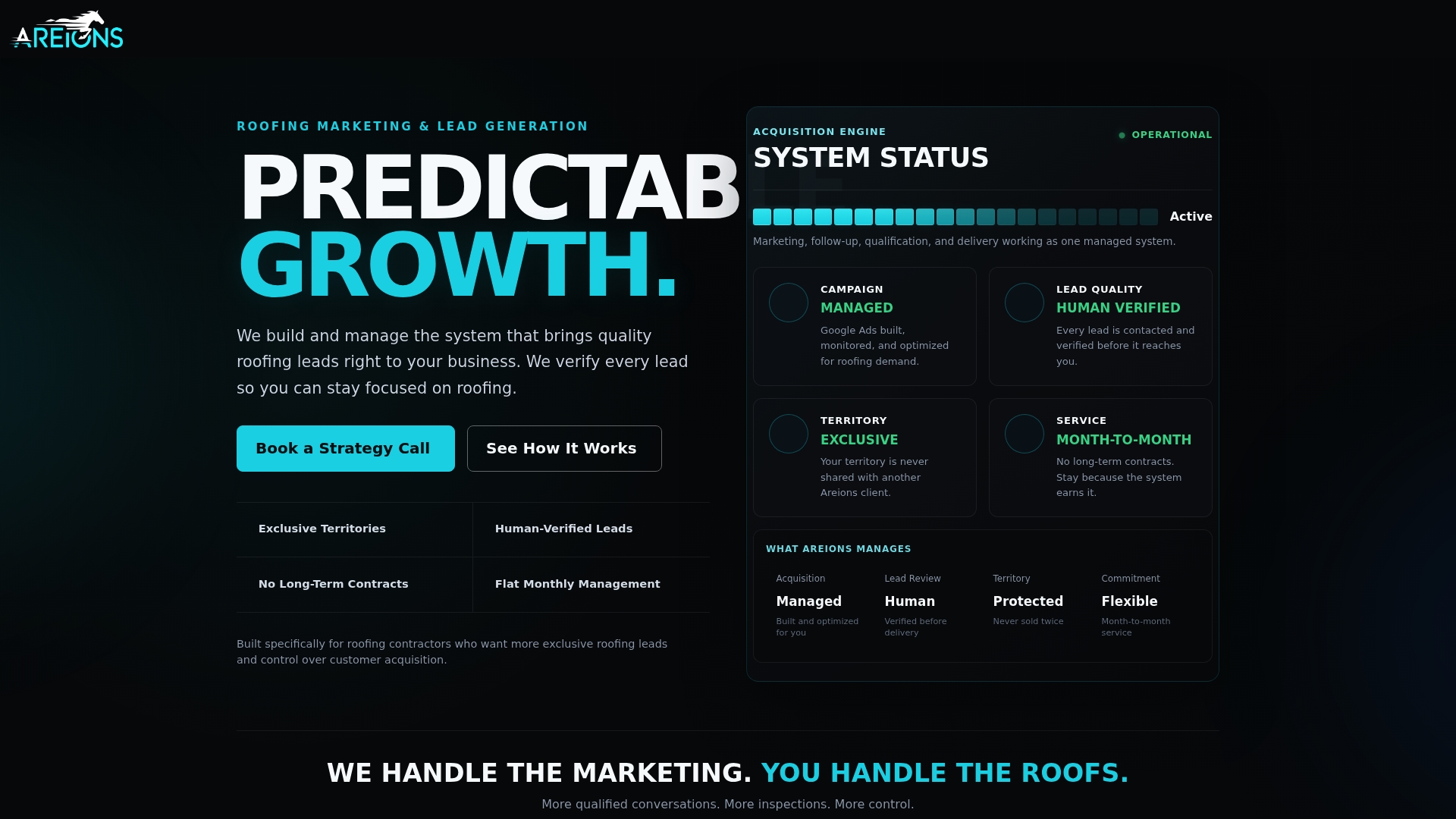
Pricing is published and flat: Foundation is $97 per month, Professional is $1500 per month and Enterprise is $5000 per month, with tiers based on the level of service and exclusivity. Service is month to month with no long-term contract, and we guarantee qualified leads within 30 days. See the plans on areions.com and pick the tier that matches how much of the work you want off your plate.
Common mistakes to avoid
- Texting from a number nobody monitors. Replies vanish. Make sure the number is attached to an inbox someone checks.
- Skipping registration. Unregistered traffic gets filtered, and you will not know your texts failed.
- One message for every caller. Existing customers do not want to be asked what work they are considering.
- Long texts. If it needs scrolling, it is an email.
- No after-hours plan. A text that says “we will call you soon” at 9 p.m. with no one on the schedule is a broken promise.
- Counting texts as success. Replies and booked inspections are the numbers that pay your crew.
FAQ
What is the missed call text back feature?
It is an automation that sends a text to someone whose call you did not answer, usually within seconds. The text acknowledges the call and invites a reply, and the answer lands in your inbox or CRM so your team can continue the conversation.
How do you text back when you missed a call?
If you are doing it by hand, reply quickly, apologize, say briefly why you missed the call, and offer a specific callback time. Identify your company by name and ask one simple question, such as the address or the problem. Automation does the same thing faster and at any hour.
Is missed call text back legal?
Generally yes, when the text is a reply to a call the person placed to you, the content is not promotional, and you honor opt-outs. The TCPA governs automated texts, and the FCC expects businesses to honor reasonable revocation requests, including “stop”. Have an attorney review your wording and consent practices.
Does it work for roofers who miss calls on job sites?
It works best when someone picks up the conversation quickly after the first text. The automation covers the first minute; a person, an appointment setter or a qualified follow-up workflow has to cover the next hour. Without that handoff, you gain speed but not jobs.
Sources
- Missed-call text-back help documentation
- How to Set Up Missed-Call Text-Back (Step by Step)
- How to Quickly Respond to a Missed Call by Text
- Missed-Call Text Back: Setup and Provider Guide
- FCC public notice on TCPA and text messages (2016)
- TCPA revocation of consent: rules and compliance guide
- CTIA messaging guidelines and compliance checklist
- Auto-replies and scheduled messages documentation
- Speed to lead: the Harvard research
- Speed to lead: why calling in 60 seconds triples conversion