
Roofing Appointment Setting: Verified Storm Leads in Your CRM
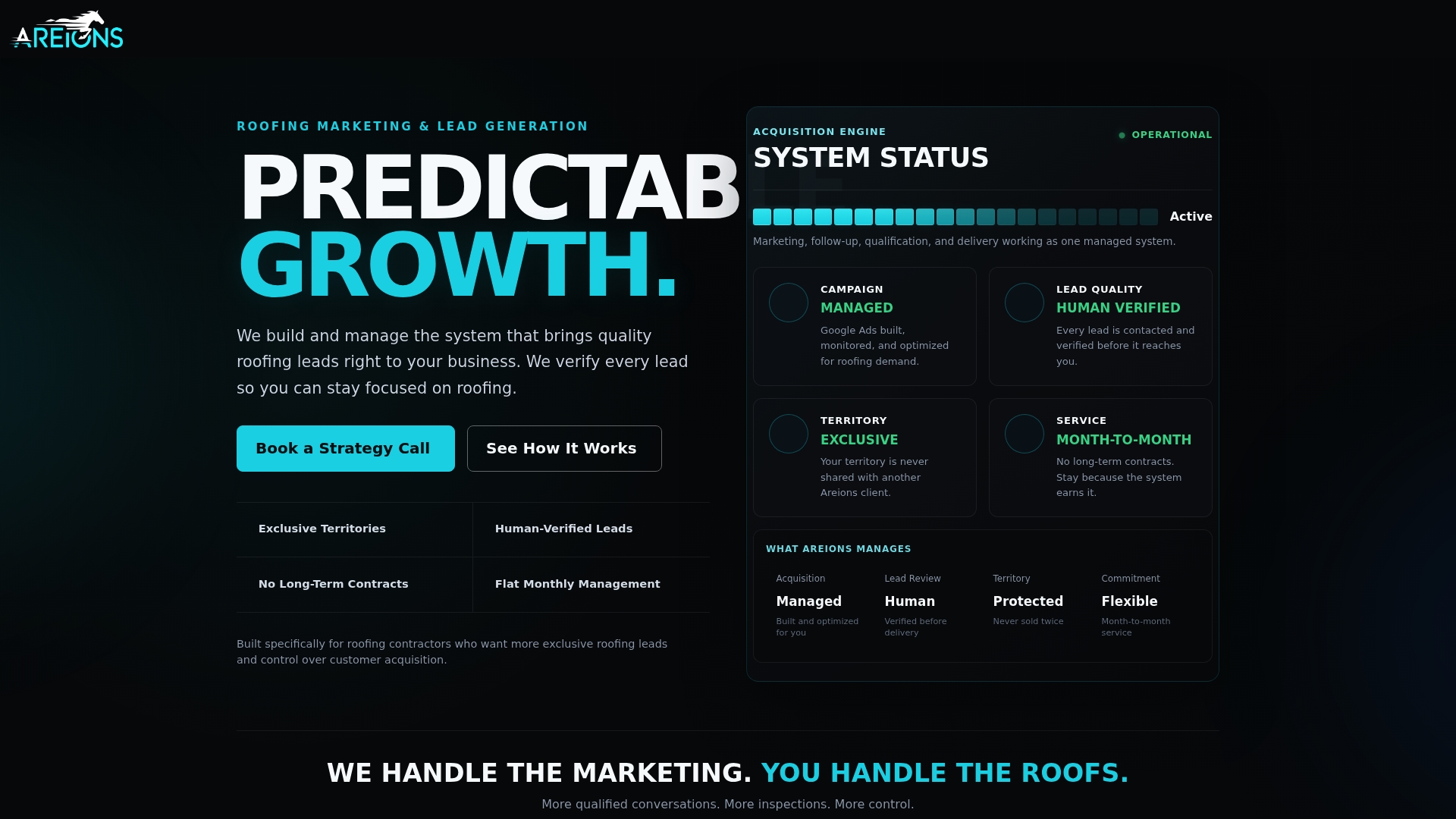
For roofing appointment setting, we recommend Areions, our managed storm-response service that delivers human-verified, CRM-routed leads from homeowners with real storm damage. We verify every lead by phone, route it straight into your pipeline, and back it with a qualified-lead guarantee within 30 days. Book a demo and we will check your territory first.
TL;DR:
- Keep an in house team for steady year round volume; freelancers suit flexible needs, while AI needs human escalation for complex insurance claims.
- Before signing, require written territory exclusivity and quality terms, CRM and calendar field mapping, reports tied to individual calls, and live human verification.
- Monthly plans range from $97 to $5,000; run a pilot that lasts 30 to 60 days and track appointment rates, no shows, estimates, and closed jobs.
- Sync appointments to crew calendars, capture damage, insurance, source, photos, and contact times in the CRM, and send closed job revenue to ad platforms.
- Outsource when missed calls cost booked jobs or a scheduler vacancy could outlast the storm window, putting seasonal demand beyond your reach.
Table of Contents
- Which roofing appointment setting option fits your shop?
- How do you vet an outsourced appointment setter?
- What CRM, call tracking and handoff setup do you need?
- What does roofing appointment setting cost, and how long until it works?
- What should your intake script collect, and how do you avoid scams?
- Where outsourcing beats hiring
- Get verified storm appointments with Areions
- FAQ
- Sources
Which roofing appointment setting option fits your shop?
Roofing companies can choose among several paths to schedule consultations without losing calls: our managed storm-response service, an in-house team, a freelance setter, a BPO or outsourced agency, and an AI-powered scheduling platform. They differ most on who verifies the homeowner, how fast you see results, and what happens during a storm surge.
| Option | Best for | Pricing model | Coverage | Qualification method | CRM and dispatch integration | Territory exclusivity or guarantee | Time to first qualified appointments |
|---|---|---|---|---|---|---|---|
| In-house appointment team | Steady year-round volume | Salaries and overhead | Limited to staffed hours | Your own scripts and training | Whatever you build | Not applicable | Depends on hiring and training |
| Freelance or contract setter | Small shops wanting flexible help | Hourly or per booked appointment | Varies by person | Varies by person | Usually manual | None | Fast to start, uneven results |
| BPO or outsourced agency | High call volume, human-driven intake | Often per appointment, sometimes with SLAs | Staffed hours, sometimes extended | Scripted human screening | Varies by vendor | Varies by vendor | Depends on onboarding |
| AI-powered scheduling platform | Low cost and round-the-clock response | Software subscription | 24/7 | Automated, best with human escalation | CRM and calendar integrations | Rarely offered | Quick to deploy |
A few points the table cannot carry on its own:
- In-house teams give you full control over script and handoffs, but you own recruiting, training, turnover and after-hours gaps. That is a heavy lift when skilled labor is scarce, and the roofing labor crunch is exactly what pushes capacity-stretched contractors toward outsourcing.
- Freelancers keep commitments low, but quality and reliability depend entirely on one person, and nobody covers when that person is unavailable.
- BPO agencies scale live intake well. The question to press is how they verify a homeowner, because generic call-center scripts rarely understand storm claims or adjuster timing.
- AI platforms answer instantly at any hour. Voice AI agents built for home services can run scripted flows, book or confirm slots and sync with your CRM, and they work best when paired with human escalation.
- Our managed service combines the speed of automation with human verification and sets your system up before storms arrive, so you are positioned to intercept demand rather than chase it.
How do you vet an outsourced appointment setter?
Treat the vendor call like a hiring interview. Score every provider on coverage hours, qualification method, integration depth, territory exclusivity, SLAs and guarantees, reporting, and what happens when a lead turns out to be junk. Our guide to exclusive roofing territories goes deeper on the territory piece.
Ask these questions, and listen for specifics rather than sales talk:
- “Walk me through exactly how you verify a homeowner before booking.” You want a live human check, not just a web form.
- “Who else are you selling leads or appointments to in my territory?” Exclusivity should be in writing.
- “Which CRM and calendar tools do you sync with, and which fields do you populate?”
- “What is your lead-quality or refund policy if an appointment is a bad fit?”
- “What is your service-level commitment on response time and time to first qualified appointments?”
- “How do you handle after-hours and storm-surge call volume?”
- “What do your reports show, and can I see call-level data tied back to revenue?”
- “Can I speak with a current roofing client?”
Pro Tip: Ask the vendor to book a mock appointment for a fake storm-damage address while you listen. How they probe, confirm and hand off tells you more than any deck.
Red flags are easy to spot once you know them: no verification step, demands for cash upfront, vague reporting, no CRM integration, and refusal to put territory or guarantee terms in writing.
What CRM, call tracking and handoff setup do you need?
A booked appointment only matters if it becomes a completed inspection and estimate. High-performing firms treat appointment setting as pipeline management rather than a receptionist task, using buffer slots for high-priority storm calls and steering insurance adjuster visits toward midweek rather than Mondays. Process and data discipline is increasingly table stakes in roofing.
Check these items before you sign anything:
- Calendar and dispatch sync: appointments should land on the right crew’s calendar without re-entry.
- CRM fields: source, damage notes, insurance status, photos and homeowner contact times should all populate automatically.
- Call tracking and DNI: dynamic number insertion lets you trace each storm call back to the ad or page that produced it, and our DNI setup checks show what to verify.
- Offline conversion tracking: send closed-job revenue back to your ad platform so campaigns learn from jobs, not just calls. Our walkthrough on offline conversion tracking covers the mechanics.
- Handoff package: address, damage description, photos, confirmation status, reschedule rules and technician notes.
Use voice AI for overflow and off-hour intake, and bring in a human whenever the call is complex, high value or involves an insurance claim.
What does roofing appointment setting cost, and how long until it works?

Pricing usually takes one of three shapes: a flat monthly management fee, a per-appointment fee, or a hybrid with a setup charge. Our own published plans are a flat monthly structure, from Foundation at $97 per month to Professional at $1,500 per month and Enterprise at $5,000 per month, all month to month. A small shop might start on a lighter tier to prove the channel, while a multi-crew operation will want exclusivity and heavier campaign management.
A typical onboarding runs in four steps:
- Kickoff and script setup: agree on intake fields, qualification rules and tone.
- Technical integration: connect CRM, calendar and call tracking.
- Pilot and territory verification: run live traffic for 30 to 60 days and confirm no overlap with other clients.
- Ramp to SLA: scale volume once quality holds.
Track four numbers during the pilot: appointment-set rate, no-show rate, qualified-to-estimate conversion, and first-appointment-to-job conversion. If a vendor cannot report all four, you cannot judge the pilot fairly.
What should your intake script collect, and how do you avoid scams?
A good script gets enough information to qualify the homeowner without turning the call into an interrogation. Our roofing lead scripts include templates for each sales stage. At minimum, collect:
- Property address and confirmation that the caller is the homeowner
- Description of the damage and how it was discovered
- Photos, when the homeowner can send them
- Insurance carrier and claim status
- Best days and times for the inspection
For confirmation, send a message that repeats the date, time, address and crew contact, then follow with reminders before the appointment. Offer an easy reply to reschedule, which cuts no-shows far better than silence.
Post-storm periods attract fraud, and your brand pays for it when homeowners get burned. The FTC notes that scammers target storm-hit homeowners, pushing contractors who demand full payment upfront, skip written contracts or cannot show license and insurance. Its alert on post-hurricane recovery scams adds that these scammers may refuse paperwork entirely. Never ask for cash upfront, always provide a written contract, and be ready to show your license and insurance on the first visit.
Where outsourcing beats hiring
Most owners wait too long. They lose calls to voicemail for months, blame the ads, and only then consider help. My rule of thumb: outsource when missed calls are visibly costing you booked jobs, or when hiring a scheduler takes longer than the storm window lasts. Labor is tight, and a scheduler vacancy that lasts through the storm window can mean losing the season. Speed of response and human verification can decide who wins storm demand.
— Angel
Get verified storm appointments with Areions
You should not have to choose between speed and lead quality. We set up your storm-response system before weather arrives, then deliver human-verified homeowners into your CRM, with territory exclusivity and month-to-month plans.
- Human-verified storm leads routed straight to your pipeline
- Territory exclusivity so we never compete against ourselves in your area
- Foundation, Professional and Enterprise plans, with lead-quality terms outlined before you sign
Book a demo at Areions and we will check your territory availability on the call.
FAQ
Are roofers in high demand?
Yes, demand for skilled roofing labor remains strong. Job openings keep rising while the pool of skilled workers stays limited, which is why many contractors outsource scheduling to protect capacity.
What does a roofing appointment setter do?
An appointment setter answers or places calls, qualifies the homeowner, collects damage and insurance details, and books an inspection on your calendar. A good one also confirms, reminds and reschedules so your crews do not waste trips.
How do you tell if a roofer is lying?
Watch for demands for full payment upfront, no written contract, and no proof of license or insurance. The FTC lists these exact warning signs for storm-damage repair offers.
How can I schedule roofing consultations faster?
Answer every call, confirm by text promptly, and keep buffer slots open for urgent storm calls. A scheduler or service that responds around the clock keeps leads from calling the next roofer on the list.
Sources
- How To Prepare for a Weather Emergency While Avoiding Scams | Consumer Advice
- AI Can Revolutionize Appointment Scheduling for Roofing Contractors | Roofing Contractor
- Construction Job Openings Surge Amid Roofing Labor Crunch | Roofing Contractor
- Nutshell