
Marketing Audit Checklist for Roofing Contractors
A marketing audit is a structured review of your goals, channels, tracking and results, ending in a short, ranked list of fixes. For a roofing company, the checklist below covers the standard areas (website, local search, paid ads, email, brand, funnel) and adds the ones that decide whether you win storm work: lead quality, service-area fit, speed to response and revenue tracking. Set aside half a day, pull 12 months of numbers first, and score each area before you change anything.
TL;DR
- Start with data, not opinions: 12 months of visitors, leads, customers, revenue, cost per lead and lead-to-customer rate.
- Audit eight areas in order: goals, website, local profile, paid ads, tracking, lead handling, storm readiness, budget.
- Score each item pass, partial or fail, then fix the failures that sit closest to booked inspections first.
- Repeat the audit at least once a year, and run a lighter KPI check weekly.
- Copy the template table in this article into a spreadsheet and fill it in with your own numbers.
Table of Contents
- What a marketing audit actually covers
- Before you start: pull your numbers
- The eight-step roofing marketing audit checklist
- A template you can copy
- How to turn findings into a fix list
- Our perspective on auditing roofing marketing
- Where Areions fits
- FAQ
- Sources
What a marketing audit actually covers
Generic audit guides agree on the core list. Mailchimp’s audit guide names website and SEO, social media, email, content, paid advertising and ROI, branding and messaging, and the customer journey and conversion funnel. That is the skeleton. A roofer needs to bend it toward how jobs are actually won.
Academic work adds a useful lens. Morgan, Clark and Gooner (2002) describe the six-part audit model refined by Kotler and colleagues: environment, strategy, organization, systems, productivity and function. You do not need a university framework to audit a roofing company, but the six parts are a good sanity check:
| Audit type | The question it asks | Roofing version |
|---|---|---|
| Environment | What outside forces and players shape demand? | Hail and wind seasons, insurance behavior, competing contractors in your counties |
| Strategy | Are goals and positioning clear? | Retail vs. insurance work, which territories, which job size |
| Organization | Who owns marketing and sales? | Who answers the phone, who follows up, who reports |
| Systems | Do the processes work? | Lead routing, CRM, call tracking |
| Productivity | Is spend earning its keep? | Cost per lead, cost per booked inspection, cost per signed job |
| Function | Is each tactic performing? | Ads, profile, website, reviews, email |
The checklist that follows folds these into eight practical steps.
Before you start: pull your numbers
An audit without numbers is a feelings review. The PR 20/20 marketing audit template from HubSpot asks you to collect last-12-month totals for website visitors, leads, new customers, new-customer revenue, visitor-to-lead conversion rate, cost per lead and lead-to-customer conversion rate. Those seven figures work for a roofing company with one change: count a lead only after it is a real person with a real roof, not a spam form fill.
The U.S. Small Business Administration advises focusing on a small number of metrics tied to the growth area you are managing, with customer-acquisition cost among them. So resist the urge to build a 40-column dashboard. Seven numbers, by month, is enough to see trends.
Where to find them:
- Visitors and leads: Google Analytics, your call-tracking platform and your form submissions.
- Customers and revenue: your CRM or job-costing software. If jobs are only in a spreadsheet or a crew lead’s head, that is your first audit finding.
- Spend: ad platform invoices, agency fees, directory fees, yard signs, truck wraps, mailers. Count everything.
If you want a weekly version of this routine, our guide to roofing marketing KPIs for contractors shows what to track each week.
The eight-step roofing marketing audit checklist
For each item, mark Pass, Partial or Fail. Add a one-line note on evidence, such as a screenshot or a number.
1. Goals, territory and target customer
The SBA says a marketing plan should define the target market, competitive advantage, sales plan, goals, action plan, budget, measurement process and operational implications, according to its marketing and sales guidance. Turn that into questions you can answer in writing:
- Do you have a revenue goal for the next 12 months, and the number of signed jobs it implies?
- Which counties or ZIP codes do you actually want work in, and which do you refuse?
- What mix do you want: repairs, full replacements, insurance-funded storm work, commercial?
- In one sentence, why should a homeowner pick you over the next roofer on the list?
- Is your crew capacity enough for the volume you are trying to generate?
The last question matters more than it looks. Marketing that outruns your ability to inspect and install turns into slow follow-up and bad reviews.
2. Website and conversion path
Open your site on a phone, as a homeowner with a leak would.
- Is the phone number tappable and visible without scrolling?
- Does the form ask only for what you need (name, phone, address, short description)?
- Is there a page for each core service and each major city you serve?
- Do you show real project photos, licensing and insurance details, and reviews?
- Does the page load quickly on mobile data?
- Is there a dedicated landing page for paid traffic, separate from the home page?
Mark a Fail if a visitor needs more than two taps to call or request an inspection.
3. Local presence and Google Business Profile
For most roofers, the local profile is where cheap, high-intent leads come from. Google describes Business Profile as the way to manage your presence on Search and Maps, with insights on how customers search for and contact you. Check:
- Are name, address, phone and service areas correct and consistent everywhere they appear?
- Are the primary category and services accurate?
- Are photos recent and real?
- How many reviews have you gained in the last 90 days, and does someone reply to each?
- Is the profile linked to your analytics? Google says linking Business Profile to Google Analytics can combine interactions such as website clicks, calls, directions, messages and bookings with website data.
One caution on calls: Google’s call history feature is described as experimental and available to a selected group of businesses in the United States and Canada. Do not assume you have it. If you do, calls can show in the profile and, when the profile is linked to Google Ads, qualifying calls can appear as “Calls from Ads” conversions. If you do not, use call-tracking numbers so profile calls are counted somewhere.
For a deeper look at ranking in the map results, this 30/60/90-day Google Maps ranking plan is a helpful companion to this step.
4. Paid advertising
This is where roofing budgets leak fastest. Review the last 90 days of your Google Ads account (or ask whoever runs it to export it).
- Are campaigns split by intent, such as repair, replacement and storm damage, rather than one catch-all campaign?
- Is geo-targeting limited to areas you serve? Our guide to roofing geo targeting explains how to reach storm-hit homeowners without paying for clicks outside your territory.
- Is the negative keyword list maintained? Job seekers, DIY searches and material shoppers burn budget. See roofing negative keywords for the categories to block.
- Are ad copy and landing pages matched to the search?
- Which advertising channels are you using, and do they fit how fast you can respond? Our overview of roofing advertising channels covers that trade-off.
Mark a Fail if you cannot say what you paid per lead last month.
5. Tracking and attribution
If this step fails, every other number in the audit is suspect. A company-published audit template from Marketing Health Test frames the basic test well: conversion tracking should fire correctly on every key action, and you should be able to report cost per lead and cost per acquisition for each active channel. Apply that to a roofer:
- Do form submissions, tracked calls and chat messages each register as conversions?
- Does every ad, profile link, email and flyer carry a consistent UTM tag? Our UTM tracking setup guide for roofers shows a naming convention you can reuse.
- Does the source of each lead land in the CRM record, not only in the ad platform?
- Do signed-job revenues flow back to the ad platform? That is what offline conversion tracking for roofers does, so the platform learns which clicks became contracts.
If you want a broader view of what to measure across campaigns, this piece on marketing campaign analytics is a useful companion to this step.
6. Lead handling and the CRM
Marketing gets the lead to your door. Sales hygiene decides whether it counts.
- How long does it take the first human to respond to a new lead? Measure it from timestamps, not memory.
- Are missed calls returned the same day, and do after-hours leads get an automatic text?
- Does every lead get a status in the CRM: new, contacted, inspection booked, estimate sent, won, lost?
- Are lost jobs given a reason?
- Do follow-up sequences exist for estimates that have gone quiet?
For the tracking side of this, tracking leads in a CRM from first contact to booked job lines up with the funnel stages above. For automation ideas, see CRM automations to set up first, and for the phone conversation itself, our roofing lead scripts by sales stage.
7. Storm readiness
This is the item most generic audits miss. Storm demand arrives in bursts, and the contractor who is live first often wins the inspection. Ask:
- If a hail or wind event hit one of your counties tonight, how many hours until ads, a landing page and a phone answerer were live there?
- Do you have pre-built storm landing pages and ad structures, or would you start from scratch?
- Is there a plan for pausing ad spend in areas the storm missed?
- Who handles the inspection surge, and what is the cap before response times slip?
Our Kansas storm-ready Google Ads playbook is a worked example of a state-specific setup, and the same logic applies in the other states we serve.
8. Budget and return
The SBA’s guidance says to compare marketing and sales costs with the revenue they generate, measure ROI consistently and revisit the marketing plan at least annually. Put that into a simple block:
- Total marketing spend, last 12 months
- New-customer revenue, last 12 months
- Cost per lead, cost per booked inspection, cost per signed job, by channel
- Which channel has the lowest cost per signed job, not just per lead
Cheap leads that never sign are expensive. Our look at how storm leads change roofing marketing ROI explains why demand-based leads change the math.
A template you can copy
Paste this table into a spreadsheet. Add a column for the owner and a due date once you have scored it.
| Area | Key question | Evidence to attach | Score | Fix priority |
|---|---|---|---|---|
| Goals and territory | Are revenue goal and service area written down? | One-page plan | Pass / Partial / Fail | |
| Website | Can a mobile visitor call or book in two taps? | Phone screenshots | ||
| Local profile | Are info, reviews and photos current? | Profile export | ||
| Paid ads | Is spend limited to your territory and intent? | 90-day search terms report | ||
| Tracking | Do calls, forms and revenue map to a source? | Conversion list, UTM sheet | ||
| Lead handling | Is first response time known and fast? | CRM timestamps | ||
| Storm readiness | Could you launch in a new county within hours? | Saved landing pages and campaigns | ||
| Budget and ROI | Is cost per signed job known by channel? | 12-month spend and revenue |
How to turn findings into a fix list
PR 20/20’s template treats alignment among executives, marketing, sales, technology and reporting as necessary for turning audit findings into priorities. In a roofing company that usually means the owner, the office manager and whoever runs ads sit down together for an hour. Then:
- Sort Fails by proximity to revenue. A broken call-tracking number outranks an outdated About page.
- Fix measurement before spend. You cannot judge new campaigns on bad data.
- Pick three actions for the next 30 days. Give each an owner and a number it should move.
- Re-check weekly on a small set of KPIs. Review the full audit annually or after a major change in markets or budget.
Treat the audit as a baseline. Shopify’s audit guide describes effective audits as objective, regular, comprehensive and actionable, and says regular audits create comparable baselines over time. A score of 5 Fails today and 2 next year is real progress you can show.
Our perspective on auditing roofing marketing
We see the same pattern when a roofing company looks at its marketing for the first time: the problems are rarely creative. They are operational. Leads arrive but nobody knows which ones were real, the ads are not ready when a storm hits, and revenue never makes it back to the ad account.

That is why we build around a proactive storm-response system instead of waiting for a hail report. Our approach prepares campaigns and landing pages in advance so they can go live when a storm hits, then focuses on homeowners with verified storm damage. Human-verified qualification and territory exclusivity exist for one reason: so that a lead in your CRM is a lead you can actually work.
If your audit shows too many Fails in tracking and lead handling, fix those before you spend more. More traffic into a leaky process only makes the leak bigger.
— Angel
Where Areions fits
If the audit leaves you with a long list and no time to work it, this is the part we take off your plate. We manage Google Ads campaigns, landing pages, CRM and pipeline setup, call tracking, automated lead routing and follow-up, and human verification of homeowner leads, then deliver qualified leads to your CRM. Service is month-to-month with no long-term contract, and we guarantee qualified leads within 30 days.
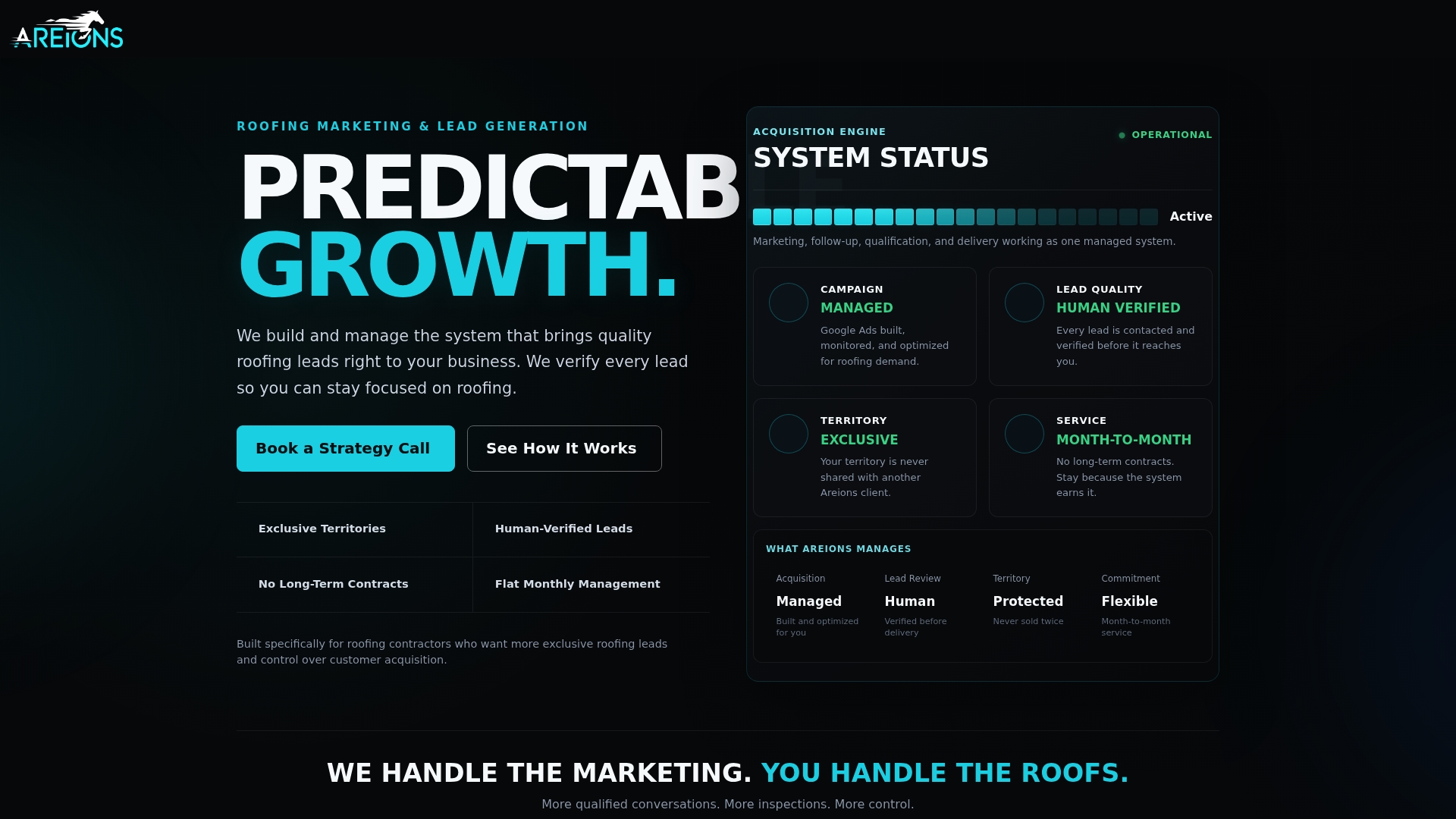
Published plans are Foundation at $97 per month, Professional at $1,500 per month and Enterprise at $5,000 per month. See what each includes on the Areions plans page.
FAQ
What should be included in a marketing audit?
Cover goals and target market, website, local profile, paid ads, social and email, content, branding, and the customer funnel, plus the numbers behind each. For a roofing company, add lead handling speed, service-area fit and storm readiness. End with a spend-versus-revenue comparison by channel.
What are the six types of marketing audit?
The six-part model from Kotler and colleagues, described in Morgan, Clark and Gooner’s 2002 paper, is: environment, strategy, organization, systems, productivity and function. Most small-business audits blend them into one checklist.
What are the four traits of an effective marketing audit?
Shopify’s guide describes effective audits as objective, regular, comprehensive and actionable. In practice: use data rather than opinion, repeat on a schedule, include sales and service as well as marketing, and end with specific next steps.
How often should a roofing company run a marketing audit?
The SBA advises maintaining marketing plans at least annually, per its marketing and sales guidance. Run the full checklist once a year and after any big change, such as a new territory. Check a handful of KPIs weekly in between.
Can I use this marketing audit template for a company that isn’t in roofing?
Yes. The structure of goals, channels, tracking, funnel and ROI applies to any business. Swap the roofing-specific items (storm readiness, service-area fit) for the equivalents in your trade.
Sources
- What is a Marketing Audit & How to Do One, Mailchimp
- Morgan, Clark and Gooner (2002), Journal of Business Research
- Marketing Audit Template, PR 20/20 via HubSpot
- Check Your Business KPIs Before The Holiday Season Starts, U.S. Small Business Administration
- Manage your business: marketing and sales, U.S. Small Business Administration
- About Google Business Profile, Google
- Connect your Business Profile to Google Analytics, Google
- How To Conduct an Effective Marketing Audit, Shopify
- Marketing campaign analytics: what to track
- How to rank higher on Google Maps: a 30/60/90-day plan
- CRM lead tracking: from first contact to booked job