
Lead Nurturing Emails for Roofers: Sequences and Examples
A lead nurturing email is a follow-up message that responds to what a lead did or asked for, and moves them toward a booked inspection or a signed estimate. For a roofing company, the best sequence is short and fast at the start (a reply within minutes, then a few emails in the first week), then slower and more patient for people who are not ready to decide. This guide gives you the timing, the structure and the example emails for each stage.
TL;DR
- Nurture emails react to behavior (a form fill, an estimate sent, a click). Drip emails run on a fixed timer. Most roofers need both.
- For a new inquiry, send the first email within minutes. For estimates you have already sent, plan roughly 5 to 8 emails over four to eight weeks.
- Every email needs one job: teach something, prove something, or ask for one next step.
- Storm-damage leads move faster than replacement leads, so compress the first week and slow down after it.
- Include your business name, a real postal address and a working unsubscribe link in every marketing email.
Table of Contents
- What lead nurturing emails are, and how they differ from drip emails
- Who should get a nurture sequence in a roofing business
- How many emails and how far apart
- The first hour matters more than the sequence
- A five-email nurture sequence for an estimate you have sent
- How to write each email so it gets a reply
- Example sequences for other stages
- Combine email with calls and texts
- Sending rules you should follow
- Measure what the sequence actually produces
- Perspective
- Put qualified storm leads into your follow-up system
- FAQ
- Sources
What lead nurturing emails are, and how they differ from drip emails
Lead nurturing emails are triggered by something a person does, then adapt to where that person is in the buying process. Drip emails go out on a fixed schedule whatever the person does. Constant Contact puts the difference simply: time sets a drip in motion, behavior sets a nurture in motion. Mailchimp adds that nurture emails are built on user activity and segmentation, and use softer calls to action than a typical drip.
In roofing terms:
- Drip: every homeowner who submits a storm-damage form gets the same “what to expect at your inspection” email on day 1, a financing email on day 3, and a reviews email on day 6.
- Nurture: the homeowner who opened your estimate twice but did not reply gets a different email than the one who never opened it. The one who clicked your insurance-claim guide gets a claims-focused message.
You do not have to choose. The goal of both approaches, as Constant Contact’s team notes, is more relevant email at the right moment rather than just more email, and most small businesses run both in the same tool. A practical setup: a short drip for the first 72 hours (confirmation, what happens next), then behavior-based branches after that.
Who should get a nurture sequence in a roofing business
Not every lead needs the same treatment. Group them by what they have already done:
- New inquiry, no contact yet. Needs speed more than nurture.
- Inspection done, no estimate yet. Needs a clear recap and a promised date.
- Estimate sent, no decision. The core nurture audience. They are comparing bids, waiting on an insurance adjuster, or thinking about timing.
- Old leads that went quiet. Need a gentle reactivation, not a hard sell.
- Past customers. Need check-ins and referral asks, on a slow cadence.
The bulk of your nurture effort belongs in groups 3 and 4, because those homeowners already showed real interest and cost you nothing more to reach. This is also why lead quality matters upstream: a verified homeowner with confirmed storm damage responds to follow-up far better than a name pulled from a list. Our guide to roofing appointment setting with verified storm leads covers that first handoff.
How many emails and how far apart

There is no universal number, and the published figures come from marketing blogs rather than controlled studies, so treat them as starting points you tune on your own data.
Here is what the sources agree on:
- Scalry suggests starting with 5 to 8 emails spaced 3 to 7 days apart, covering about four to eight weeks. For shorter sales cycles it suggests 4 to 5 emails 2 to 3 days apart over about two weeks.
- Sequenzy’s cadence is day 0, then every 3 to 4 days for the first three emails, then weekly (days 0, 3, 7, 14, 21, 28), because the first emails must land while intent is still warm.
- Pedowitz Group recommends a weekly baseline, speeding up to 2 or 3 touches a week for 10 to 14 days after a high-intent action, cooling to biweekly or monthly when engagement fades, and capping nurture at one touch a day.
A roof replacement is a high-ticket, considered purchase, so lean toward the longer end for estimates. A storm repair with an active leak sits at the other end: the homeowner wants an answer this week.
| Lead situation | Suggested rhythm | Total emails |
|---|---|---|
| Active leak or fresh storm damage | Day 0, 1, 3, 5, 8, then weekly | 5 to 6 over about 3 weeks |
| Estimate sent for repair | Day 0, 3, 7, 14, 21 | 5 over 3 weeks |
| Estimate sent for full replacement | Day 0, 3, 7, 14, 21, 28, 42 | 6 to 8 over 6 weeks |
| Quiet lead, no response | Every 2 weeks, then monthly | 3 to 4, then pause |
These rhythms are our suggestion, built on the ranges above. Adjust them from your own open, reply and booking data.
The first hour matters more than the sequence
Before any nurture email, the homeowner needs a human reply. Storm-damage inquiries arrive in bursts, and homeowners often contact several roofers at once. The first message should go out automatically within minutes and say who you are, what happens next and when they will hear from a person.
Example: instant confirmation (email, day 0)
Subject: We got your roof inspection request
Hi Maria, thanks for reaching out about the storm damage at 214 Elm Street. Dan from our office will call you today between 1 and 4 p.m. to set up a free inspection. If you would rather pick a time yourself, reply with two windows that work and we will confirm. Photos of any ceiling stains or missing shingles help us prepare. Reply to this email with them or text them to the number below.
That single email confirms receipt, sets an expectation, gives an easy micro-step (send photos) and reads like a person wrote it. Pair it with a text and a phone attempt. We cover the text side in SMS follow-up for roofing, including timing and TCPA rules.
A five-email nurture sequence for an estimate you have sent
The sequence below follows the stages most published frameworks share: deliver what was promised, clarify, build trust, handle concerns, then ask. AWeber outlines a similar six-step flow (welcome, establish value, build trust, invite engagement, present the offer, follow up). For tracking where each estimate stands, our list of roofing CRM automations shows which triggers to set up first. If you want a second view of how to space and word quote follow-ups for trades, these quote follow-up templates and cadence are worth a look.

Email 1, day 0: the estimate and what it includes
Send the estimate with a short plain-language summary: what is being replaced or repaired, materials, warranty and expected start window. One call to action: reply with questions or pick an install window.
Subject: Your roofing estimate for 214 Elm Street
Email 2, day 3: answer the question they did not ask
Most homeowners hesitate about price, insurance or timing and say nothing. Pick the most common one for that lead.
Subject: How the insurance process works after hail damage
If the lead came from a storm event, link a short guide to the claim steps and offer to meet the adjuster at the property. Keep the tone helpful, not urgent.
Email 3, day 7: proof from a similar job
Send before-and-after photos from a nearby street, a short customer comment you have permission to use, and the type of damage it fixed. Local proof beats general claims. Only use real jobs and real quotes.
Subject: A similar roof two streets over
Email 4, day 14: address a common concern
Pick one: financing options, how long the job takes, what happens if it rains mid-project, or how you handle debris. One concern per email.
Subject: What happens if it rains during your roof replacement?
Email 5, day 21: a low-pressure ask
Hi Maria, I wanted to check in on the estimate for your roof. If timing is the issue, tell me when would suit you and I will hold a spot on the schedule. If you have chosen another route, no problem, and thank you for letting us take a look.
This “close the loop” message often gets the most replies, because it makes responding easy in either direction.
If you have sold many roofs, you may want to extend with emails at weeks 4 and 6. Cleverly reports that most positive responses in B2B sequences come from emails 4 to 7, which is a reason not to give up after two follow-ups.
How to write each email so it gets a reply
One job per email. WordStream advises a single, clear call to action in each nurture email, noting that too many choices can result in no action. HubSpot’s Jeanne Jennings recommends a small, relevant next step (a micro-CTA) in every email, plus an option for people who are ready to commit now.
Lead with relevance. Name the street, the storm date or the type of damage. “Following up on the hail damage at your home” outperforms “Just checking in” because it shows you remember them.
Teach, prove or reframe. A useful test for every touch: it should teach the homeowner something, prove a claim, or change how they think about the problem. If it does none of these, do not send it.
Write like a person. Short sentences, a real sender name, a reply-to address that reaches someone. Skip images-heavy templates; plain text often feels more personal for a local contractor.
Use segmentation lightly. Three tags are enough to start: lead type (storm repair vs. replacement), stage (inspected, estimated, quiet) and whether they have an insurance claim open. If your email setup is still a free address and a spreadsheet, a proper business email setup on your own domain makes your messages look more trustworthy and helps them reach the inbox.
Example sequences for other stages
Reactivating a lead that went quiet
Two or three emails, two weeks apart:
- “Still thinking about the roof?” with one new piece of information (a seasonal schedule note, a financing update).
- A short, useful checklist, such as what to look for after the next storm.
- A close-out: “We will stop emailing, but reply anytime.”
Then stop. Moving them to a monthly newsletter only if they opted in is cleaner for your sender reputation.
After the job: referral and review
Day 2 thank-you and warranty paperwork, day 10 review request, day 45 referral ask. The best moment to ask for a referral is when the homeowner just saw a clean roof go on.
Storm-event outreach to existing contacts
When a storm hits your area, past customers and old leads may have damage too. A short email (“Storm passed through [town] on [date]. If you notice leaks or missing shingles, we can inspect for free”) is relevant by nature. Keep it to a single message, then follow normal rules for anyone who responds.
Combine email with calls and texts
Email rarely works alone for a homeowner with active damage. A sensible mix for the first week of a storm lead: an email within minutes, a call the same day, a text if the homeowner gave consent, a second email the next day with photos requirements and inspection options. Our roofing lead scripts give you call wording for each sales stage, so your emails and calls tell one consistent story.
Sending rules you should follow
In the U.S., commercial email falls under the CAN-SPAM Act. The FTC’s compliance guide says the law covers all commercial messages, including business-to-business email. In practice, that means:
- Accurate “From” and “Reply-To” details that identify your business.
- A subject line that reflects what is inside.
- A clear indication that the message is an ad, where it is one.
- Your valid physical postal address.
- A working way to opt out, honored promptly.
A purely transactional message, such as a confirmation of an appointment the homeowner requested, is treated differently from promotional content, but a nurture email that sells your services is commercial. Text messages carry separate consent rules; see our TCPA guide. If you have questions about your specific setup, ask a business attorney familiar with marketing law in your state.
Measure what the sequence actually produces
Open rates tell you little. Track replies, booked inspections, signed estimates and revenue by sequence. Tag every inbound lead’s source so you can see which campaigns generate homeowners who close; our guides on UTM tracking for leads and offline conversion tracking show how to connect the click to the contract. Keep the list tidy too: bounced and duplicate contacts distort results, and CRM data hygiene is a quick cleanup job each quarter.
Pedowitz Group’s guidance is to tighten the delay after opens or clicks, lengthen it after no response, and pause on bounces, spam complaints or unsubscribes. Build those rules into your tool once and they run themselves.
Perspective
Most roofers do not lose jobs because their follow-up emails were badly written. They lose them because nobody followed up consistently, or the lead was never really in the market in the first place.
That is why we start upstream. Our system is designed to reach homeowners with verified storm damage while demand is active, qualify them with a human check, and deliver them into your CRM, so your nurture emails go to people who actually need a roof. Territory exclusivity means the homeowner is not also getting the same pitch from a competing client of ours.
From there, the work is operational: fast first contact, a pipeline that shows who is waiting on what, and automated follow-up that sounds like you. A good sequence is a safety net for the leads who are not ready today, not a substitute for speed on the ones who are.
Angel
Put qualified storm leads into your follow-up system
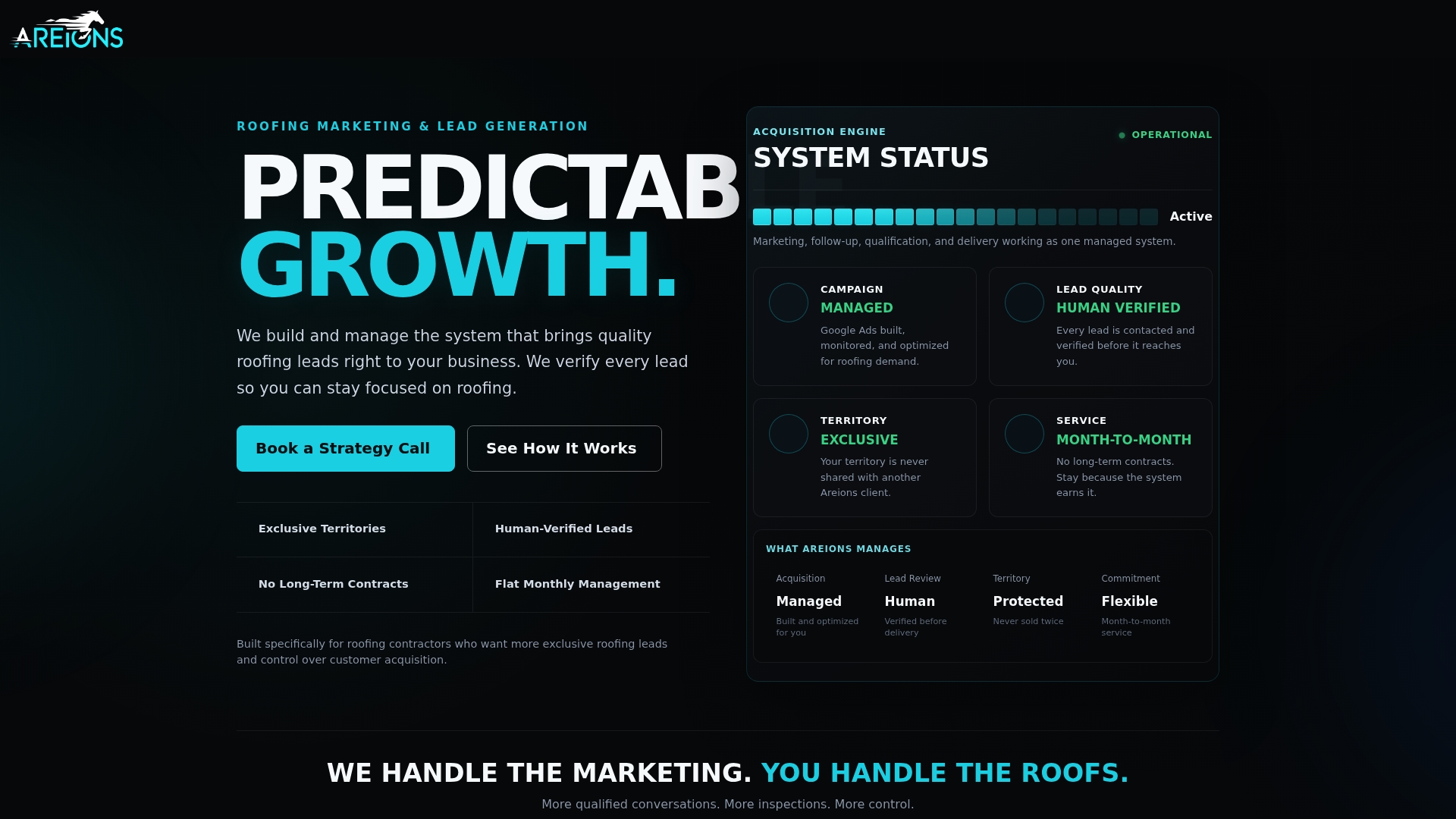
A nurture sequence is only as good as the leads feeding it. Areions runs a proactive storm-response system for roofing companies: managed Google Ads campaigns, landing pages, CRM and pipeline setup, automated lead routing and follow-up, call tracking and human-verified homeowner qualification. Service is month to month with no long-term contract, and we guarantee qualified leads within 30 days.
Plans are published at $97 per month (Foundation), $1500 per month (Professional) and $5000 per month (Enterprise), with the level of service and exclusivity increasing by tier. See the details on the Areions plans page and choose the one that fits your territory.
FAQ
How many emails should be in a lead nurturing sequence?
For most service businesses, 5 to 8 emails is a sound starting range, spread over about four to eight weeks. Shorter cycles, like a small repair, can run 4 to 5 emails over two weeks. Check replies and bookings after a month and adjust.
What is the difference between drip and nurture emails?
Drip emails go out on a preset schedule regardless of what the recipient does. Nurture emails respond to behavior, such as opening an estimate or clicking a guide. Many roofers use a short drip for confirmations and behavior-based nurture afterward.
How soon should a roofer email a new lead?
As fast as possible, ideally within minutes, with an automatic confirmation that names a real person and a next step. Follow with a phone call the same day. Speed matters most for storm-damage and active-leak inquiries.
Do I need permission to send nurture emails in the U.S.?
CAN-SPAM does not require prior opt-in for commercial email, but it requires accurate sender details, your postal address and a working opt-out that you honor. Text messages have stricter consent requirements. Ask a business attorney about your specific situation.
When should I stop emailing a lead?
Stop immediately when someone unsubscribes, bounces or complains. For silent leads, a final close-out email after 3 to 4 weeks is a sensible endpoint, followed by a slow, opt-in-only check-in if you keep contact at all.
Sources
- Constant Contact: Drip Campaign vs. Nurture Campaign
- Mailchimp: Build Relationships with Nurture Campaigns
- Scalry: Lead Nurturing Email Sequence
- Sequenzy: Email Nurture Sequence Examples
- Pedowitz Group: Optimal Frequency for Nurture Campaigns
- AWeber: Mastering Email Nurturing
- Cleverly: B2B Lead Nurturing Emails
- WordStream: Lead Nurturing Emails
- HubSpot: Lead Nurturing Email Best Practices
- FTC: CAN-SPAM Act Compliance Guide for Business