
Review Generation Strategy for Roofing Companies
A good review generation strategy for a roofer is a repeatable habit, not a campaign. Ask every satisfied homeowner at the same point in the job, make the review link one tap away, never offer anything in exchange, and answer every review you get. Do those four things on every job and the reviews build up on their own.
This guide covers when to ask, what to say, what Google and the FTC allow, how to choose review software, how to handle a bad review, and how to tell whether any of it is working.
TL;DR
- Ask at the end of the job, once the homeowner can fairly judge the work. For storm and insurance jobs, wait until everything is finalized.
- Send a direct Google review link by text, email, QR code or in person. Ask for honest feedback, never for five stars.
- Never offer discounts, gifts or payments for reviews, and never route unhappy customers away from your public profile.
- Reply to every review, positive or negative, quickly and without getting defensive.
- Measure calls, estimates booked and closed jobs from your profile, not just your star rating.
Table of Contents
- Why reviews matter more for roofers than for most trades
- The ground rules: what Google and the FTC allow
- When to ask: the timing that gets honest reviews
- How to ask: channels, links and templates
- A weekly workflow that does not depend on memory
- Choosing review management software
- Handling negative reviews
- Measuring whether it is working
- Where reviews fit in a storm-response marketing system
- Perspective
- Put a system behind your reviews
- FAQ
- Sources
Why reviews matter more for roofers than for most trades
A roof is a large, infrequent purchase, and the homeowner usually has no way to judge the work until long after the crew leaves. Reviews fill that gap. A BrightLocal survey cited by the Federation of Small Businesses found that 71% of consumers always or regularly read reviews when browsing local businesses. That survey covers consumers in general, but the habit is easy to picture for a homeowner choosing who gets on their roof.
Recency matters too. A field-service software guide to roofing reputation describes reviews as a chief local ranking factor for roofing contractors and reports that 47 percent of people highly value how recent reviews are. A company with 200 reviews that stopped two years ago looks less active than one with 80 reviews and a new one every week.
That is why the strategy is a process. A roofing SEO guide from a business-software company frames it the same way: recent honest reviews, an easy review link, and a response to each review.

The ground rules: what Google and the FTC allow
Get the rules straight before you write a single request, because the most common mistakes come from well-meaning shortcuts.
Google’s rules
Google’s own guidance says you can ask customers for reviews, including with a link or QR code, but you cannot offer incentives. Google Business Profile Help lists discounts, free services and payments as off limits, and requires that reviews reflect a genuine experience. Google’s content policy for user-generated content also prohibits selectively soliciting only positive reviews and pressuring people to leave a rating or to include specific content.
In practice, that means:
- No “leave us 5 stars and get $50 off your gutters.”
- No asking only your happiest customers while skipping the rest.
- No scripting what the review should say.
If you want a walkthrough of setting up and moderating your profile, this Google Business Profile plan covers the profile side of the work, including review guidelines and moderation.
The FTC’s rules
The FTC’s final rule on fake reviews and testimonials bans buying or selling fake reviews and lets the agency seek civil penalties against knowing violators. It also bans incentives that are conditioned, explicitly or implicitly, on the review expressing a particular sentiment. Other parts of the rule matter to a small contractor:
- Reviews or testimonials written by officers or managers without clear disclosure are prohibited, and so is spreading testimonials you should have known came from insiders.
- Using groundless legal threats, intimidation or physical threats to stop or remove a negative review is prohibited.
- You cannot present a review section you control as representing most or all reviews when negative ones have been suppressed.
The FTC’s questions and answers on the rule add that incentives are not banned across the board under the FTC Act, but failing to disclose them, such as a gift card or discount, can violate its endorsement guidelines. Google still prohibits incentives outright, so for a Google profile the safe answer is simple: offer nothing.
Is review gating illegal?
Review gating means screening customers first, for example with a “how did we do?” form, and sending only happy ones to the public review page. Google’s policy against selectively soliciting positive reviews rules it out on Google, and the FTC’s rule targets suppressing negative reviews in a way that misleads readers. Treat gating as off limits. Send the same request to everyone, and handle the unhappy ones in public, honestly, as covered below.
When to ask: the timing that gets honest reviews
The best moment is right after a positive touchpoint, when the homeowner feels the relief of a finished job. Industry guidance often points to the final walkthrough as that peak. For roofers, a few refinements help:
- Replacement jobs: ask at the final walkthrough, after cleanup, when the yard is clear of shingle debris and magnets have been run over the lawn.
- Repairs: give the repair a short time to prove itself, such as through the next rain, then ask.
- Callbacks: ask after you have resolved the issue. A customer who saw you fix a problem fast often writes the most credible review you will ever get.
- Storm and insurance work: wait until the claim paperwork, supplements and payments are finalized. Asking mid-claim catches the homeowner at their most stressed.
Volume matters as much as timing. A project manager quoted in the same field-service guide calls review generation a numbers game: the more requests you send, the more reviews you get. So make asking automatic for every closed job rather than something the crew lead remembers when they feel like it.
How to ask: channels, links and templates
Pick the channel the homeowner already uses
Text messages usually get opened fastest, so make that the default. Email works well as a follow-up, and a QR code on a printed invoice or job-completion card suits homeowners who prefer paper. An in-person ask from the crew lead or project manager at the walkthrough is the most personal, and it works best when followed immediately by a text with the link so the homeowner does not have to search for you.

Use a direct Google review link
Google’s help page says you can share a link or QR code to your review form. Find it in your Business Profile, copy the review link, and shorten it if you like. A homeowner who has to search your name, find the right listing and hunt for the review button will usually give up.
Review request templates you can copy
Keep them short, personal and neutral. None of these ask for a star rating.
Text, right after the walkthrough
Hi [First Name], thanks for trusting [Company] with your roof. Now that everything is wrapped up and cleaned off, we would appreciate your honest feedback on how it went. Here is a quick link: [Review Link]
Email, a day or two later
Subject: How did we do on your roof?
Hi [First Name], it was a pleasure working with you on your [replacement/repair]. If you have two minutes, an honest review helps neighbors who are choosing a roofer and helps us see what we are doing well and where we can improve. [Review Link]
Thank you, [Name], [Company]
Follow-up text, one reminder only
Hi [First Name], just a gentle reminder in case it got buried. If you have a moment, we would value your honest feedback: [Review Link]. Either way, thank you for choosing us.
Storm and insurance jobs
Hi [First Name], now that your claim is settled and the roof is complete, we would like to hear how the whole process went, from the first inspection to cleanup. Honest feedback is welcome: [Review Link]
Two cautions on wording. Do not write “if you were happy, please leave a review,” because that is selective solicitation in disguise. And do not add “as a thank you” followed by any perk.
A weekly workflow that does not depend on memory
- Trigger: mark the job complete in your CRM or job-management tool, which fires the text.
- Day 0: the crew lead mentions at the walkthrough that a text with a review link is coming.
- Day 0 to 1: the text goes out automatically.
- Day 3 to 4: one reminder to anyone who has not responded. Stop there. Repeated nagging produces resentment, not reviews.
- Within 24 hours of any new review: someone replies by name.
- Monthly: the owner reads every new review, praise and complaint alike, and shares themes with the crews.
This is the part many roofers skip. The reviews are free feedback on your sales process, your crews and your communication. If three reviews in a month mention late callbacks, that is an operations issue, not a reputation issue.
Choosing review management software
You can run this process with a spreadsheet and a phone, and many small crews do at first. Software earns its keep once you are closing enough jobs per month that manual texts slip. What to look for:
- CRM or job-software integration, so a completed job triggers the request without double entry.
- Automated text and email sequences with a single reminder step.
- Review monitoring and alerts for new reviews across platforms.
- Review syncing and reply tools, including AI-drafted replies that you edit before posting.
- Multi-location or multi-crew support, if you work across several markets.
On cost, one published example is Reveo’s pricing page, which lists reputation software at $75, $149 or $299+ per month, with a custom plan at the top tier. It lists features including review and messaging automations, CRM integrations, review syncing across platforms and AI review replies. A roofing-specific cost guide from June 2026 puts typical pricing at roughly $49 to $600+ per month depending on automation, integration depth and locations. Treat both as ballparks and confirm current pricing on each vendor’s own page.
Whichever tool you choose, check that it lets you send the same request to every customer and does not filter by sentiment. A feature that sends only positive responders to Google is gating, and it puts your profile at risk.
If you are also working out how software, ad tools and platforms fit into your wider marketing, this lead generation framework is a useful way to think about the overall funnel your reviews will feed.
Handling negative reviews
Every roofer with enough volume will get a bad review: a leak that returned, a scheduling slip, a dispute over an insurance supplement. How you reply is read by every future customer, often more closely than the complaint itself. GAF’s guidance on online reviews for roofers notes that replying to both positive and negative reviews shows prospects that a business is proactive and transparent.
The field-service guide recommends replies that are professional, timely and private: acknowledge the issue, show empathy, explain what you will do, and move the conversation offline.
A reply structure that works:
- Thank them by name for the feedback.
- Acknowledge the specific problem without arguing the facts.
- State what you are doing, such as sending a project manager out on a specific day.
- Give a direct phone number or email to continue privately.
- Keep it under five sentences and free of blame.
Example reply
Hi [Name], thank you for telling us. A leak after a new roof is not the experience we want for you. Our project manager will call you today to schedule an inspection this week. You can also reach us directly at [number]. We will make this right.
If you resolve it, the customer may update their review. Never ask them to delete it as a condition of the fix, and never threaten them; the FTC rule prohibits groundless legal threats and intimidation aimed at suppressing a negative review.
When a review breaks the rules
Some reviews are not complaints but violations: spam, fake reviews from someone who was never a customer, or abusive content. Google’s Reviews Management Tool lets you report reviews that violate its content policies, and offers a one-time appeal if the first report is rejected. Keep your reply free of personal attacks while you wait; Google’s review tips page says as much. A review you simply dislike does not qualify, so answer it instead.
Measuring whether it is working
Star rating alone is a weak scorecard. The roofing SEO guide linked above suggests tracking Google Business Profile calls and website visits, calls, form submissions, booked estimates, close rate, revenue and cost per qualified lead, and warns that rankings by themselves do not show whether the effort generates leads.
A simple monthly dashboard:
| Metric | Why it matters |
|---|---|
| Requests sent | Shows whether the process is actually running |
| New reviews and response rate | Your conversion from request to review |
| Average review age (newest 10) | A proxy for recency |
| Profile calls and direction requests | Whether people act on your listing |
| Estimates booked from profile calls | Ties reviews to pipeline |
| Close rate and revenue by source | Shows what the reviews are worth |
Give it a few months before judging. Review volume compounds slowly, and seasonal swings, especially after storm events, will distort any single month.
Where reviews fit in a storm-response marketing system
Reviews do not produce leads by themselves. They raise the odds that a homeowner who has already found you decides to call you and not the next name on the list. That matters most in the days after a hailstorm or windstorm, when homeowners compare several contractors fast and trust signals decide who gets the inspection.
The rest of the system has to be in place so those homeowners find you at all. Our guides on roofing advertising channels and geo targeting for storm-hit homeowners cover how to reach people when demand is active, and our marketing audit checklist helps you see whether your reviews, profile and ads are working together. To see how lead quality changes the economics, read about storm leads and roofing marketing ROI.
Perspective
Most roofers treat reviews as something to fix after the phones go quiet. We think about it the opposite way. Storm demand arrives in a burst, and the contractors who win it are the ones who were already prepared: a profile full of recent, honest reviews, a fast response process, and a system ready to take the call.
That is how we build our work at Areions. We prepare roofing businesses before storms hit, then intercept active demand from homeowners with verified storm damage, with human-verified qualification and territory exclusivity so you are not bidding against another client of ours in your area. Reviews are the trust layer that helps that demand convert.
Our advice is to keep the review process boring and consistent: one ask per job, one link, one reminder, one reply. Then put your attention where it pays most, which is answering qualified leads fast and doing the work right.
Angel
Put a system behind your reviews
Reviews help the right homeowners say yes. Areions handles the part before that: managed Google Ads, landing pages, CRM and pipeline setup, call tracking, automated lead routing and follow-up, and human-verified homeowner qualification, all delivered as qualified leads to your CRM. We work month to month with no long-term contract, and our plans are Foundation at $97 per month, Professional at $1,500 per month and Enterprise at $5,000 per month.
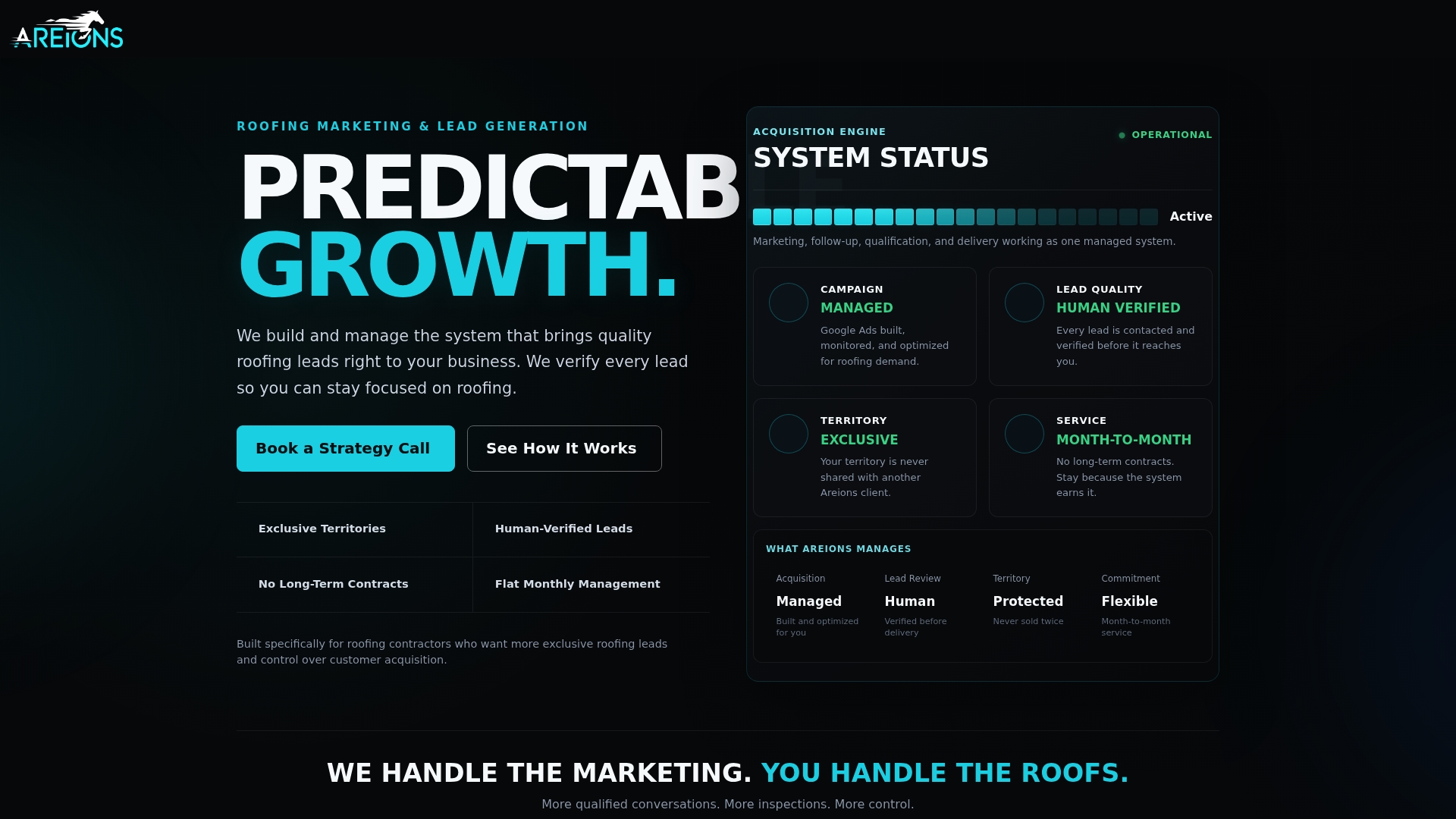
See the plans and what each includes at Areions, or book a strategy call to talk through your territory.
FAQ
How many Google reviews does a roofing company need?
There is no magic number, and nothing special happens at a round figure like 100. What matters is that your count is competitive with the roofers in your market and that new reviews keep arriving. Check the top three contractors in your service area and aim for steady monthly growth beyond their pace.
Can I give customers a discount for leaving a review?
Not on Google. Its guidance prohibits offering discounts, free services or payments in exchange for reviews. The FTC bans incentives tied to a particular sentiment and expects disclosure of any incentive, so the safest path is to offer nothing and simply ask politely.
Should I ask for a five-star review?
No. Ask for honest feedback. Requests for a specific rating can be read as pressuring the customer, which Google’s policy prohibits, and the FTC bans incentives conditioned on a favorable sentiment. Honest reviews from satisfied customers will skew positive on their own.
How should I respond to a review from someone who was never my customer?
Reply briefly and politely that you cannot find a job under that name and invite them to contact you. Then report the review through Google’s Reviews Management Tool as a policy violation. If the first report is rejected, Google allows one appeal.
Is a review management tool worth paying for?
It becomes worthwhile when you close enough jobs that manual texts get missed. Published pricing for review software ranges from about $49 to $600+ per month, so compare what you would pay against the value of the extra reviews and saved admin time. Pick a tool that sends the same request to every customer.
Sources
- Tips to get more reviews, Google Business Profile Help
- Report inappropriate reviews on your Business Profile, Google
- Prohibited and restricted content, Google Maps user-generated content policy
- FTC announces final rule banning fake reviews and testimonials
- FTC: The Consumer Reviews and Testimonials Rule, questions and answers
- FSB: Three ways online customer reviews can increase your sales
- Reputation management for roofing companies: practical guide
- Roofing SEO: how to get more roofing leads from Google
- How to get more reviews for roofing companies
- Review request software cost for roofers: ROI guide 2026
- Reveo pricing
- GAF: How to use online reviews for roofing reputation management
- Lead generation framework