Roofing Sales Pipeline That Books Inspections in 1 Hour
The right roofing sales pipeline is a compact five to seven stage model, run on a minute level speed-to-lead SLA, with your CRM as the single source of truth for every next action. Get an inspection scheduled within an hour of first contact, assign explicit ownership at every stage, and automate the follow-ups nobody remembers to send by hand. Do that and you’ll see fewer deals rot in “thinking it over” limbo and more signed deposits per hundred leads.
TL;DR:
- Responding to leads within five minutes significantly increases the likelihood of qualification, and automation should facilitate instant acknowledgment and assignment.
- A streamlined five to seven-stage pipeline with clear exit criteria and SLAs is essential to prevent deals from stalling, especially during storm surges.
- Focusing on fast response times and qualified lead criteria reduces wasted inspection capacity and improves overall pipeline efficiency.
- A CRM must track specific deal fields like owner, next action, and claim details, with automations for reminders and alerts to keep deals moving daily.
- Building and maintaining a verified storm damage lead flow, as offered by Areions, ensures quick, qualified lead delivery with source attribution to optimize response time and conversion.
Table of Contents
- What Should a Roofing Sales Pipeline Look Like?
- Where Should You Spend on Roofing Lead Generation, and How Fast Should You Respond?
- How Do You Qualify Roofing Leads Before You Send a Crew Out?
- What Should Your CRM Track to Keep Deals Moving?
- Which Roofing Sales KPIs Actually Tell You Something?
- What Scripts and Follow-Up Sequences Should You Use?
- How Do You Train a Sales Team to Keep the Pipeline Moving?
- How Should Your Pipeline Connect to Estimating and Project Management?
- How Do You Handle Objections in Roofing Sales?
- What Happens After the Sale to Keep Customers Coming Back?
- What Legal and Compliance Issues Matter in Roofing Sales?
- Why Ownership and Deadlines Beat Activity Metrics
- How Areions Handles the Storm-Response Pipeline for You
- Sources
- FAQ
What Should a Roofing Sales Pipeline Look Like?
Most roofing companies either run too few stages (lead, sold, done) or drown in twelve micro-stages nobody updates. Seven stages is the practical ceiling. Each one needs an exit criterion, an SLA, and ideally an automation that fires when the deal enters it.
- New lead: exit when contact is made and qualified. SLA: 5 minutes. Automation: instant text/email acknowledgment plus rep assignment.
- Inspection scheduled: exit when the appointment is confirmed by phone or text. SLA: 24 hours from lead. Automation: calendar invite and reminder sequence.
- Inspection completed: exit when photos, measurements, and damage notes are logged. SLA: same day. Automation: task created for estimate build.
- Estimate delivered: exit when the homeowner has received a written proposal. SLA: 48 hours post-inspection. Automation: follow-up cadence starts.
- Negotiation/objection handling: exit on verbal agreement or claim approval. SLA: track time-in-stage, flag at 7 days.
- Signed/deposit: exit when contract and deposit clear. This is the only real “won.”
Two mistakes wreck this model fast: stacking in extra micro-stages that just measure busywork, and letting reps mark a deal “won” on a verbal yes. A handshake isn’t a contract. Track appointment show-rate separately from “scheduled,” too. A booked inspection that never happens is a different problem than a bad estimate, and lumping them together hides where deals actually die.
Where Should You Spend on Roofing Lead Generation, and How Fast Should You Respond?
Channel mix matters less than most owners think. What matters more is what happens in the first few minutes after a lead lands.
Google Local Services Ads typically run $75 to $150 in cost per lead and tend to convert at higher booking rates because homeowners see a verified badge before they click. Non-branded search sits far more expensive, around $124 per lead, while branded search drops to roughly $44 and Performance Max lands near $64.
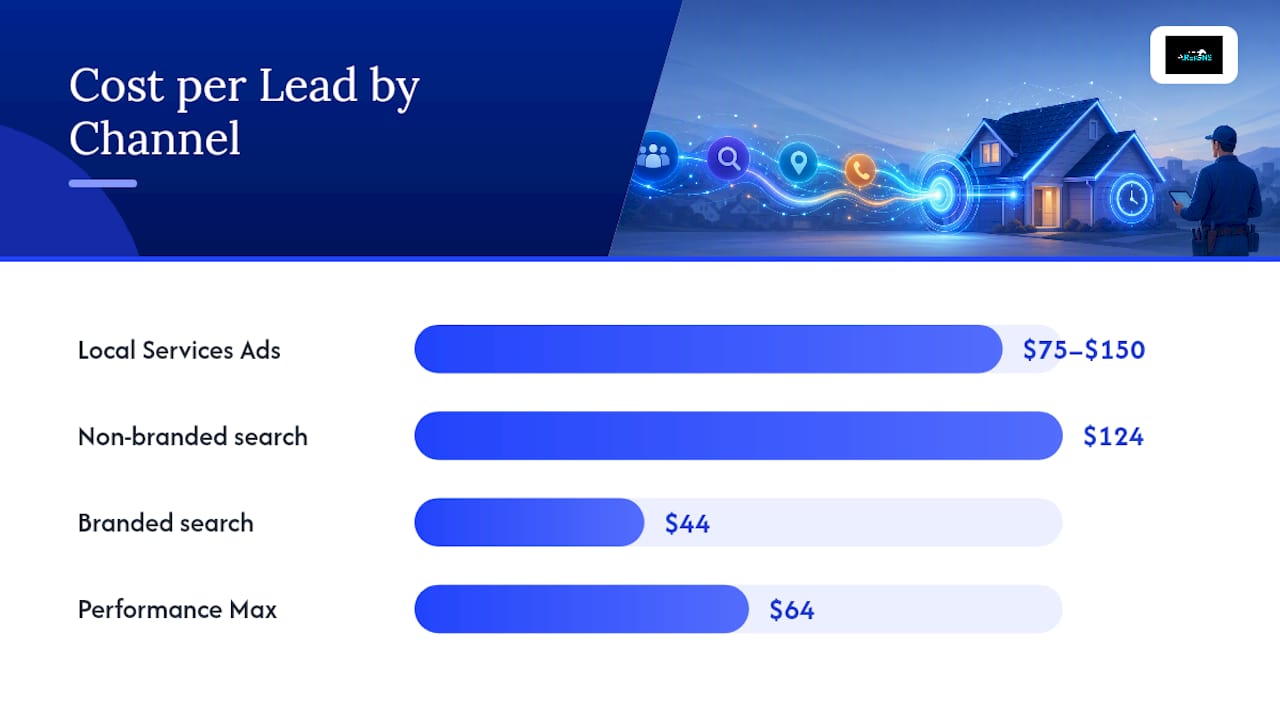
Quick benchmark: if your non-branded search CPL is creeping past $124 with no matching lift in signed deposits, that channel is subsidizing someone else’s pipeline, not yours.
Organic and local SEO, canvassing after confirmed storm events, and a well-optimized Google Business Profile round out the mix.
Speed matters more than any of that channel math. Companies that make contact within an hour are nearly seven times more likely to qualify the lead than ones that wait longer. Build these into your workflow:
- Automated text acknowledgment within 60 seconds of form submission
- Immediate round-robin or skill-based assignment, not a manual queue
- Phone-first landing pages with a visible click-to-call button, not a buried form
How Do You Qualify Roofing Leads Before You Send a Crew Out?
Every inspection you send on a bad lead is one you can’t send on a good one. During storm surges, inspection capacity is your real bottleneck, not lead volume.
- Confirm the pain is real. Visible damage, a recent storm date, or a documented claim number beats a vague “might need a new roof” inquiry.
- Verify the property type and ownership. Renters, wrong addresses, and commercial properties routed to a residential crew waste appointment slots.
- Check the insurance path. Has a claim been filed? Is an adjuster scheduled? This changes your sales motion entirely.
- Confirm budget or claim authority. Someone has to be able to sign, not just describe the problem.
- Throttle acquisition when queues fill. Pause or cap paid channels once your inspection calendar hits capacity, and route overflow leads into a nurture sequence instead of letting them go cold.
Pre-storm, this means locking in capacity plans and staffing before the first call comes in. Post-storm, it means triaging by damage severity and claim status so your best crews hit the highest-value roofs first.
What Should Your CRM Track to Keep Deals Moving?
A CRM that just archives calls and emails is a filing cabinet, not a sales tool. The job is to force a next action on every open deal, every day.
Track these fields on every lead: original source, storm/event tag, current owner, next action with a due date, time-in-stage, photos and documents, and claim number where applicable. Without a named owner and a due date, a lead just sits.
Layer in automations that do the chasing for you:
- Instant response workflow the moment a lead enters the system
- Inspection reminder texts 24 hours and 2 hours before the appointment
- Estimate follow-up sequences that fire automatically at set intervals
- Aging alerts that flag any deal sitting in one stage past its SLA
- Deposit request automation once a proposal is marked accepted
Integrate call tracking, e-signature, aerial measurement tools, and calendar sync so reps aren’t toggling between five apps. Platforms like the ones listed on Microsoft AppSource show how many contractor-facing integrations already exist for exactly this.
Pro Tip: Set your aging alert threshold at half your average sales cycle length, not the full length. Catching a stalled deal at day 7 is a save; catching it at day 14 is often a loss you’re just now noticing.
Which Roofing Sales KPIs Actually Tell You Something?
Most dashboards track activity. Few track the numbers that predict revenue. Focus on these:
- Time-to-contact: minutes from lead capture to first outreach
- Time-in-stage by stage: where deals actually stall
- Stage-to-stage conversion: which handoff is bleeding leads
- CPL by channel: compared against the $44 to $150 range typical across search and LSAs
- Revenue by source: which channel produces jobs, not just clicks
- Estimate-to-close rate: the number that tells you if your proposals are actually working
Weekly funnel reports matter more than monthly ones during storm season, when volume and capacity shift fast. Blended home-service benchmarks can mislead here. Roofing-specific ranges run higher than the industry average, so compare your numbers against trade-specific benchmarks rather than a generic services average that will make your CPL look worse than it is.
What Scripts and Follow-Up Sequences Should You Use?
You don’t need to reinvent language for every lead. You need a few templates that work, used consistently.
- Instant acknowledgment text: “Hi [name], thanks for reaching out about your roof. [Rep name] will call within the next few minutes to schedule your free inspection.” Send this the second a form submits.
- Phone-answer rule: every inbound call gets answered live during business hours, no exceptions, with voicemail-to-text follow-up within 5 minutes after hours.
- Estimate follow-up cadence: a call at 48 hours, a text with photos and next steps at 7 days, and a final value-focused email at 14 days before the lead moves to long-term nurture.
- Proposal checklist: include annotated photos, precise measurements, a clearly itemized scope, and a direct deposit link. Digital measurement tools let you send this within hours of inspection instead of days, which matters most during surge windows when three other contractors are quoting the same roof.
How Do You Train a Sales Team to Keep the Pipeline Moving?
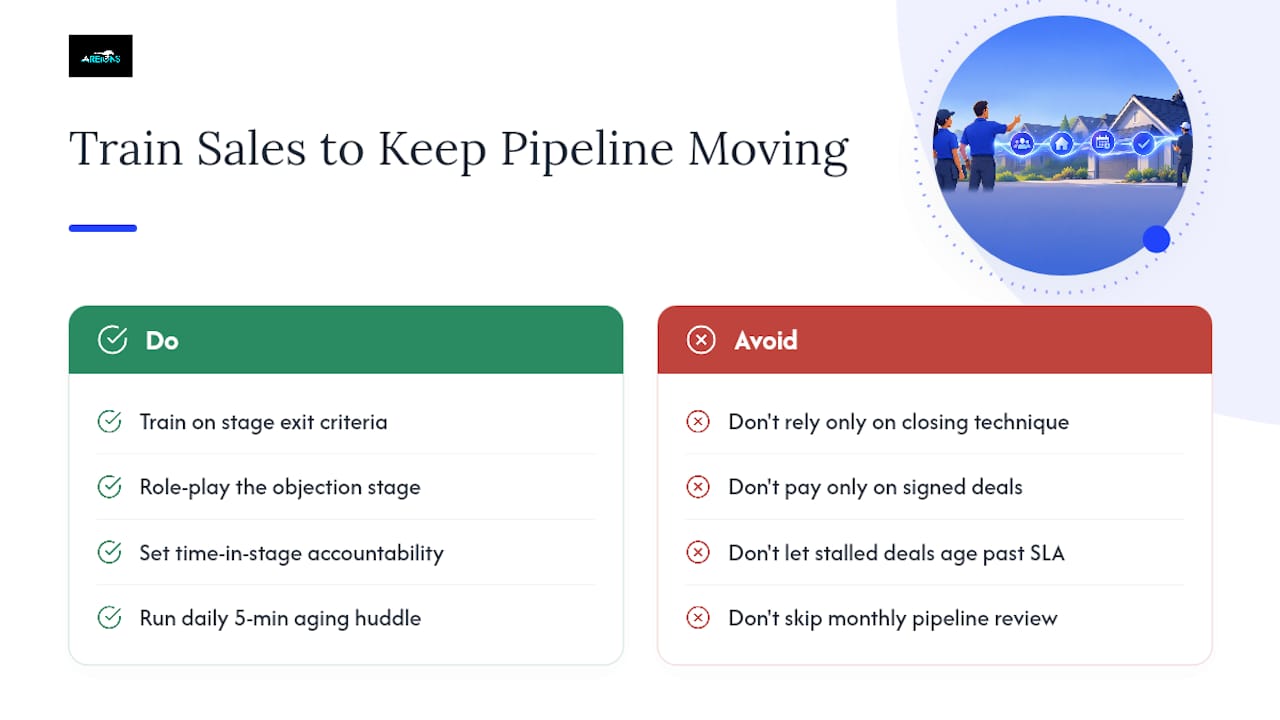
A great pipeline structure fails fast with an untrained team running it. Training has to focus on stage discipline, not just closing technique.
Start new reps on stage exit criteria before they ever touch a script. If a rep doesn’t know that “estimate delivered” means the homeowner has a written proposal in hand, not a verbal walkthrough, your reporting will lie to you within a week. Role-play the objection stage specifically. Most lost deals don’t die on the pitch, they die in the gap between estimate delivery and follow-up call three.
Set individual rep accountability on time-in-stage, not just total deals closed. A rep who closes ten deals but lets thirty sit stalled past SLA is costing you more than one who closes eight and keeps a clean pipeline. Review aging alerts in a short daily huddle, five minutes, naming specific stuck deals and who owns the next move.
Pair new hires with your best closer for live ride-alongs during the first month, especially for inspection and objection stages where tone and pacing matter more than any script. Commission structures should reward speed-to-first-contact and inspection show-rate alongside closed revenue. If your comp plan only pays on signed deals, reps will chase the easy ones and let harder, slower-moving leads go cold.
Run a monthly pipeline review with the whole sales team, not just leadership. Show them the stage-to-stage conversion numbers. Reps change behavior faster when they see exactly where deals are dying than when they’re just told to “follow up more.”
How Should Your Pipeline Connect to Estimating and Project Management?
A sales pipeline that doesn’t talk to your estimating and production tools creates a second job for someone: manually re-entering data that already exists.
The handoff point is the estimate stage. Aerial measurement tools should feed directly into your CRM so a rep isn’t retyping square footage by hand. When a proposal gets accepted and the deposit clears, that record should push straight into your project management or scheduling tool without a manual data entry step. Every hour spent copying information between systems is an hour not spent on the next lead.
Look for calendar sync between your CRM and production scheduling so a signed job automatically reserves a crew slot instead of getting lost in a group text or a spreadsheet. E-signature integration matters here too. A contract signed on a rep’s phone in the driveway should trigger the next stage immediately, not wait until someone gets back to the office.
The bigger point: your CRM shouldn’t be a separate system from your operations stack. It should be the front door that operations data flows through. When a claim number, a set of photos, and measurement data are already attached to the deal by the time production picks it up, you cut days off the time between signed contract and crew on the roof. That speed matters even more after a storm, when supply and labor are already stretched and homeowners are comparing timelines across multiple bids.
How Do You Handle Objections in Roofing Sales?
Roofing objections cluster around a handful of predictable concerns, and most reps lose deals by arguing the wrong one.
Price objections rarely mean “too expensive.” They usually mean “I don’t understand why this costs what it does.” The fix isn’t a discount, it’s a clearer breakdown: materials, labor, warranty terms, and what happens if hidden damage turns up mid-job. Homeowners who see an itemized scope object less than ones handed a single lump number.
Insurance-related objections need a different playbook entirely. When a homeowner says “I’m waiting on my adjuster,” don’t push for a signature. Push for a scheduled follow-up date tied to their claim timeline, and keep that deal in an active nurture track instead of letting it go quiet. This is exactly where a claim-nurture automation earns its keep.
“I’m getting other quotes” is rarely a stall tactic. It’s often true, especially after a widespread storm event when five contractors are canvassing the same block. The counter isn’t badmouthing competitors. It’s speed and specificity: a same-day itemized proposal with clear measurements beats a vague verbal estimate delivered a week later almost every time.
Trust objections, “how do I know you’ll actually show up,” deserve the most respect. Reviews, local presence, and a specific start date do more work here than any pitch. Negotiation in roofing sales isn’t about moving off price. It’s about removing the specific uncertainty behind each objection, one at a time.
What Happens After the Sale to Keep Customers Coming Back?
The pipeline doesn’t end at signed deposit. What happens next determines whether that customer refers you to three neighbors or leaves a two-star review about being ghosted.
Set a clear communication cadence for the production phase: a call or text when the crew is scheduled, a heads-up the morning of the job, and a walkthrough at completion where the homeowner can ask questions before final payment. Automated appointment reminders reduce no-shows on both sides, homeowner and crew, and keep the job moving without a manual chase.
After completion, a short follow-up sequence matters more than most companies realize. A check-in call at 30 days catches small issues before they become warranty disputes. A request for a review, timed right after that positive check-in, converts far better than one sent the day the crew leaves. Keep warranty documentation and claim numbers attached to the CRM record permanently, not archived elsewhere, so a callback five years later doesn’t start with a scavenger hunt through old files.
Referral requests work best when they’re specific: ask for a neighbor’s name, not a general “let us know if you know anyone.” Storm events create natural referral clusters since whole streets often need work at once. A satisfied customer who just watched their neighbor’s roof torn off is your easiest next lead, if you ask before that window closes.
What Legal and Compliance Issues Matter in Roofing Sales?
Roofing sits closer to regulated territory than most trades realize, mostly because of insurance claims and storm-chasing dynamics.
Contracts need clear scope language, payment terms, and cancellation rights. Many states require a written right-to-cancel window on door-to-door or storm-related sales, and getting that wrong can void a contract entirely. Insurance-related sales language deserves particular care. Promising specific claim outcomes, or implying you can guarantee an adjuster’s approval, crosses into misrepresentation in most jurisdictions and creates liability that outlasts the job itself.
Licensing and permit requirements vary significantly by state and even by municipality. A pipeline stage for “permit pulled” isn’t bureaucratic overhead, it’s a checkpoint that protects the business. Document everything tied to the claim: photos before and after, the original damage assessment, and any correspondence with the insurer. That paper trail is what protects you if a claim gets disputed months later.
Canvassing after storms brings its own rules in many areas, including local ordinances on door-to-door solicitation and “no-knock” list compliance. Build a compliance checklist into your onboarding for new reps rather than assuming they’ll pick it up in the field. A single bad-faith complaint against one rep can follow the whole company’s reputation.
Why Ownership and Deadlines Beat Activity Metrics
The pipeline models above only work if every stage has a named owner and a deadline. Activity metrics, calls made, doors knocked, feel productive but hide the real problem: deals sitting untouched because nobody’s job depends on moving them. Storm-response volume makes this worse, not better. Automation can acknowledge a lead in seconds, but only human verification catches the difference between real damage and a hopeful DIY inquiry. The pipeline that survives a surge is the one built on forcing a decision at every stage, not just recording that contact happened.
— Angel
How Areions Handles the Storm-Response Pipeline for You
Everything above works, but building and running it takes real operational bandwidth most roofing companies would rather spend on crews and estimates than on ad accounts and CRM automation. Areions was built to operationalize exactly this playbook: human-verified leads tied to actual storm damage, delivered straight into your CRM with source attribution and claim details attached, so the pipeline stages above are already populated by the time your rep picks up the phone.
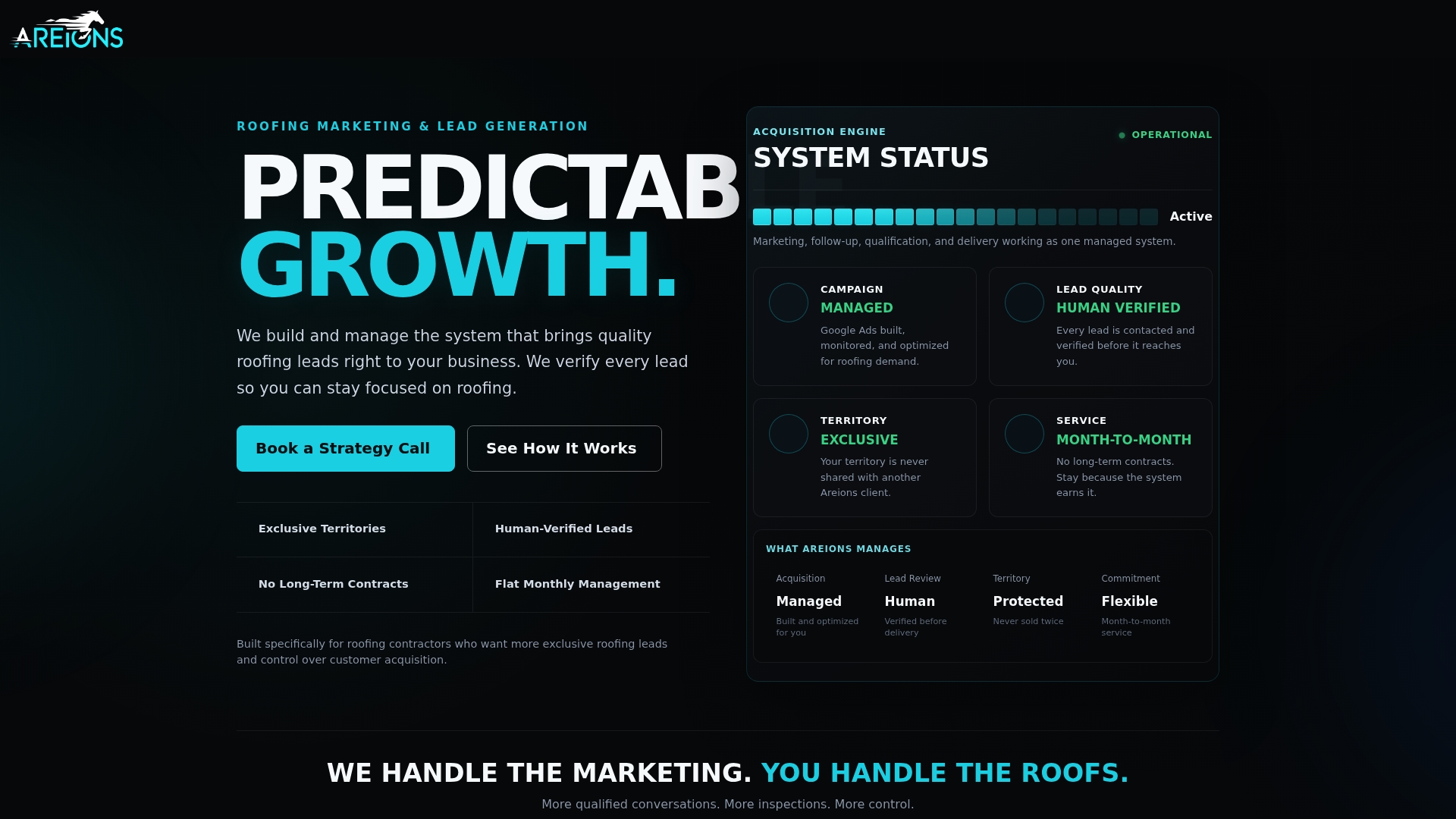
The speed-to-lead SLA discussed earlier is the core of what Areions manages daily, immediate routing, verified qualification before a lead ever reaches your team, and ongoing campaign optimization so your cost per lead doesn’t drift the way unmanaged search campaigns tend to. Plans run month-to-month with no long-term contract across the Foundation, Professional, and Enterprise tiers, and territory exclusivity means you’re not bidding against another client in your own zip code. Areions guarantees qualified leads within 30 days of starting.
If your pipeline is losing deals to slow response or unqualified inspections, book a strategy call to see how this fits your current setup.
Sources
- How to get roofing leads: proven tactics that actually work - GAF
- Roofing Google Ads statistics - Webtonic
- Get roofing leads - EagleView
FAQ
Are Roof Salesmen Making a Lot of Money?
Top roofing sales reps often earn well into six figures through commission-heavy pay structures, especially during active storm seasons. Income varies widely by region, company, and lead quality, and reps working off cold canvassing typically earn less than those working warm, qualified leads.
What Are the 5 Stages of a Sales Pipeline?
A common simplified model runs new lead, inspection, estimate, negotiation, and signed/deposit, though roofing companies often split inspection into scheduled and completed for a 5 to 7 stage model. Each stage needs a clear exit criterion so deals don’t stall silently.
What Is the 25% Rule in Roofing?
Definitions of this rule vary by state and insurer, and it generally refers to a threshold some jurisdictions or insurance policies use to determine whether a roof section needing repair over a certain percentage must be fully replaced rather than patched. Check your specific state’s building code and the homeowner’s policy language, since this isn’t a uniform national standard.
How Do You Make $100k in Roofing Sales?
Reaching six figures in roofing sales generally requires a high inspection show-rate, a fast estimate-to-close cycle, and consistent follow-up on every open deal rather than chasing only new leads. Reps who track their own time-in-stage numbers and fix their weakest conversion point tend to outearn reps who just work more leads without changing their process.
What Does Areions Cost for Roofing Lead Generation?
Areions offers three tiers: Foundation at $97 per month, Professional at $1500 per month, and Enterprise at $5000 per month, all available on a month-to-month basis with no long-term contract.