
Roofing PPC Benchmarks: Blended CPL ~$105 and the Revenue Math
Expect a blended cost per lead near $105, non-branded search closer to $124, branded search around $44, and Performance Max landing near $64, based on a 15-contractor dataset tracking $310,000 in ad spend. Local Services Ads often run cheaper per lead but the range varies widely by market. None of these numbers matter without context on job value, close rate, and season, which is what the rest of this briefing covers.
TL;DR:
- Non-branded search typically costs around $124 per lead, but in highly competitive markets or storm seasons, this can exceed $180.
- Local Services Ads usually generate leads priced between $30 and $150, with higher costs in saturated markets or when review volume is low.
- The most valuable metrics for roofing PPC are cost per appointment and cost per sold job, which better reflect revenue than cost per lead alone.
- Proactive storm-response strategies and verified lead qualification can significantly lower actual costs per sale compared to reactive bidding during storm recovery.
- A trial period with clear operational SLAs and verified lead quality is essential before committing to any PPC vendor or managed lead service.
Table of Contents
- Roofing PPC Benchmarks at a Glance: Core Numbers and Distribution
- Roofing PPC Benchmarks by Campaign Type: CPL, CPC, and ROAS
- Seasonality and Storm Markets: Why Your CPL Moves Every Month
- The Roofing PPC Metrics That Actually Predict Revenue
- Recommended Roofing PPC Budgets and Worked Revenue Examples
- How Proactive Storm Response Changes Roofing Lead Economics
- What Roofing Marketers Get Wrong About Vendor Evaluation
- A Managed Path to Verified Roofing Leads
- Sources
- FAQ
Roofing PPC Benchmarks at a Glance: Core Numbers and Distribution
Averages hide as much as they reveal, but you still need a starting point. The clearest one available comes from SearchLight’s Q1 2026 analysis, which tracked $310,000 in non-branded Google Ads spend across 15 roofing contractors. That’s a small sample, worth flagging before anyone treats it as gospel, but the percentile spread it produced still tells you something useful about where a healthy account sits versus an outlier.
The topline figures: blended CPL of $105, non-branded CPL of $124, branded CPL of $44, and Performance Max CPL of $64. Local Services Ads don’t fit neatly into that same dataset, but industry guides commonly indicate LSA cost per qualified call varies depending on market saturation and review volume.
| Campaign Type | Typical CPL | What Drives the Number |
|---|---|---|
| Blended (all campaigns) | ~$105 | Mix of branded, non-branded, PMax spend |
| Non-branded search | ~$124 (median) | Competitive keywords, high commercial intent |
| Branded search | ~$44 | Low competition, existing brand awareness |
| Performance Max | ~$64 | Automated bidding, mixed inventory |
| Local Services Ads | $30 to $150 | Market saturation, review count, response speed |
The percentile breakdown matters more than the median alone. Accounts in the 25th percentile for non-branded CPL tend to land closer to $85 to $95, while the median sits at $124, and the 75th percentile can climb past $160 in competitive metros. If your non-branded CPL is sitting at $180, you’re not necessarily doing something wrong. You might be in a market where every competitor is bidding on the same 20 keywords during storm season.
Roofing PPC Benchmarks by Campaign Type: CPL, CPC, and ROAS
Each channel plays a different role, and treating them the same way in a spreadsheet is where most roofing marketing budgets go sideways. Non-branded search catches homeowners actively searching “roof repair near me” or “roof replacement cost,” and it tends to cost more because the intent is high and the competition is fierce. CPCs vary by market, often falling within a moderate range.
Branded search is typically the cheapest traffic you’ll buy, reflecting high intent. Undervaluing this budget can risk trading low-cost branded leads for more expensive non-branded ones.
Performance Max sits in a strange middle ground. Google’s automated bidding pulls from search, display, YouTube, and Discover inventory simultaneously, and the platform doesn’t hand you clean attribution by channel. A $64 CPL looks attractive on paper, but without granular reporting you can’t always tell whether that lead came from someone actively searching or someone who saw a banner ad and clicked out of curiosity.
Here’s how the four channels stack up on role and risk:
- Non-branded search: highest intent, highest cost, the backbone of most storm-season campaigns
- Branded search: cheapest CPL, protect this budget before expanding elsewhere
- Performance Max: efficient on paper, worth testing with a capped budget and close attribution monitoring
- Local Services Ads: pay-per-lead model with Google’s own verification badge, often the fastest path to a booked call
LSA deserves particular attention because Google verifies your license and insurance before you show up in that unit, and homeowners tend to trust the badge. Industry PPC guides note close rates on LSA leads often run higher than shared-lead alternatives, which changes the ROAS math even when the sticker price per lead looks similar to search.
Seasonality and Storm Markets: Why Your CPL Moves Every Month
Roofing PPC costs are not flat across the calendar, and any benchmark you read should come with a month attached. Non-branded CPL often declines as winter turns into spring in many markets due to seasonal changes in demand and competitor spend.
Storm-affected markets experience spikes in CPC and CPL following hail or wind damage because many contractors compete simultaneously for the same keywords, increasing costs during recovery windows.
A few practical takeaways for reading your own monthly trend line:
- Compare month-over-month CPL against your own trailing 12-month average, not against a single benchmark
- Expect elevated CPC in the first two to three weeks after a hail or wind event in your service area
- Maintaining modest spend through slow months usually lowers your blended CPL once volume ramps back up, because you’re not restarting bidding history from zero
The RoofingContractor industry guidance is blunt about this: react to trends, not single-month fluctuations. A bad week in a slow month isn’t a crisis. A bad week during active storm recovery, when competitors are outbidding you for the highest-intent leads of the year, is worth a same-day budget review.
The Roofing PPC Metrics That Actually Predict Revenue
Cost per lead tells you almost nothing about whether your campaigns are working. JobNimbus makes the case that roofing marketers should track cost per appointment and cost per sold job (CPSJ) instead, because those numbers connect spend directly to booked revenue rather than to a form fill that may never answer the phone.
Here’s how the math actually works:
- Cost per appointment = total spend ÷ number of appointments set. If you spent $5,000 and booked 25 appointments, that’s $200 per appointment.
- Cost per sold job (CPSJ) = total spend ÷ number of signed contracts. If 10 of those 25 appointments closed, your CPSJ is $500.
- ROAS = revenue generated ÷ ad spend. If those 10 jobs averaged $12,000 each, that’s $120,000 in revenue against $5,000 spent, or 24 to 1.
That 24 to 1 ratio looks nothing like the CPL number most dashboards show you, and it’s the number that actually matters to your bank account.
Lead-value weighting takes this further. Not every roofing lead is worth the same amount. A storm-damage full replacement inquiry might carry an expected value of $15,000, while a minor repair call might be worth $800. WhatConverts’s analysis argues that headline averages, including the commonly cited $350 per-lead figure, obscure exactly this kind of variation, and marketers who optimize purely to CPL end up cutting campaigns that generate expensive but highly profitable leads.
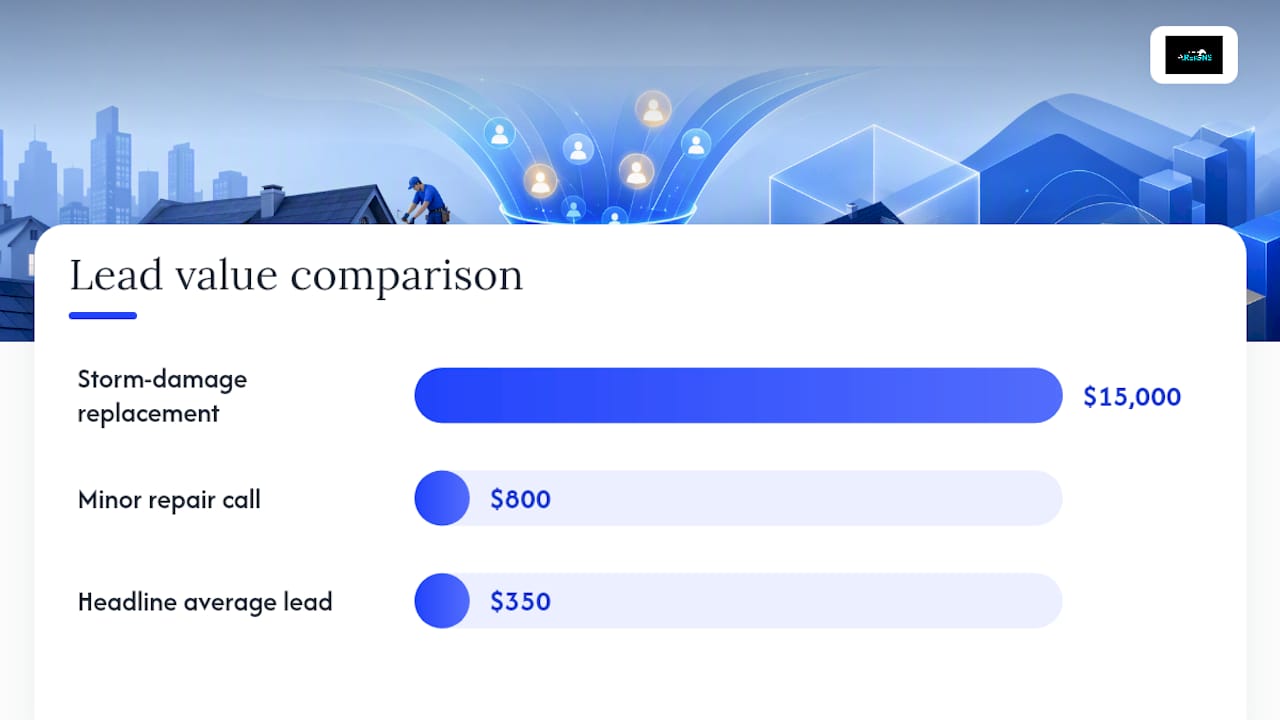
Pro Tip: Assign an expected revenue value to each lead source before you touch your bidding strategy. A higher-cost non-branded lead converting to a large project often yields more value than a cheaper branded lead for a smaller job, highlighting the importance of lead quality over CPL alone.
None of this works without proper attribution. Call tracking numbers, UTM parameters on every campaign, and a CRM that maps leads through to closed revenue are the minimum setup required to calculate real CPSJ and ROAS instead of guessing.
Recommended Roofing PPC Budgets and Worked Revenue Examples
Budget bands depend heavily on market size and storm activity, but a few reference points help with planning. Monthly spend levels directly influence lead volume, with typical budgets yielding progressively more leads, though exact numbers vary by market and campaign type.
Two worked examples show why the CPL number alone tells an incomplete story:
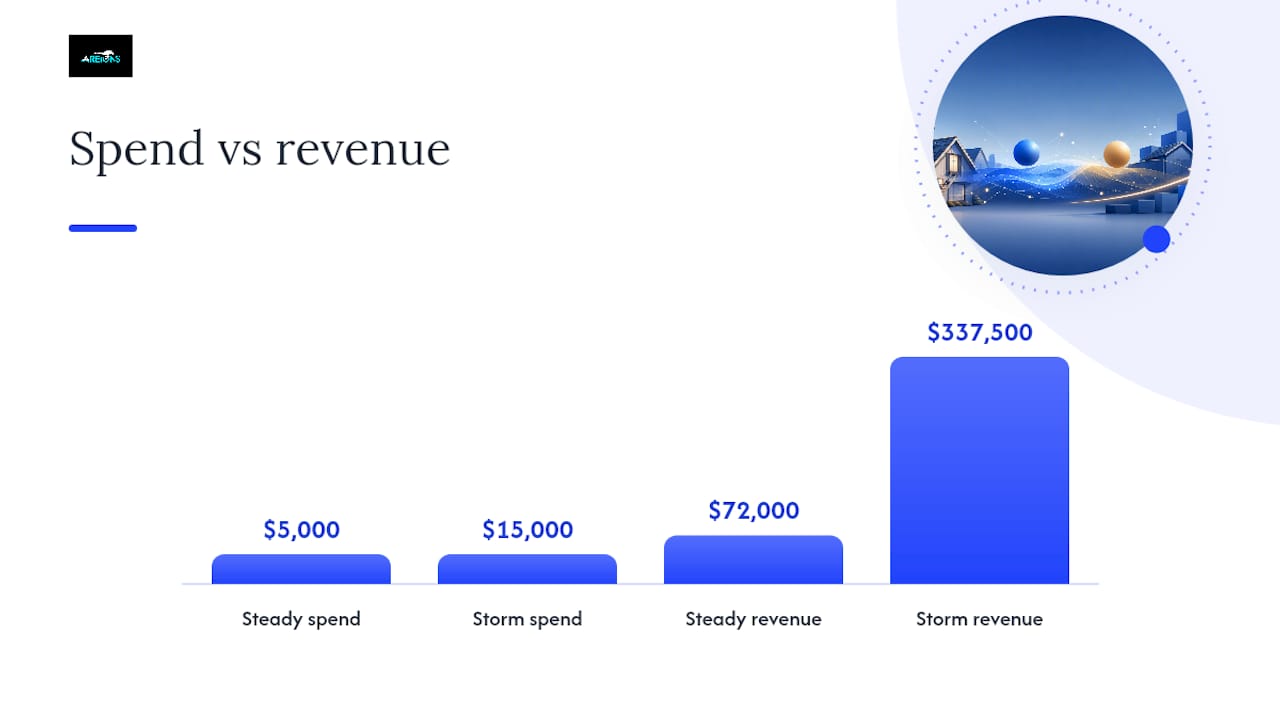
- Steady-market contractor: $5,000 monthly spend, $124 non-branded CPL, produces 40 leads. A 20% close rate yields 8 sold jobs. At an average job value of $9,000, that’s $72,000 in revenue against $5,000 spent, roughly $625 CPSJ and 14.4 to 1 ROAS.
- Storm-market contractor: $15,000 monthly spend during active recovery, CPL rises to $175 due to competition, producing 85 leads. A higher close rate of 30%, common in storm markets where homeowners are motivated, yields 25 sold jobs. At an average job value of $13,500 for storm-related replacements, that’s $337,500 in revenue against $15,000 spent, or roughly $600 CPSJ and 22.5 to 1 ROAS.
How Proactive Storm Response Changes Roofing Lead Economics
Areions builds its model around a different assumption: waiting for a homeowner to search “roof repair near me” means you’re competing in the most expensive, most crowded moment possible. A proactive storm-response system intercepts demand earlier, tied to verified storm damage in a specific territory, before every competitor floods the same keyword auction.
Human-verified qualification changes the CPSJ math directly. When a lead has already been confirmed as a real homeowner with actual storm damage, close rates rise, which lowers effective cost per sold job even if the raw CPL looks unremarkable on a spreadsheet.
A short checklist for evaluating any vendor against this standard:
- Does the vendor verify homeowner identity and damage before delivery, or just pass along a form fill?
- Is there direct CRM integration and lead routing, or manual export and re-entry?
- Do you get exclusive territory rights, or are leads shared with competitors?
- Is there a clear SLA on lead qualification timelines, and does the contract require long-term lock-in?
What Roofing Marketers Get Wrong About Vendor Evaluation
Most contractors negotiate PPC vendor contracts around a single number: promised CPL. That’s the wrong starting point. A vendor quoting $80 leads with no verification and no CRM integration will almost always cost more per sold job than a vendor quoting $150 leads that arrive pre-qualified.
Require a trial period with clear 30/60/90 expectations: leads delivered by day 30, a measurable qualified-lead rate by day 60, and at least one booked job by day 90, supported by operational SLAs as explained in Speed to Lead: The SLA That Wins the First Conversation. If a vendor can’t commit to those checkpoints, that’s a red flag worth taking seriously.
The bigger red flag is a vendor who only talks about CPL and never mentions revenue attribution, close rate, or lead verification. That conversation avoidance usually means they don’t track those numbers, which means neither will you.
— Angel
A Managed Path to Verified Roofing Leads
Areions is the alternative to chasing your own storm-season keyword auctions: instead of bidding against every competitor the moment a hailstorm hits, Areions positions your business ahead of the demand with verified homeowner leads delivered directly to your CRM.
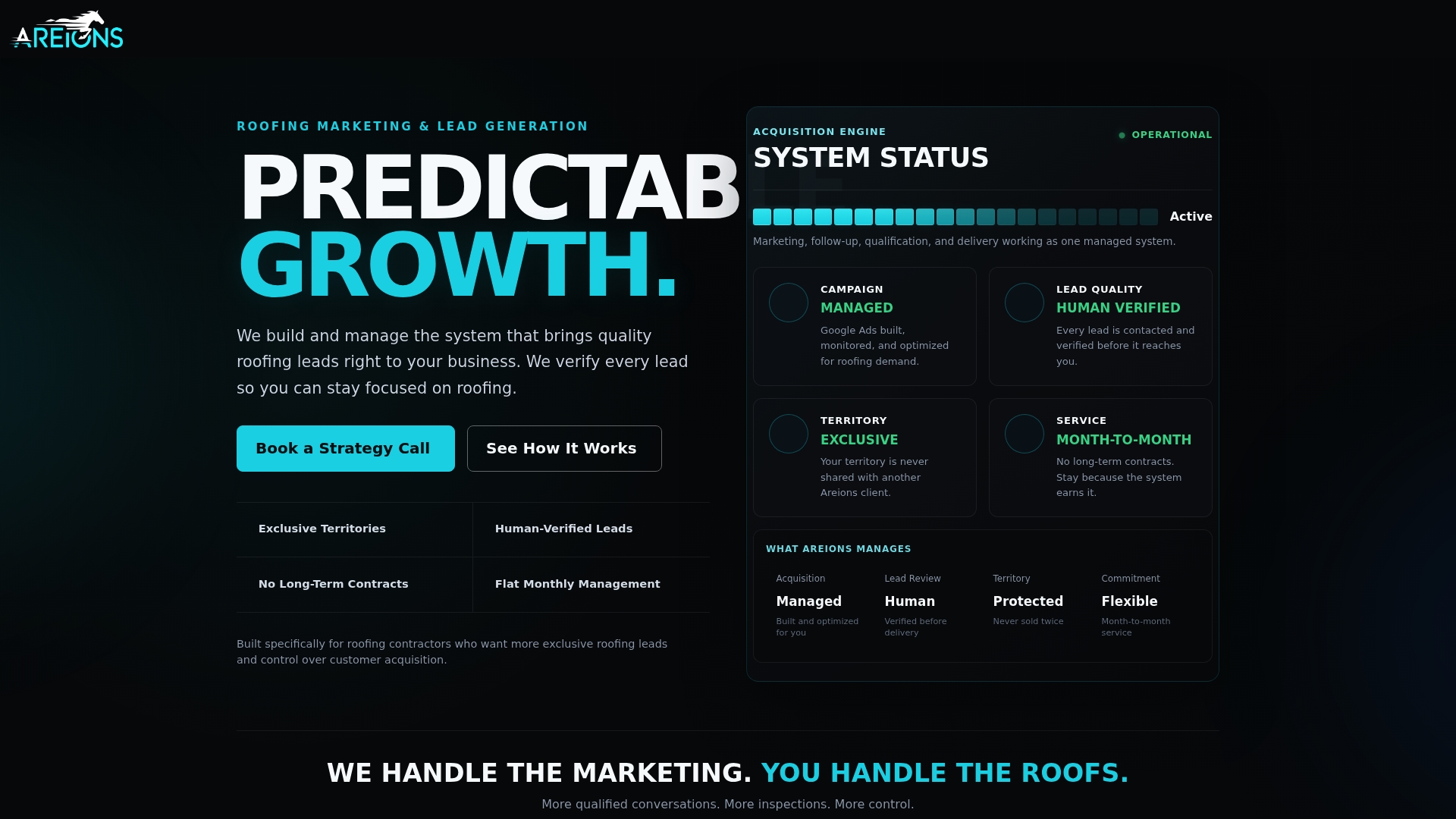
The service runs month-to-month with no long-term contract, and offers a lead delivery timeline to support early results. That structure matters most for contractors who’ve been burned by 12-month agency contracts that promised volume and delivered unverified form fills. Areions handles campaign management, landing pages, call tracking, and lead qualification, so your team spends time on booked jobs instead of chasing bad numbers. Roofing companies in storm-prone regions typically see the clearest early results, since the proactive model is built around intercepting active storm-damage demand before competitors do. If your current CPL looks fine on paper but your close rate doesn’t match it, book a strategy call to see how verified qualification changes the math.
Sources
- Roofing Google Ads Cost Per Lead (2026 Benchmarks)
- Why Roofing PPC Benchmarks Break Down Without Lead Quality Data
- Cost Per Lead Is Lying to You: The Roofing Metrics That Actually Matter | JobNimbus
- 6 Marketing Metrics Every Roofing Contractor Needs
FAQ
What Is a Good Cost Per Lead for Roofing PPC in 2026?
A blended CPL near $105 is typical, with non-branded search closer to $124, branded search around $44, and Performance Max near $64, based on SearchLight’s 2026 dataset. Your actual target should account for job value and close rate, not the raw number alone.
What Is the 25% Rule for Roofing?
The 25% rule generally refers to guidance whereby if a substantial portion of a roof requires repair or replacement due to damage, some jurisdictions require the entire roof to be brought up to current code. This threshold varies, so confirm specifics with local authorities.
What Is the Typical Profit Margin for a Roofing Contractor?
Profit margins vary widely by business model and overhead, but healthy roofing contractors generally aim for gross margins in the 30% to 40% range before accounting for marketing spend and overhead. Marketing efficiency, tracked through metrics like cost per sold job, directly affects how much of that margin survives to the bottom line.
How Do I Measure PPC Success Beyond Cost Per Lead?
Track cost per appointment, cost per sold job, and ROAS by mapping each lead through to closed revenue in your CRM, as JobNimbus recommends. A campaign with a high CPL can still outperform a cheaper one if it produces higher-value, higher-closing leads.
How Do Storm Markets Affect Roofing PPC Costs?
CPC and CPL both rise sharply in the days following hail or wind damage as every contractor in the affected metro bids on the same keywords. Proactive systems that identify verified storm damage before the auction gets crowded, like the approach Areions uses, can reduce reliance on that reactive, high-cost bidding window.