
What Percent of Revenue Should Your Roofing Marketing Budget Be?
Budget 5% to 10% of gross revenue for roofing marketing, with growth-focused companies leaning toward the top of that range. On $3 million in revenue, that’s roughly $15,000 to $20,000 a month. A workable starting split looks like this:
- 35% to high-intent paid search and Local Service Ads (expect a blended cost per lead near $105)
- 20% to SEO and content
- 20% to website, landing pages, and conversion optimization
- 15% to reputation management and automation
- 10% held as storm contingency
That’s the whole framework in miniature. Everything below explains how to adjust it for your revenue tier, your close rate, and the season you’re in.
Key Takeaways
A roofing marketing budget works best when it starts at 5% to 10% of revenue, prioritizes high-intent paid channels and website conversion, and holds a storm contingency in reserve rather than cutting spend when demand spikes.
| Point | Details |
|---|---|
| Set the baseline | Budget 5%–10% of gross revenue, leaning toward 8%–10% in growth mode. |
| Fund conversion first | A well-built site converting at 12%–18% multiplies the value of every dollar spent on ads. |
| Reverse-engineer the number | Work from revenue goal to required jobs to required leads, not from a copied percentage. |
| Keep a storm reserve | Hold 10%–20% in flex spend so demand spikes don’t get missed. |
| Consider a managed program | Areions delivers verified, exclusive storm-response leads within a guaranteed 30-day window on a month-to-month basis. |
Table of Contents
- Roofing Advertising Costs: Industry Benchmarks and When to Flex
- Roofing Advertising Costs by Channel
- Sample Roofing Marketing Budgets by Revenue Tier
- Budgeting for Roofing Marketing: Picking the Right Allocation Method
- Roofing Lead Generation Budget: KPIs and Timeline to Expect
- Agency vs. In-House: Where the Roofing Marketing Budget Actually Goes
- Where a Storm-Response Program Fits Your Marketing Budget
- Frequently Asked Questions
- Sources
Roofing Advertising Costs: Industry Benchmarks and When to Flex
The 5% to 10% range isn’t arbitrary. It maps to company stage. Companies protecting an established referral base can often run near 5%, while companies pushing hard for growth or entering new territories tend to land at 8% to 10% or higher. Think of the low end as maintenance and the high end as expansion capital.
Statistic to anchor your planning: most established roofing companies spend 5% to 10% of gross revenue on marketing, but that figure is a sanity check, not a target to hit blindly.
Move toward the higher end when:
- You’re chasing an aggressive revenue goal rather than steady-state volume
- Your close rate has been dropping and you need more leads to hit the same number of signed jobs
- You’re expanding into a new metro or county with no existing reputation
- Referral and repeat business has slowed and paid channels need to carry more weight
Storm season changes the math entirely. Budgeting is not just a monthly average. Roofing demand spikes hard after hail and wind events, and pulling back spend during those windows is one of the costliest mistakes an owner can make, because it hands the most profitable jobs of the year to competitors who stayed visible. Build a storm surge line into the plan now, before the sky turns green.
Roofing Advertising Costs by Channel
Here’s where the money actually goes, channel by channel, with realistic ranges for 2026.
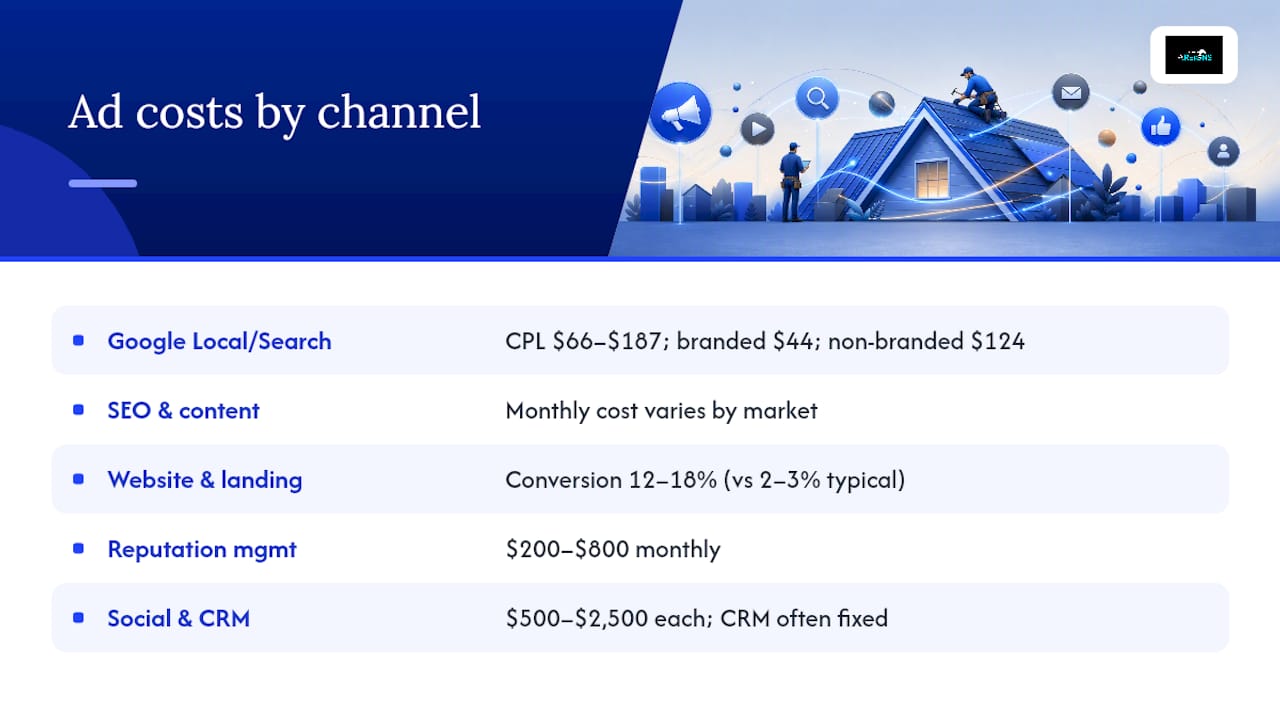
Google Local Service Ads and Search Ads. This is your highest-intent traffic, homeowners actively searching for a roofer right now. Expect a blended cost per lead around $105, with non-branded search running closer to $124 and branded search around $44. Directional ranges across campaign types and markets swing between roughly $66 and $187, so local testing matters more than any published average. Budget for platform spend plus a management fee, whether that’s an in-house hire or a managed program.
SEO and content. Plan a dollar amount monthly for SEO and content depending on market competitiveness. This is a compounding asset, not a monthly expense you can turn off.
Website and landing pages. A properly built site converts at 12% to 18%, compared to the 2% to 3% typical of an average contractor site. That gap alone can double or triple leads from the same ad spend, which makes this one of the highest-leverage line items in the entire budget.

Reputation management. $200 to $800 monthly for review generation and response automation. Roofing is a trust purchase, and review volume directly affects Local Service Ads eligibility and rank.
Social ads, email/SMS, direct mail, and CRM/automation round out the mix, typically $500 to $2,500 each depending on scale, with CRM and call tracking treated as fixed infrastructure rather than optional spend.
Sample Roofing Marketing Budgets by Revenue Tier
A $3 million roofing company should plan on roughly $15,000 to $20,000 a month to push toward $5 million in revenue, with dollars split across those same channel categories.
More leads into a weak funnel just raises your cost per job.
Budgeting for Roofing Marketing: Picking the Right Allocation Method
Two models dominate. Percent-of-revenue budgeting sets a fixed share of top-line revenue and is simple to plan around, but it can overspend in slow months and underspend right when storm demand spikes. Cost-per-lead and cost-per-acquired-customer (CAC) budgeting works backward: figure out how many signed jobs you need, divide by your close rate to get required leads, then multiply by your target CPL to set the actual dollar spend. This reverse-engineered method tends to produce more honest numbers than copying a percentage from another contractor.
A workable tiered split: 30% to 40% toward high-intent paid channels, 20% to 25% toward SEO and content, and the remainder split across website/CRO, reputation, and automation. Track CAC monthly, not just CPL. A cheap lead that never closes is more expensive than an expensive one that does.
Write your reallocation rule into the plan itself: review numbers monthly, reallocate quarterly, and add a pre-approved storm posture that can add 10% to 20% to spend during active weather windows without a committee meeting first.
Roofing Lead Generation Budget: KPIs and Timeline to Expect
Track these numbers every month:
- Cost per lead (CPL) — expect $66 to $187 for paid search, with a blended average near $105
- Cost per acquired customer (CAC) — divide total spend by signed jobs, then compare against average ticket to confirm profitability
- Booked inspections and signed jobs — the two numbers that actually pay the bills
- Revenue per channel — so you know which line items to fund harder
- Close rate — the multiplier that turns lead volume into job volume
Paid channels usually show results within two to four weeks. SEO and content take three to twelve months to compound. Website and conversion rate improvements can shift lead volume in four to twelve weeks once the new site or landing pages go live, thanks to that jump from a 2% to 3% baseline conversion toward the 12% to 18% range a well-built site can hit.
Agency vs. In-House: Where the Roofing Marketing Budget Actually Goes
Most roofing companies outsource Local Service Ads management, search campaign management, landing page builds, and reputation automation. These require specialized platform knowledge that’s expensive to build in-house for a single company. Keep customer relationships, sales follow-up, and day-to-day CRM entry internal, since nobody outside your business should own the relationship with a homeowner.
Typical agency fees run as a flat monthly retainer or a percentage of ad spend, separate from the media budget itself. Watch for red flags: agencies promising a rock-bottom CPL without ever touching your website or reviews, long contracts locked in with no performance reporting, or dashboards that show clicks instead of booked jobs. Month-to-month terms with actual lead delivery metrics are the standard worth holding agencies to.
A publisher’s note on where the money should go first
Prioritize high-intent channels and website conversion before anything else, and never cut spend during storm windows just because cash flow feels tight that month. The companies that hold steady or add a surge budget capture the leads their competitors abandon. Areions built its storm-response program around exactly that gap, delivering verified, exclusive leads when demand is highest.
Where a Storm-Response Program Fits Your Marketing Budget
Areions maps directly onto the high-intent paid line in the budget you just built. Instead of managing Local Service Ads, landing pages, call tracking, and lead qualification separately, Areions runs all of it as one managed line item, complete with human-verified homeowner leads and territory exclusivity so you’re not bidding against another roofer in your own zip code.
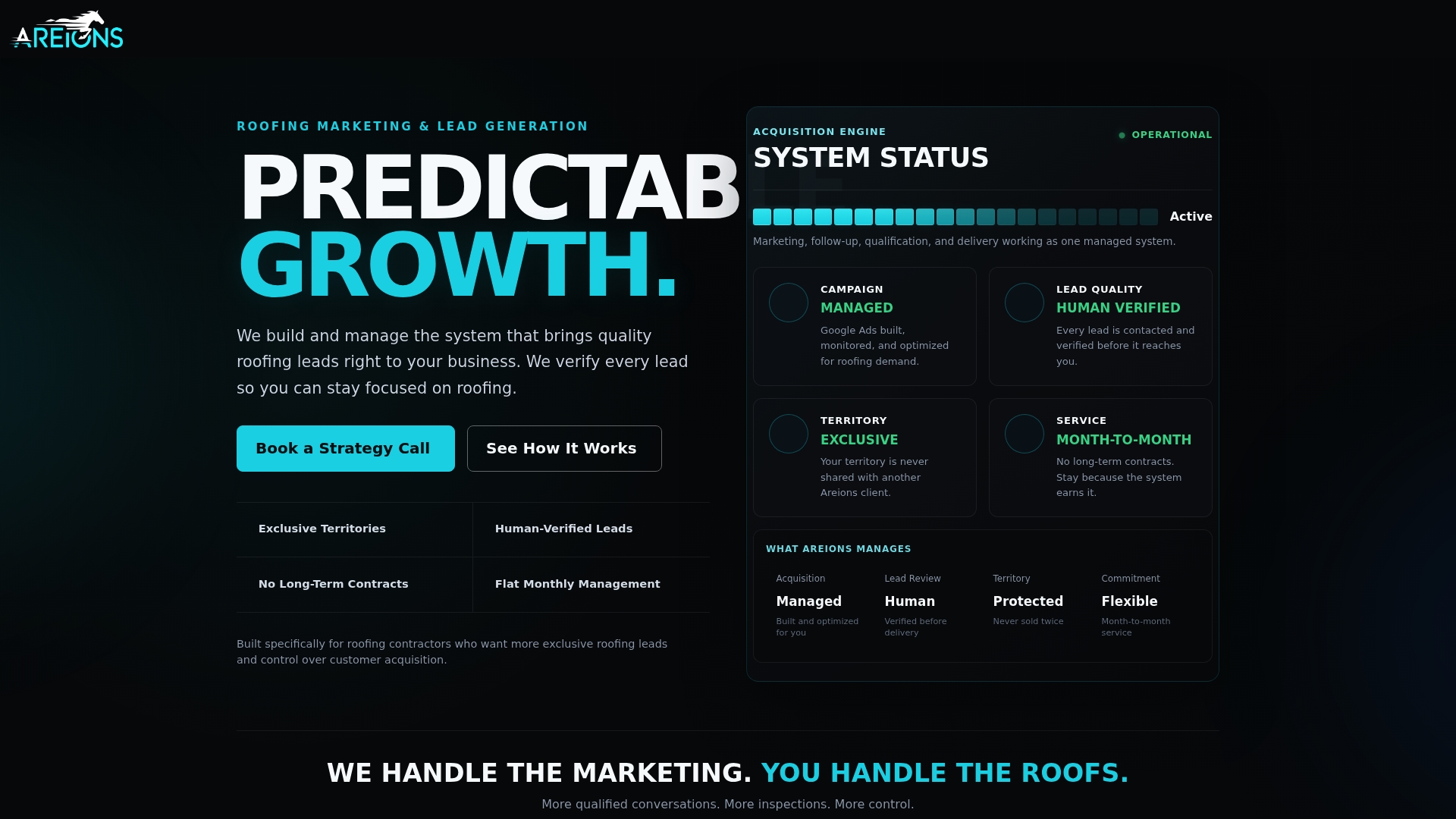
What lands in your CRM is a verified lead tied to actual storm damage, not a generic contact form submission. That’s the difference between paying for clicks and paying for demand that’s already qualified. There’s no long-term contract locking you in, and Areions guarantees qualified leads within 30 days, which makes it easy to test against a single month’s budget before committing further. If you’re ready to see how a storm-response line item performs against the rest of your plan, start a pilot month with Areions and compare the results directly.
Frequently Asked Questions
What percent of revenue should a roofing company spend on marketing? Most established roofing companies spend 5% to 10% of gross revenue on marketing, with growth-focused companies and those expanding into new markets closer to the top of that range.
How much does a roofing lead cost from Google Ads? Expect a blended cost per lead near $105, with branded search around $44 and non-branded search closer to $124, though local market and campaign type can push costs to $66–$187.
How much should a $1 million roofing company spend on marketing monthly?
Should I cut my marketing budget during slow winter months? No. A better approach shifts budget toward SEO, content, and reputation building in slow months, then holds or increases paid spend heading into storm season rather than pulling back entirely.
Is it better to hire an agency or build an in-house marketing team? Most roofing companies outsource specialized work like Local Service Ads management and landing page builds while keeping sales follow-up and CRM management internal, since agency platform expertise is hard to replicate at a single-company scale.
Sources
- Roofing Google Ads Cost Per Lead (2026 Benchmarks)
- The Complete Guide to Roofing Marketing in 2026 | DFS
- Roofing Marketing Budget Planning: 5 Tips for Next Year | RoofPredict Blog