
Roofing Lead Qualification: Book Storm Leads in 30 Days
A working roofing lead qualification process does one thing above all else: it stops your estimator from driving to a house that would never become a job. That means verifying service fit and appointment readiness before anyone leaves the office, capturing a small set of hard evidence at intake, and routing the lead instantly based on what that evidence shows. Get those three mechanisms right, and everything else, your close rate, your cost per job, your team’s morning, improves on its own.
TL;DR:
- Prioritize collecting clear evidence during intake on roof type, damage, and insurance status to accurately route leads and avoid wasting estimator time.
- Keep fit and readiness as separate CRM fields to better differentiate high-potential leads from those ready to contract immediately.
- Use quick response tiers based on urgency, aiming for five-minute contact with hot leads and within 30 minutes for warm prospects during storm surges.
- Automation tools help with sorting and enrichment but cannot replace homeowner-provided damage descriptions and photos for accurate qualification.
- Ensure your CRM mapping and auto-routing triggers are precise to prevent leads from defaulting into wrong categories or delays.
Table of Contents
- What Does Roofing Lead Qualification Actually Mean?
- Fit vs Readiness: Store Them as Separate Facts in Your CRM
- Tools and Workflows: Capture, Enrichment, and CRM Integration
- Routing and Speed to Lead: Priority Tiers and SLAs
- Measuring What Matters: KPIs and a Realistic Timeline
- How Areions Applies This Blueprint in Practice
- What This Guide Gets Right That Most Advice Misses
- If You Want a Managed Storm-Response Option
- Sources
- FAQ
What Does Roofing Lead Qualification Actually Mean?
Roofing lead qualification is the process of confirming, before you commit field time, that a prospect matches your service scope and is actually ready to move forward. It’s not the same as lead generation, and it’s not the same as scoring a lead “hot” because they filled out a form during a hailstorm. Qualifying roofing leads means separating two questions that most contractors accidentally merge into one: is this the kind of job we do and is this person prepared to act on it right now.
That distinction matters more during storm season than any other time of year, because storm surges flood your pipeline with volume, not necessarily quality. A homeowner who Googles “roof damage inspection” ten minutes after a hailstorm might have real damage and an insurance claim already forming, or they might be checking a box before calling their agent. An effective lead qualification roofing system tells the difference in under two minutes of intake.
The pre-appointment qualification checklist
Here’s the checklist your intake staff, or your automated capture system, should run through before booking any estimator visit. Each field has a defined evidence standard and a defined “unknown” path, because pretending you know something you don’t is how bad appointments get scheduled.
- Problem type: Storm damage, general repair, replacement, or new construction. Ask directly; don’t infer from the marketing channel.
- Roof type and age: Shingle, tile, metal, flat. Homeowner estimate is acceptable evidence; permit records are better if available.
- Visible damage: Photos, a homeowner description, or an insurance adjuster note. If none exists, mark “unconfirmed” rather than guessing.
- Insurance involvement: Has a claim been filed, is one pending, or is this an out-of-pocket job? This single field often determines your entire sales script.
- Timeline: Urgent (active leak, tarp needed), near-term (within 30 days), or exploratory (just gathering quotes).
- Decision-maker: Confirm you’re talking to the person who signs the contract, not a renter or a family member relaying information.
- Access constraints: Gated property, HOA rules, or scheduling conflicts that affect the estimator visit.
- Budget signal: Not a hard number, but whether the homeowner has acknowledged cost expectations or insurance deductible responsibility.
Once those eight fields are filled, or explicitly marked unknown, the lead routes to one of five outcomes:
- Book: Fit and readiness both confirmed. Send the estimator.
- Gather: Fit looks likely, but one or two fields are missing. Assign an owner to call back within a set window.
- Nurture: Timeline is exploratory. Add to a follow-up sequence instead of the calendar.
- Refer: Doesn’t match your service scope (wrong roof type, outside territory). Pass along or close out.
- Escalate: Active damage plus insurance urgency. Skip the queue.
This structure mirrors what most pre-appointment qualification templates recommend: confirm problem type, timing, property basics, appointment fit, and decision readiness, then stop. Over-qualifying at intake just burns time you’ll need later for the actual estimate.
Fit vs Readiness: Store Them as Separate Facts in Your CRM
Fit and readiness are not the same fact, and collapsing them into a single “hot/warm/cold” score is the single most common mistake in roofing lead assessment. Fit describes whether the job matches what your company actually does. Readiness describes whether the person is prepared to move forward right now. A lead can be a perfect fit and completely unready, or a mediocre fit who’s ready to sign today.
Consider a homeowner with confirmed hail damage on an asphalt shingle roof, exactly your service scope, who says she wants to wait until her insurance adjuster visits next week. That’s high fit, low readiness. Now consider a homeowner asking for a metal roof estimate (outside your scope) who wants work started tomorrow. That’s low fit, high readiness. A single blended score tells your team nothing useful about either case.
Best practice treats fit and readiness as two separate CRM fields, each verified by different evidence and, ideally, owned by different roles:
- Fit verification typically belongs to the intake person or automated system: roof type, damage type, and territory match.
- Readiness verification typically belongs to a setter or salesperson: timeline confirmation, decision-maker access, and insurance claim status.
- Unknowns get recorded explicitly, with an assigned owner to close the gap, rather than defaulted into a low score that buries the lead.
Pro Tip: Build a CRM view that filters by fit and readiness independently. A “high fit, low readiness” list is your nurture campaign. A “high fit, high readiness” list is your dispatch queue. Mixing them into one pipeline stage is how good leads go cold.
Tools and Workflows: Capture, Enrichment, and CRM Integration
Phone calls still convert better than web forms for storm leads, but web forms scale better during surges, and referrals need the lightest qualification of the three because trust is already established. Prioritize phone capture with a live or automated answering flow during active storm windows, and treat web forms as a 24/7 backstop that still asks the same core fields.
Automated enrichment, pulling property records, storm-track maps, and aerial imagery, can speed up fit verification, but it has a real limit: it tells you a storm passed near an address, not that the specific roof sustained damage. Automated qualification systems built for roofing contractors can gather property-level data and apply multi-factor scoring to route high-scoring leads instantly, and vendor reporting suggests this kind of automation can cut manual screening time by a large margin. That’s a meaningful efficiency gain, but it applies to sorting, not to confirming actual damage, so don’t let an aerial imagery flag substitute for a homeowner’s own description or a photo.
Integration checkpoints worth locking down before you turn on any automation:
- Field mapping: Every checklist field above needs a corresponding CRM field, not a free-text note nobody reads.
- Auto-routing triggers: Define exactly which combination of fit and readiness fields triggers “book” versus “escalate.”
- Fallback human review: Set a maximum time (commonly 15 to 30 minutes) before an unclaimed automated lead gets a human phone call.
Third-party marketplace “ready to hire” labels deserve particular skepticism. Angi’s own reporting on home spending makes clear that platform readiness flags aren’t a substitute for your own verification. Treat every purchased or marketplace lead through the same checklist you’d apply to an inbound call.
Routing and Speed to Lead: Priority Tiers and SLAs
Storm surges create a narrow window where the fastest, best-informed response wins the job, often before three competitors even call back. Sort every qualified lead into one of three tiers the moment intake finishes:
- Hot/urgent: Active leak, tarp needed, or confirmed insurance claim with an adjuster visit already scheduled. Target first contact within 5 minutes.
- Warm/bookable: Fit confirmed, readiness likely, but no active emergency. Target first contact within 30 minutes.
- Nurture: Exploratory or budget-uncertain. Folded into a follow-up sequence, no SLA pressure.
Set an escalation timeout for the hot tier: if the assigned estimator hasn’t acknowledged the lead within roughly 8 minutes, the system should auto-reassign to a backup rep rather than let the lead sit in one inbox. That kind of automated escalation rule is standard in modern roofing lead management workflows precisely because storm-week volume makes manual reassignment too slow.
Speed alone isn’t the whole story, though. Practitioner interviews on The Roofr Report make a point worth repeating: an instant but generic callback loses to a slightly slower one that references the homeowner’s actual roof type and storm date. Fast and informed beats fast and blank.
Pro Tip: Before dispatching any estimator, run a two-second calendar check against drive time and existing appointments. A double-booked estimator undoes every speed-to-lead gain you just made.
Measuring What Matters: KPIs and a Realistic Timeline
Track six numbers weekly: qualified leads per week, contact rate within SLA, estimator show rate, conversion to booked inspection, close rate, and average job value by lead source. A simple dashboard tagging each lead by channel (storm campaign, referral, organic, paid) lets you see which source actually produces signed jobs, not just form fills.
- 30 days: Expect cleaner intake data and fewer wasted estimator trips, even if total job volume hasn’t moved yet.
- 60 days: Contact rate and show rate should visibly improve as routing rules mature and staff trust the checklist.
- 90 days: Close rate and average job value by source become reliable enough to shift ad spend or lead-source investment.
Automation vendors report meaningful time savings when first-pass scoring is handled by software instead of a person manually reading every form. Treat those figures as directional, but the pattern, less manual screening, more time on booked work, holds up across most contractors who make this switch.
How Areions Applies This Blueprint in Practice
Areions built its storm-response model around the exact sequence described above: intercept homeowners with verified storm damage while demand is active, run them through structured intake, and hand the sales team only leads where fit and readiness are already documented. Intercepting verified demand this early preserves the evidence trail, photos, storm dates, insurance status, that makes a stronger case on the first sales call and tends to close better than a cold callback days later.
The engagement itself runs month-to-month, with no long-term contract, and some providers offer a guarantee of qualified leads within a certain timeframe. In practice, that guarantee means:
- CRM sync: Intake data can flow directly into the contractor’s existing CRM, mapped to fields like the ones in the checklist above.
- Intake templates: Leads may arrive with problem type, damage evidence, and insurance status already populated.
- Territory exclusivity: Some services provide exclusivity so leads aren’t shared among multiple contractors in the same territory during a storm.
What This Guide Gets Right That Most Advice Misses
Most lead qualification advice in roofing still treats “qualified” as a single yes/no gate, which is exactly backwards during storm season. The research behind this guide points somewhere more useful: fit and readiness are different facts, verified by different evidence, and owned by different people on your team. Contractors who keep scoring leads on one blended scale will keep sending estimators to houses that were never ready to buy.
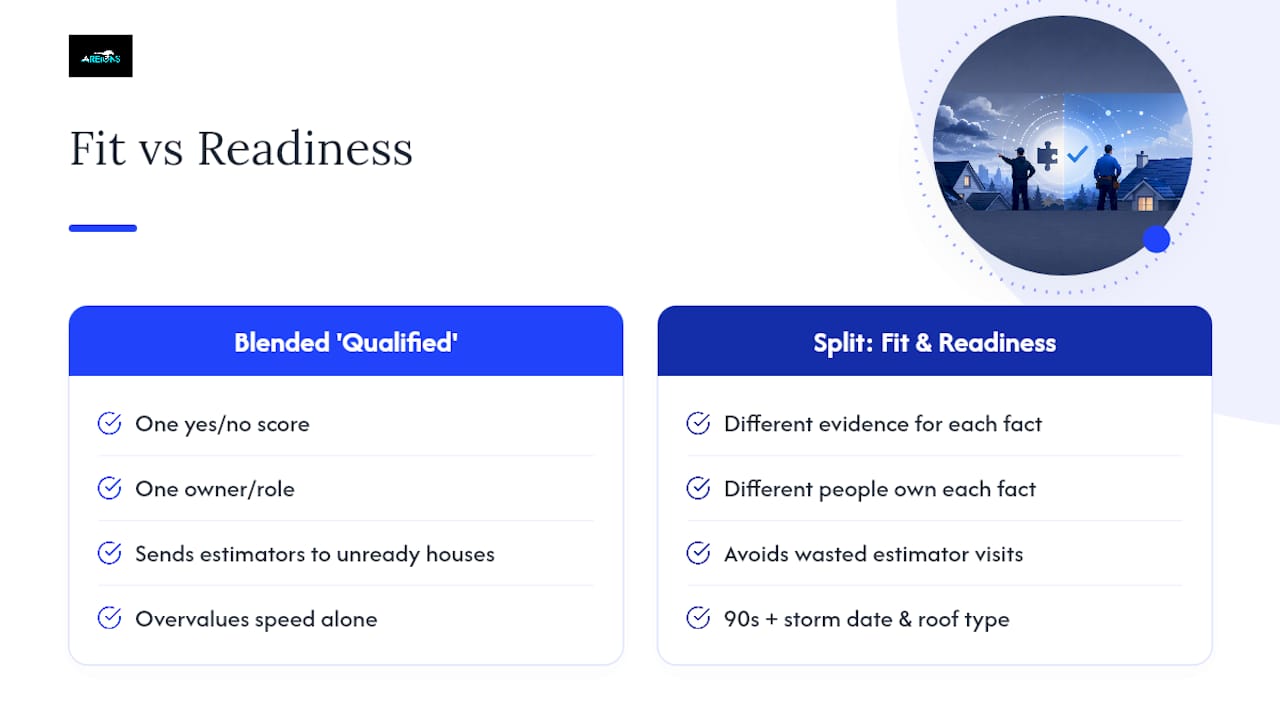
The conventional wisdom oversells speed by itself. Answering in 90 seconds matters far less than answering in 90 seconds with the right storm date and roof type already in hand. That’s a training problem as much as a technology problem, and most shops invest in the software before they invest in the script.
If you take one thing from this, prioritize the CRM field split over any new tool purchase. A $10,000 automation platform layered on top of a single “hot lead” field just automates the same mistake faster. Fix the data model first. Everything downstream, routing, SLAs, dashboards, works better once fit and readiness stop competing for the same box.
— Angel
If You Want a Managed Storm-Response Option
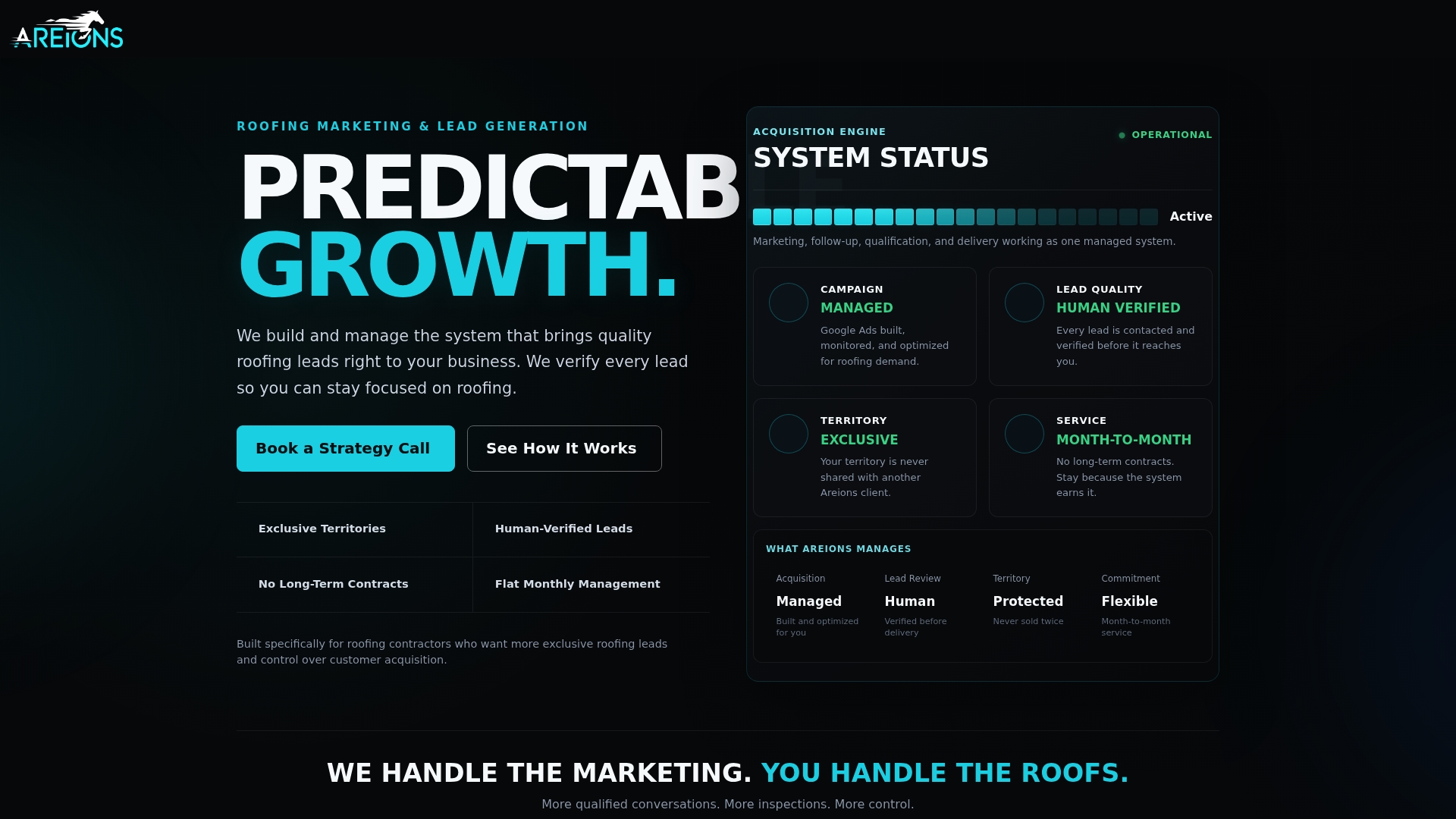
Areions runs as the built-for-roofers alternative to hiring a generalist marketing agency: instead of generic ad management, it intercepts homeowners with verified storm damage and hands your team leads that already match the fit-and-readiness checklist above, backed by month-to-month terms and a guarantee of qualified leads within 30 days.
If you’re evaluating any managed provider, storm-response or otherwise, ask three questions on the demo call: how do you verify damage before calling it a qualified lead, how does your intake data map into our existing CRM fields, and what happens to a lead if our estimator doesn’t respond within your SLA window. A vendor that can’t answer the CRM mapping question in specifics is asking you to trust a black box during your busiest season.
Areions structures its service around exactly those answers, with territory exclusivity so leads aren’t shared with competitors in your market. If that fits what you’re building toward, book a strategy call and walk through your current intake process against the checklist in this guide.
Sources
- Automated Lead Qualification for Roofing Contractors (2024)
- Roofing Lead Fit vs. Readiness: What to Qualify First
- Roofing Lead Qualification Checklist: What to Confirm Before You Send the Estimator
- Angi investor relations: 2024 state home spending report
FAQ
How much do roofers pay per lead?
Costs vary widely by market, storm activity, and whether the lead comes from paid ads, referrals, or a managed provider, and current pricing details for any specific service should be confirmed directly with that provider rather than assumed from industry averages.
What is the 25% rule for roofing?
There’s no single, universally recognized “25% rule” in roofing lead qualification. Some insurance policies use a percentage threshold to determine whether a full roof replacement is required versus a partial repair, but that figure varies by insurer and state, so confirm it against the specific policy in question rather than treating it as a fixed industry standard.
How do I get leads as a roofer?
Combine channels: paid search and storm-response campaigns for active demand, referral programs for warm trust-based leads, and organic content for long-term visibility, then run every lead through the same fit-and-readiness checklist regardless of source. A provider like Areions focuses specifically on intercepting active storm demand rather than relying on general brand marketing.
How thick is code 7 lead?
Code 7 lead, sometimes referenced in flashing and roofing lead work, has thickness specifications that vary by supplier and should be confirmed against current manufacturer standards before ordering material.
What’s the difference between lead fit and appointment readiness?
Fit measures whether the job matches your company’s service scope, like roof type or damage category, while readiness measures whether the homeowner is prepared to move forward right now, including timeline and decision-maker access. Storing them as separate CRM fields, rather than one blended score, keeps your routing decisions accurate.