
5-Minute Response and a 5 to 7 Touch Follow-Up Cadence for Roofers
Do one thing before anything else: acknowledge every new roofing inquiry within five minutes, assign it to a named owner, and run a 5 to 7 touch multi-channel cadence over 30 days. That single change moves the needle more than any script, ad spend increase, or new landing page. The rest of this playbook is the exact cadence, the CRM triggers, and the checklist to make it stick.
TL;DR:
- Responding to roofing inquiries within five minutes significantly increases the chances of qualifying the lead, making speed the most critical factor.
- Implementing automated follow-up sequences with at least five touches over 30 days across multiple channels boosts the quote-to-close rate by up to 15 percentage points.
- Enforcing a specific CRM system with triggers, clear ownership, and cancellation rules ensures consistent follow-up and prevents leads from falling through the cracks.
- Automations like missed-call text-back and instant form replies should be active immediately to prevent lead leakage and confirm receipt of inquiries.
- Using a storm-response system that verifies urgent damage and routes qualified leads directly into the CRM can help meet quick response targets during storm seasons.
Table of Contents
- Why Roofing Lead Follow-Up Falls Apart
- The 5 to 7 Touch Cadence That Converts
- How Fast Does Roofing Lead Follow-Up Need to Be?
- Setting Up a CRM to Enforce the Cadence
- What Metrics Actually Prove This Is Working
- Your Implementation Checklist
- A Publisher’s Note on Running This System
- What Actually Moves the Needle Here
- Get a Storm-Response System Built for This Cadence Already
- Sources
- FAQ
Why Roofing Lead Follow-Up Falls Apart
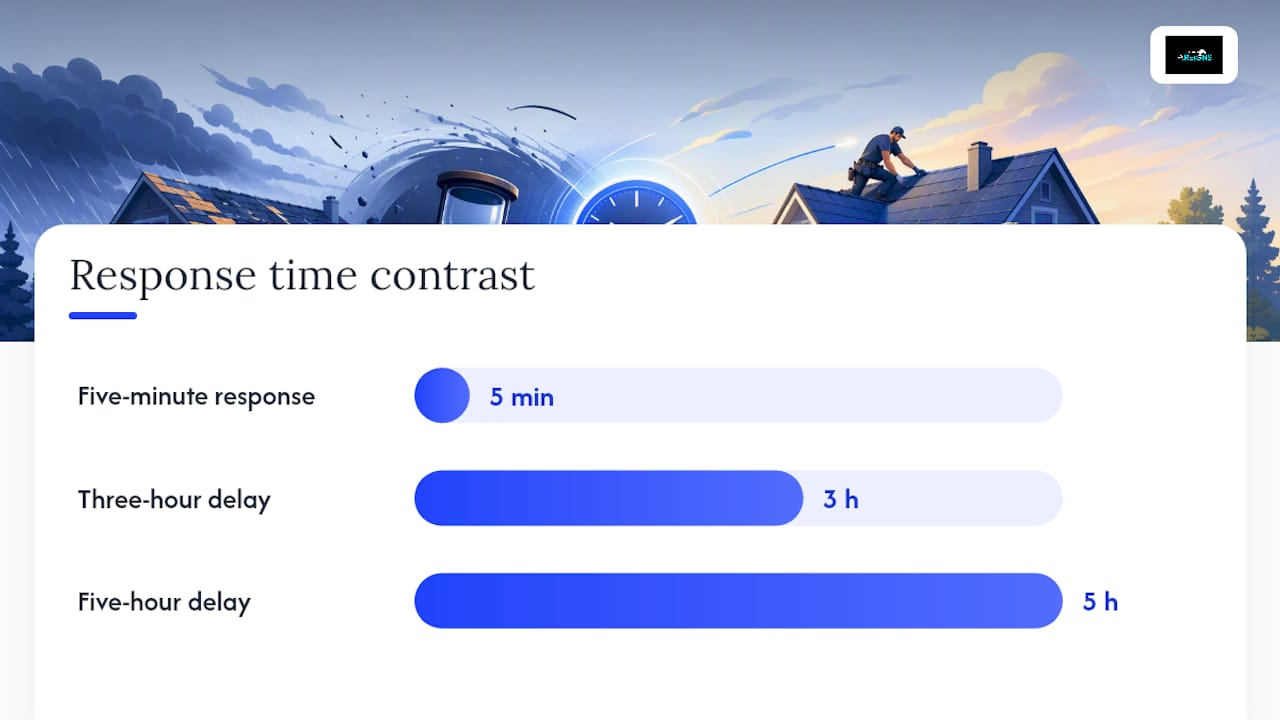
Most roofing companies don’t lose jobs on price. They lose them on timing. A homeowner fills out a form or calls after a storm, gets no response for three hours, and books an estimate with the competitor who called back first. The gap between a five-minute response and a five-hour response isn’t a small edge. It’s the difference between getting on the calendar and never getting a callback.
The second failure point is structural, not behavioral. Leads sit in a shared inbox or a sticky note pile with no owner and no status. Nobody is accountable for touch three or touch five, so the sequence quietly dies after the first call goes to voicemail.
A few patterns show up again and again in roofing shops that struggle with conversion:
- No missed-call text-back, so a ringing phone that isn’t answered just disappears.
- No service-level agreement for proposal delivery, so quotes go out whenever someone gets around to it.
- No tracking on whether a homeowner even opened the proposal, which means the follow-up call is a guess instead of a targeted next step.
- No defined cadence, so “we’ll follow up” becomes one call and then silence.
Fix the timing and the structure, and conversion rates move without spending another dollar on leads.
The 5 to 7 Touch Cadence That Converts
Top-performing roofing sales teams use a minimum of five touches spread across 30 days, mixing phone, text, and email rather than leaning on one channel. Single-channel follow-up is the quiet killer here. A homeowner who ignores three calls might still read a text. Here’s the sequence, touch by touch.
- Day 0 (before you leave the driveway): Send a short recap text. Something like: “Thanks for having me out today, [Name]. I’ll have your estimate to you by [time/date]. Text me here with any questions.” This does two things: it confirms you showed up and sets a concrete expectation for the proposal.
- Hour 1 to end of Day 0: If the inquiry came in as urgent (active leak, storm damage, missing shingles), a confirmation call takes priority over the text. Homeowners with visible damage want to hear a human voice, not just read a message.
- Day 3 to 4: Send a value-add touch, not a “just checking in” message. A short text with a photo of similar work, or an email explaining what to look for in a roofing estimate, keeps you useful instead of pushy.
- Day 7 to 9: This is the estimator call. Its job is to surface objections directly. Ask what’s holding the decision back. Offer two specific scheduling windows instead of an open-ended “let me know when works.”
- Day 14: Send a testimonial or a short case study relevant to their situation. Storm damage claims respond well to a story about another homeowner who navigated the insurance process successfully.
- Day 30: Send a final “door is open” email. No pressure, just a clear statement that you’re still available and a reminder of what’s included in the quote.
- Day 60 to 90: If there’s still no answer, move the lead into a reactivation sequence rather than deleting it. A structured reactivation touch at 60 to 90 days recovers 8 to 15 percent of quotes that would otherwise sit dead in the CRM.
Stop the sequence immediately on an explicit decline, a written “no,” or a signed contract with a competitor. Anything short of that stays in the cadence.
Pro Tip: Write your Day 0 text before you ever knock on the door. Save it as a template in your phone or CRM so it goes out in the truck, not back at the office three hours later when the moment has already cooled off.
How Fast Does Roofing Lead Follow-Up Need to Be?
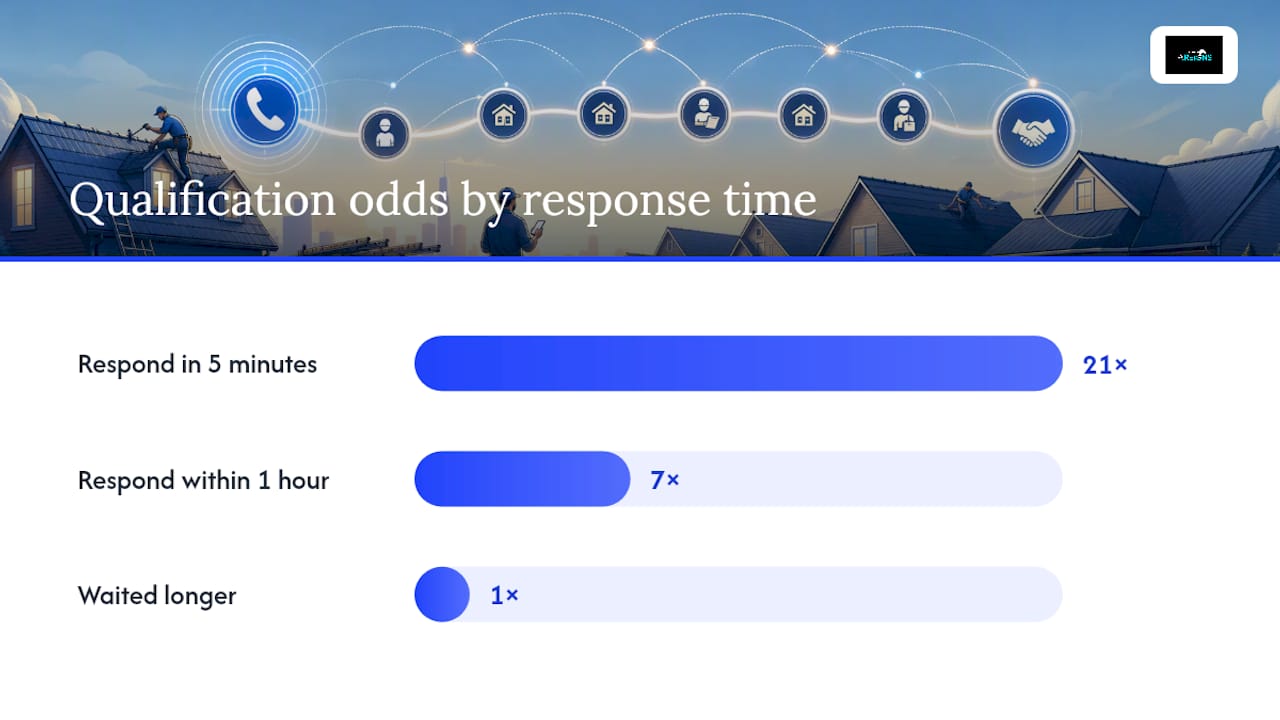
Five minutes. That’s not a rounded-up estimate, it’s a specific target backed by research. Reaching a new web lead within five minutes makes a company roughly 21 times more likely to qualify that lead compared to waiting 30 minutes, based on the widely cited MIT and InsideSales research and an HBR audit of 2,241 companies. Firms that responded within an hour were still nearly seven times more likely to qualify a lead than those who waited an hour longer than that. Speed isn’t a nice-to-have here. It’s the single biggest lever in this entire playbook.
Three automations get you most of the way there:
- Missed-call text-back, firing within about 60 seconds of an unanswered call, so a ringing phone that nobody picks up doesn’t just go silent.
- Instant form-reply, confirming receipt in under a minute whenever a homeowner submits a web form.
- Urgent-lead paging, routing anything flagged storm damage or active leak straight to a live person instead of a queue.
Your first automated message should do four things: confirm you received the inquiry, name your company clearly, indicate when a human will follow up, and ask one or two routing questions so the right person can act immediately.
After hours, the goal is triage, not resolution. An auto-acknowledgment plus an urgent page to an on-call rep covers the gap until morning without leaving a homeowner wondering if the message even went through. As Ringport’s guide on speed-to-lead SLAs puts it, the companies that win the first conversation are usually the ones that treated response time as a formal commitment, not a best effort.
Setting Up a CRM to Enforce the Cadence
A cadence only works if the system enforces it instead of relying on someone’s memory. That means building specific fields and triggers into whatever CRM your team uses.
Every lead record needs these fields at minimum: owner, status, an urgent flag, proposal_sent_at, last_contacted_at, and proposal_opened_at. That last one matters more than most contractors realize. If a homeowner opened the proposal yesterday and still hasn’t responded, your next touch should assume they’ve seen the numbers and are working through objections. If it’s still unopened, your job is to help the document land, not to ask what they thought of pricing they never saw.
Build automated triggers around these events:
missed_callfires a text-back within about 60 seconds.form_submitfires an instant confirmation reply.estimate_sentstarts the clock on the Day 3, Day 7, and Day 14 touches.proposal_openedalerts the assigned rep so they can call within the hour while it’s top of mind.urgent_flagskips the standard queue and routes directly to a live rep.
Cancel logic matters as much as trigger logic. When a lead replies, books a job, or signs a contract, every pending automated task tied to that record should cancel automatically. Nothing kills trust faster than a “just checking in” text going out to someone who signed with you last week.
On the integration side, you’ll need an SMS provider, an email sender, and document analytics that can report proposal opens back into the CRM. Bella FSM’s same-day proposal framework and pipeline visibility through color-coded stage gates make it far harder for a lead to sit untouched without someone noticing.
What Metrics Actually Prove This Is Working
Four numbers tell you almost everything: quote-to-close rate, first-touch rate (within 5 minutes and within 24 hours), median days to decision, and reactivation rate on expired quotes.
Set these as your working targets:
- First-touch within 24 hours: 95% or higher.
- Same-day proposal delivery for active estimates: 80% or higher.
- Quote-to-close improvement after deploying a full cadence: an 8 to 15 percentage point lift is a realistic range once the system runs consistently.
- A structured 7-touch cadence executed properly can push close rates from an industry average in the high teens to low 30s up toward 35 to 50 percent.
Run a straightforward before/after test: track 90 days of close rates under your old process, deploy the cadence, then compare the next 90 days using the same lead sources and rep team. If first-touch rate is high but quote-to-close still lags, that’s usually a pricing or scope problem, not a follow-up problem. If first-touch rate itself is weak, that’s a process failure you can fix this week.
Your Implementation Checklist
Work through this in order. Don’t skip ahead to optimization before the basics are running.
- Today: Turn on missed-call text-back and instant form-reply. Write your Day 0 recap text and save it as a template.
- This week: Assign lead owners by territory or rotation so nothing sits unclaimed. Build the
estimate_senttrigger and create one proposal template everyone uses. - Within 30 days: Add proposal-open tracking, set reactivation tasks to fire automatically at 60 and 90 days, and A/B test two subject lines on your Day 3 email.
Three scripts to paste in now:
Day 0 text: “Thanks for the visit today, [Name]. Estimate coming your way by [date]. Reply here with questions.”
Day 1 phone opener: “Hi [Name], this is [Rep] following up on your estimate. Did you get a chance to look at the proposal I sent?”
Day 30 close-out email: “Just checking in one last time, [Name]. Your quote is still valid and we’re happy to answer anything before you decide. No pressure either way.”
Pro Tip: Assign the missed-call text-back and estimate_sent trigger to whoever owns your CRM setup this week, not “someday.” These two automations alone cover the two biggest points of lead leakage in most roofing shops.
A Publisher’s Note on Running This System
Angel has spent years watching roofing sales teams build and rebuild follow-up processes, and the pattern is consistent: the teams that win aren’t smarter, they’re faster and more organized in the first 72 hours after contact.
A company built its model around this exact gap. It runs a proactive storm-response system that intercepts homeowner demand with verified damage before a roofer even makes first contact, then routes those qualified leads directly into a contractor’s CRM. It operates month to month with no long-term contract and guarantees qualified leads within 30 days.
For contractors who don’t have the bandwidth to build and staff a five-minute response system themselves, outsourcing that initial qualification and routing step to a system already built for it (see Areions) removes the weakest link in the entire chain: the gap between when a homeowner reaches out and when a real person responds.
What Actually Moves the Needle Here
The conventional advice on roofing follow-up spends too much time on scripts and not enough on infrastructure. A perfectly worded email sent four hours late loses to a mediocre text sent in five minutes, every time. That’s the uncomfortable part of this data: skill matters less than most sales trainers want to admit.
Where most shops go wrong isn’t attitude, it’s architecture. Nobody owns the lead, nobody tracks whether the proposal got opened, and the cadence lives in someone’s head instead of the CRM. Fix the plumbing before you fix the pitch.
If you take one thing from this article, make it speed. Everything else, the testimonials, the objection handling, the reactivation sequence, only works if the homeowner is still paying attention when it arrives. Five minutes isn’t a suggestion. It’s the whole game.
— Angel
Get a Storm-Response System Built for This Cadence Already
Areions is the alternative to building a five-minute response system from scratch: it intercepts active demand from homeowners with verified storm damage and delivers those qualified leads straight into your CRM, so the cadence above starts running the moment a lead lands instead of waiting on someone to notice a new form submission.
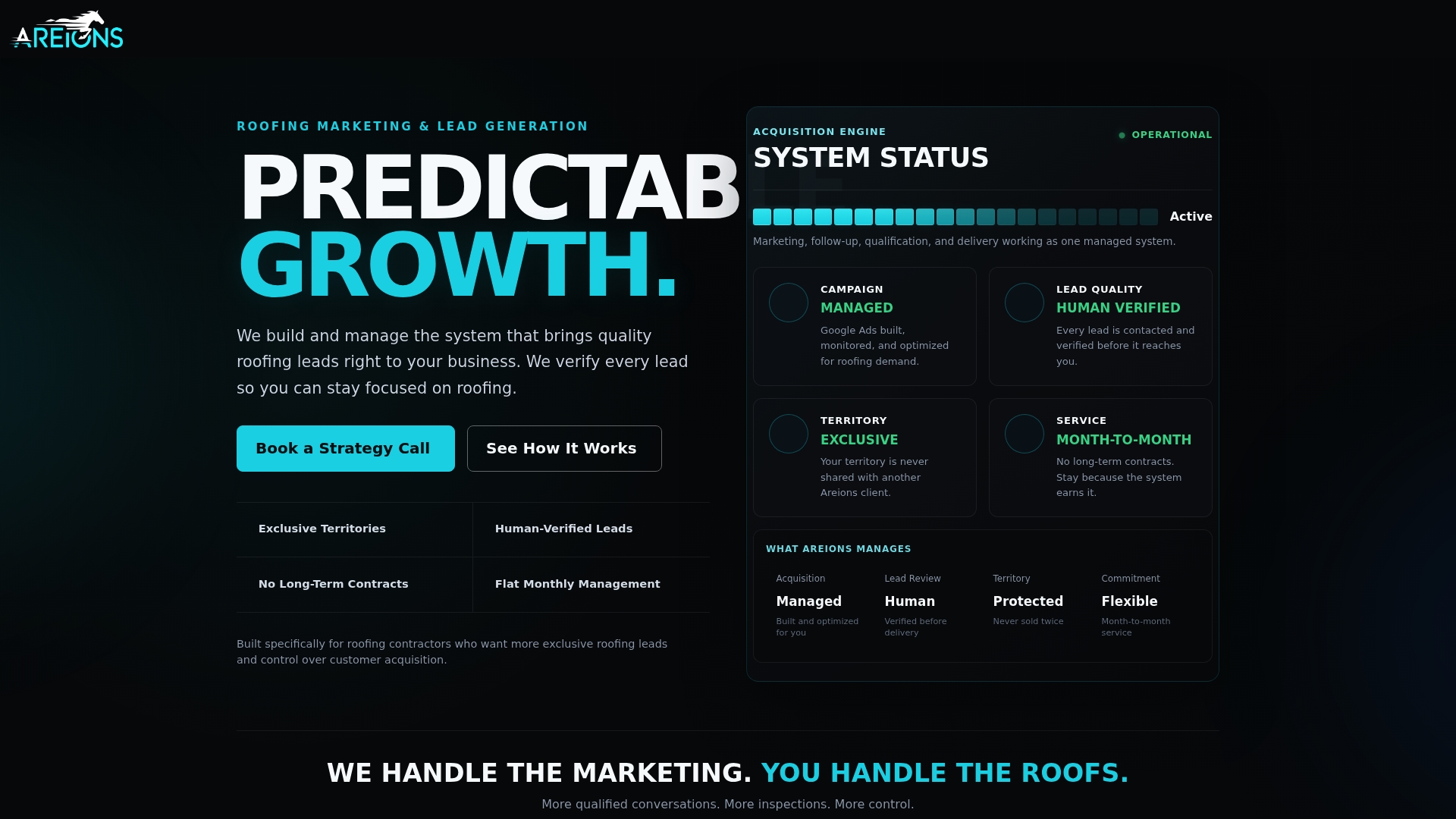
It runs month-to-month with no long-term contract and guarantees qualified leads within 30 days, which matters most to contractors who don’t have a dedicated intake team watching the phones around the clock during storm season. If your current process depends on someone remembering to check a shared inbox, this replaces that dependency with a system built specifically for roofing demand spikes. Book a strategy call to see how the routing and qualification setup would work for your territory.
Sources
- 5-Minute Roofing Lead Follow-Up: How automation boosts sales | RoofPredict Blog
- Roofing estimate follow up: Win more jobs same day | BellaFSM
- Automate roofing estimate follow-up sequences | US Tech Automations
- How to follow up with roofing leads without annoying them | Centerpoint Connect
FAQ
What is the best way to follow up with roofing leads?
Acknowledge the inquiry within five minutes, assign a named owner, and run a 5 to 7 touch cadence across phone, text, and email over 30 days rather than relying on a single call.
How many times should you follow up on a roofing lead?
A minimum of five touches over 30 days is the industry benchmark, and many sales close only after the fifth contact, so stopping after one or two attempts leaves money on the table.
How much do roofers pay per lead?
Costs vary widely by market, storm activity, and whether leads are shared or exclusive; contractors comparing options should weigh the price against how verified and qualified each lead actually is, which is where a system like Areions focuses its value.
What is the 25 percent rule for roofing?
This isn’t a standardized industry framework covered by the research behind this playbook, and definitions vary depending on who’s using the term, so treat any specific claim about it with caution rather than as an established rule.
What is speed-to-lead and why does it matter for roofing?
Speed-to-lead is how quickly a business responds to a new inquiry, and reaching a lead within five minutes makes it roughly 21 times more likely to qualify than waiting 30 minutes.