Roofers: Book Storm Damage Jobs in 30 Days With Copy and Templates
The best roofing ad copy pairs a specific, time-boxed offer with the moment homeowners are already worried about their roof: right after a storm. A free inspection headline, a storm-response carousel, or insurance-claim assistance copy consistently outperforms generic “quality roofing services” ads because it matches urgency to intent. Pick one template below, match your landing page to the exact offer, turn on call tracking, and run a two-variant test on headline and image before you spend another dollar. NOAA’s climate and storm data tells you when those windows open, Pew Research confirms where your audience actually spends time online, and a managed system like Areions exists specifically to turn that timing into qualified jobs.
TL;DR:
- Your ad campaign should focus on specific, time-sensitive offers like storm damage inspections or insurance claim assistance to attract homeowners already considering repairs.
- Running storm-response ads during active storm windows significantly lowers cost per lead, especially on social platforms, compared to steady-state campaigns.
- Testing should prioritize headlines first, followed by images and CTAs, with a minimum of 50 to 100 clicks per variation for reliable insights.
- Response time is critical; contacting homeowners within five minutes of lead submission greatly improves conversion chances, especially post-storm.
- Using a managed storm-response system helps streamline ad creation, lead routing, and qualification, ensuring faster, more qualified leads without in-house marketing overhead.
Table of Contents
- Why Focused Roofing Ad Copy Matters for Lead Quality and Cost
- Ready-to-Use Ad Copy Templates You Can Paste Into Campaigns
- How to Adapt the Copy for Each Channel
- The Headline, Offer, Proof, CTA Framework
- Testing, Tracking, and What Good Benchmarks Look Like
- Storm-Response Playbook: Preparing Copy, Routing, and Qualification
- Handling and Responding to Leads Generated From the Ads
- Compliance and Disclaimers Specific to Roofing Advertising Regulations
- Budgeting and Setting Realistic Bids for Roofing Ad Campaigns
- Author’s Quick-Start Checklist: The First 30 Days I’d Run
- How Areions Helps With Managed Storm-Response Lead Generation
- Sources
- FAQ
Why Focused Roofing Ad Copy Matters for Lead Quality and Cost
Vague roofing ads attract vague homeowners. Someone who clicks “Get a Free Roof Estimate” could be three years away from replacing a roof, just curious, or a competitor checking your pricing. Someone who clicks “Free Storm Damage Inspection, This Week Only” has already decided something is wrong with their roof. That specificity does the filtering work before your sales team ever picks up the phone.
Offer clarity changes who self-selects into your funnel. A tight offer, like “12 inspection slots left this week,” signals scarcity and screens out tire kickers who are not ready to commit to a scheduled visit.
Timing amplifies that effect. Run the same free inspection ad two weeks after a hailstorm hits your service area and it will outperform the identical ad running in a calm stretch of clear weather, because urgency is already baked into the homeowner’s mindset. That is a big part of why documented roofing campaigns show Facebook lead costs as low as $14 to $30 during active storm windows, compared to the higher costs typical of steady-state, non-storm campaigns.
Platform economics reinforce the split:
- Paid social (Meta) tends to produce cheaper leads during storm surges because it interrupts people who are not actively searching but are primed to react.
- Google Search and Local Service Ads capture homeowners already typing “roof repair near me,” which means higher intent but usually a higher cost per click.
- Direct mail and canvassing work best as a trust-building layer in neighborhoods where storm damage is visible but the homeowner has not searched yet.
Running all three in sequence, awareness on social, capture on search, reinforcement by mail, tends to lower blended cost per lead more than betting everything on one channel.
Ready-to-Use Ad Copy Templates You Can Paste Into Campaigns
These five templates cover the situations roofing marketers deal with most often: hail season, insurance-driven replacements, visual proof, and re-engaging people who almost booked.
-
Free inspection social ad. Hook: “Hail Last Week? Get a Free Roof Check Before Small Damage Becomes a Big Leak.” Body: “Storm damage isn’t always visible from the ground. Our certified inspectors check your roof, gutters, and flashing in under 30 minutes, no cost, no pressure.” Line two: “We document everything for your insurance claim, whether you use us or not.” Line three: “Only 15 inspection slots open this week in [service area].” CTA: “Book Your Free Inspection” with a booking-calendar link, not a generic contact form. The note that matters here: promise a specific number of slots, not “limited availability,” because a number reads as real scarcity and a vague phrase reads as filler.
-
Storm-response carousel. Use a swipe sequence that mirrors how homeowners actually process storm anxiety: first card shows a radar or hail-map graphic with the headline “Storm Tracked Through [County] on [Date].” Second card: “Common Damage We’re Finding: Cracked Shingles, Dented Vents, Loose Flashing.” Third card: before/after photos from a recent local job. Fourth card: the offer, “Free 15-Minute Roof Check, This Weekend Only,” with a phone number overlay. Carousel ads outperform single-image storm ads because they walk the viewer through a mini diagnosis before asking for anything.
-
Insurance-claim review ad. Hook: “Insurance Says ‘Minor Wear’? Get a Second Opinion From a Roofer, Not an Adjuster.” Body copy should include screening language that filters for actual claim activity: “If you’ve already filed a claim or are considering one, we’ll review your adjuster’s report against what we find on your roof, free of charge.” Add a trust line referencing licensing or a BBB listing, since BBB business profiles remain one of the few third-party trust markers homeowners actually recognize. CTA: “Request My Free Claim Review.”
-
Before/after slideshow. Static before/after images still convert well on Facebook and Instagram, but the caption does the heavy lifting. Overlay text on the “before” image: “Hail Damage Missed by Two Other Inspectors.” Overlay on “after”: “New Roof, Fully Approved Claim, Installed in 3 Days.” Caption below: “This homeowner in [neighborhood] almost skipped their inspection. Don’t make the same mistake.” Keep overlay text under eight words per image; anything longer gets lost on mobile screens.
-
Retargeting pull-back and countdown copy. For visitors who viewed your booking page but didn’t schedule, run a retargeting ad with urgency framed around the offer expiring, not the storm: “Your Free Inspection Offer Ends Friday at 5 PM.” Pair it with a countdown sticker if the platform supports one. Body: “You checked out our storm inspection offer, here’s your reminder before slots fill up.” This template consistently pulls back 10 to 20 percent of abandoned bookings when the deadline is real and enforced, rather than a rolling “always ending soon” claim that trained users learn to ignore.
How to Adapt the Copy for Each Channel
The same offer needs different packaging depending on where it runs. Meta, Google Search, Local Service Ads, and direct mail each impose their own format rules, and copy that ignores those rules gets penalized in delivery or simply reads wrong to the person seeing it.
- Meta (Facebook/Instagram): Primary text works best under 125 characters before the “see more” cutoff, so front-load the offer, not the setup. Video outperforms static images for storm-response ads because motion catches the scroll, but a strong before/after photo still wins for retargeting. A native lead form reduces friction and lowers CPL, but a dedicated landing page converts higher-quality leads because it filters out people unwilling to click through, a tradeoff worth testing with your own audience rather than assuming one wins outright.
- Google Search: You get up to 15 headlines and 4 descriptions in a responsive search ad, and Google mixes them automatically, so write headline variations that each stand alone: one on urgency, one on the offer, one on trust (“Licensed & Insured Roofers”). Descriptions should prioritize the offer detail and a call to action, since that’s what shows most consistently. Sitelinks should point to “Free Inspection,” “Insurance Claims,” and “Financing,” not generic “About Us” pages. A tool like the Google Ads headline generator can speed up permutation testing, but every line still needs a human check for local accuracy before it goes live.
- Local Service Ads: Your “ad copy” here is mostly your profile: reviews, response time, hours, and license verification badge. LSAs pull directly from your Google Business Profile, so the actual work is keeping review volume and star rating high, since that’s what homeowners see instead of a headline you wrote yourself.
- Direct mail and postcards: Put the headline in the top third of the card, since that’s what shows through a mail slot or on top of a stack. Include a QR code linking to your booking page alongside a phone number, never QR-only, because older homeowners still prefer calling. Add a trust marker (years in business, BBB rating, local address) near the bottom to counter the “who is this” hesitation that direct mail triggers more than digital ads do.
The Headline, Offer, Proof, CTA Framework
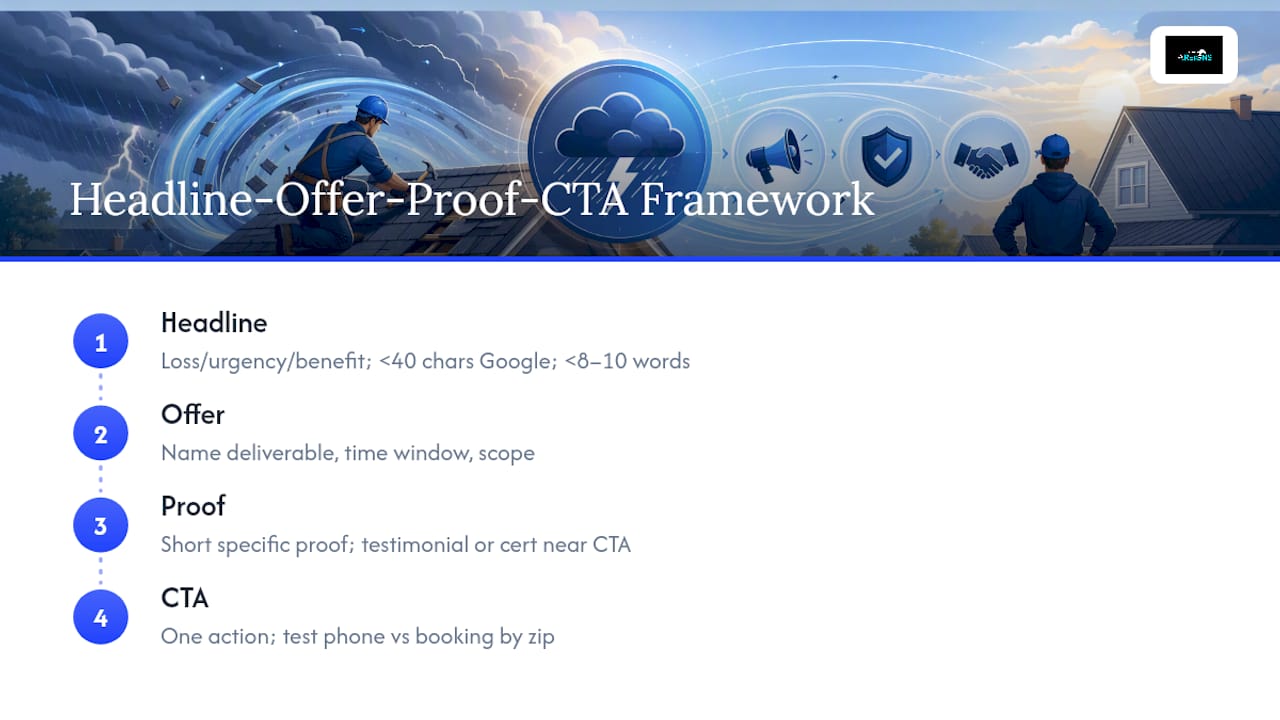
Every high-performing roofing ad follows the same skeleton: a headline that creates urgency or names a benefit, an offer specific enough to sound real, proof that reduces risk, and a single clear action.
Headlines fall into three reliable buckets. Loss-framed headlines (“Don’t Wait for a Small Leak to Become a Ceiling Collapse”) tend to outperform benefit-framed ones for storm campaigns, because loss aversion is stronger than gain-seeking when someone suspects damage. Urgency headlines (“Storm Damage Inspections, This Week Only”) work for social and search alike. Benefit headlines (“Get a Roof That Lasts 30 Years”) work better for non-storm, replacement-focused campaigns aimed at homeowners planning ahead rather than reacting. Keep headlines under 40 characters for Google (to avoid truncation) and under 8 to 10 words for social.
Offer clarity separates ads that convert from ads that get scrolled past. A believable offer names three things: the exact deliverable (“15-minute roof and gutter inspection”), the time window (“this week” or “by Friday”), and the scope (“no obligation, no cost”). “Free consultation” says nothing. “Free 15-minute inspection with a written damage report” says everything a skeptical homeowner needs to hear.
Social proof should be short and specific, not generic. A one-line testimonial overlay (“They found damage two other companies missed. Claim approved in 9 days.”) does more work than a five-star badge alone. If you mention certifications (GAF, CertainTeed, licensing numbers), keep it to a single line near the CTA, not woven into the headline where it dilutes urgency.
CTAs should ask for one action only. “Call or Book Online” is two actions disguised as one, and it measurably lowers response rates. Pick a single primary action per ad: phone-first for older, storm-anxious homeowners; QR or booking link for younger homeowners who found you on social.
Pro Tip: Test phone-first CTAs against booking-link CTAs by zip code age demographics before assuming one wins everywhere. Storm zones with older housing stock often convert better on “Call Now” alone.
Testing, Tracking, and What Good Benchmarks Look Like
A reasonable testing window is 30 to 90 days, long enough to catch at least one storm cycle if you’re in a hail-prone region, short enough to course-correct before wasting a full quarter’s budget.
- Test the headline first, then the image, then the CTA, in that order, because headline changes typically move CPL the most. Run each variant until you have at least 50 to 100 clicks per version before drawing conclusions; smaller samples produce noise, not insight.
- Track everything through UTM parameters, call tracking numbers, and CRM ingestion. A tool like LeadsBridge can automate lead routing from ad platforms straight into your CRM, which matters because manual data entry is where qualified leads quietly disappear. For QR codes on postcards, a consistent
utm_medium=qrtagging workflow keeps mail attribution from getting muddled in your analytics. - Compare CPL against channel-specific benchmarks, not one blended number. Industry writeups document storm-triggered Facebook leads landing as low as $14 to $30 per lead, while search and LSA leads, carrying higher intent, typically cost more per click but convert to booked jobs at a higher rate. Convert CPL into cost-per-booked-job, not just cost-per-lead, since that’s the number that actually tells you whether a channel is profitable.
A useful benchmark to anchor expectations: PipelineOn’s 2026 analysis recommends putting roughly 40 to 50 percent of paid budget into PPC and Local Service Ads, 15 to 20 percent into SEO and Google Business Profile work, and 30 to 40 percent into exclusive lead sources and canvassing, a mix built around measurable, scalable channels rather than a scattershot approach across everything at once.
Once you have three to four weeks of data, decide what you’re optimizing for next. If CPL is low but close rates are weak, the problem is usually lead quality, not the ad. If CPL is high but close rates are strong, you likely have room to raise budget before the channel saturates.
Storm-Response Playbook: Preparing Copy, Routing, and Qualification
Ad copy written for storm response needs different cues than evergreen roofing ads. Phrases like “inspection windows open through Sunday” or “we’ll document damage for your insurance claim whether you hire us or not” build urgency without sounding exploitative, which matters because homeowners are already wary of storm-chasing contractors.
Promise a specific response time and keep it. “We respond to every inspection request within 2 hours” only works as ad copy if your intake process can actually hit that number, since a broken promise here costs more in reputation than any single lead is worth.
- Pair every storm-response ad with a landing page that repeats the exact offer language, not a generic “contact us” page.
- Route every lead to human verification immediately, tagging CRM entries with storm date and zip code so you can measure CPL by event, not just by month.
- Use month-to-month phrasing honestly in any ad or landing page that mentions contract terms: “no long-term contract required” reads as a trust signal when it’s true, and it’s the kind of line a system like Areions is built around, since exclusivity and flexible terms are part of how it structures lead delivery.
Pro Tip: Never promise “guaranteed leads” in ad copy itself. Guarantee response time and inspection quality instead. It’s a claim you can actually keep, and it holds up better under scrutiny than a vague promise of volume.
Handling and Responding to Leads Generated From the Ads
Speed matters more than almost anything else once a lead comes in. A homeowner who filled out a “free inspection” form right after a storm is often comparing three or four roofers within the same hour, and the first company to call back usually wins the appointment slot, regardless of who had the better ad.
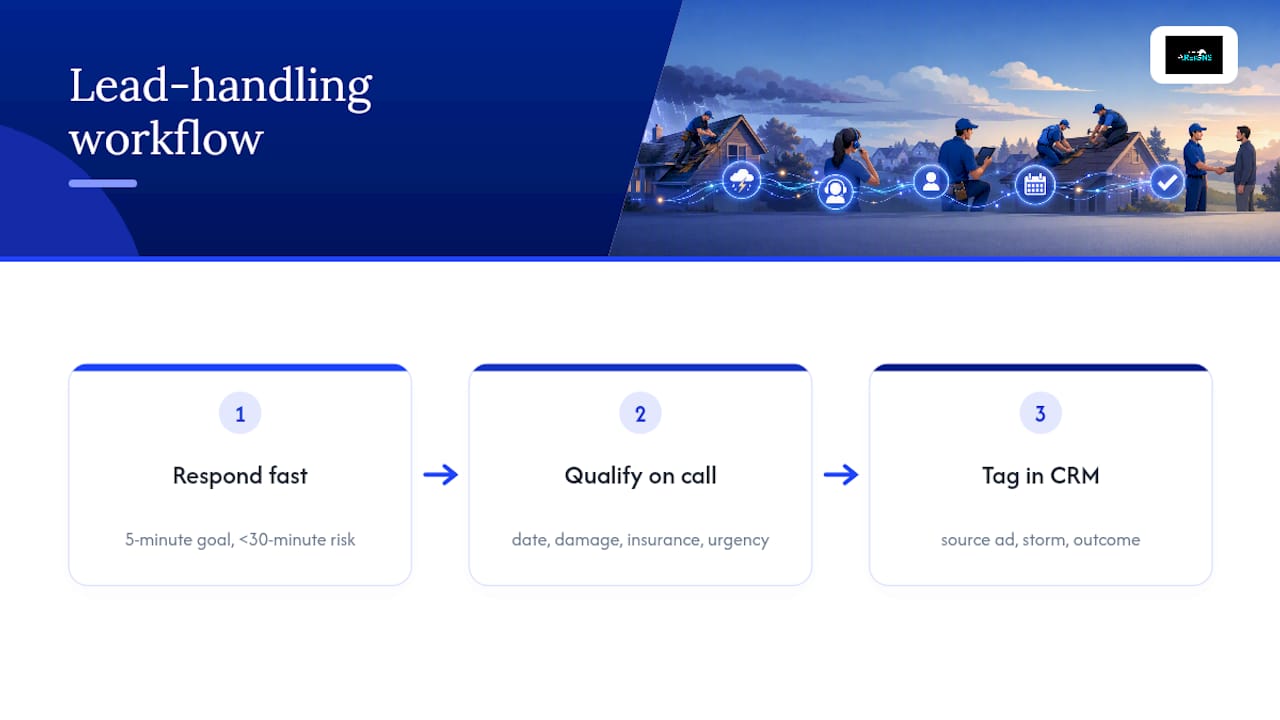
Set a response-time standard and staff for it. Five minutes is the realistic gold standard for phone follow-up on storm leads; anything past 30 minutes and conversion rates drop noticeably because the homeowner has likely already booked with someone else.
Qualification should happen on that first call, not days later. Ask about the storm date, visible damage, insurance status, and urgency before scheduling, so your crew shows up prepared instead of doing discovery work on-site. Tag every lead in your CRM by source ad, storm event, and qualification outcome, since that data is what tells you which template and which channel to scale next month.
Not every lead deserves the same follow-up cadence. A qualified storm lead who books an inspection needs same-day or next-day contact. A cold click from a generic “roof repair” search ad can sit in a nurture sequence for a week without losing much value, because the intent was lower to begin with.
Compliance and Disclaimers Specific to Roofing Advertising Regulations
Roofing ads that mention insurance claims need careful wording. Many states restrict or outright prohibit contractors from offering to waive, rebate, or absorb a homeowner’s insurance deductible as part of a promotion, since that practice has been classified as insurance fraud in a growing number of jurisdictions. Ad copy like “we’ll cover your deductible” is a legal risk in states with these laws on the books; language should stick to “we help document your claim” or “free claim review,” not anything implying a deductible waiver.
Any claim about pricing, financing, or “free” offers should match what a landing page actually delivers. If “free inspection” comes with strings attached (a required consultation, a minimum project size), that condition needs to appear somewhere in the ad flow, not buried only in fine print after a click.
Licensing and insurance claims in ad copy (“Licensed & Insured”) should be accurate and current, since state licensing boards and the Federal Trade Commission’s rules against deceptive advertising apply to small local contractors the same way they apply to national brands. If your business claims manufacturer certifications (GAF Master Elite, CertainTeed SELECT ShingleMaster), keep that language current and verifiable, since a homeowner or a competitor checking it against a manufacturer directory is common enough to matter.
When in doubt on specific claim language, a state contractor licensing board or a local attorney familiar with home-improvement advertising rules is the right resource, not a generic online template.
Budgeting and Setting Realistic Bids for Roofing Ad Campaigns
Start with a monthly budget built around your target number of booked jobs, not around what feels affordable. If your average job value is $10,000 and you close 1 in 4 qualified leads, working backward from a target of 10 new jobs a month means budgeting for roughly 40 qualified leads, not 40 raw clicks.
Storm windows justify a temporary budget spike. It’s reasonable to double or triple normal daily spend for the first one to two weeks after a major hail event in your service area, since that’s when demand and urgency peak together, and a system like Areions is designed specifically to help roofing companies prepare that spend in advance rather than scrambling once a storm hits.
Bid strategy should shift with campaign maturity. Early testing phases benefit from manual or capped bidding so you can control spend while data is thin. Once a campaign has enough conversion history, roughly 30 to 50 conversions on most platforms, automated bidding strategies that optimize toward cost-per-lead or cost-per-booked-job typically outperform manual bids, because the algorithm has enough signal to work with.
Set a floor for pausing underperforming ads, not just a ceiling for scaling winners. If an ad hasn’t produced a qualified lead within 20 to 30 clicks at a reasonable cost, cut it rather than hoping the next click fixes the average.
Author’s Quick-Start Checklist: The First 30 Days I’d Run
Launch the free inspection social ad first, since it’s the lowest-friction offer to test, and run it against a plain “Get a Free Roof Estimate” control to see how much specificity actually moves your numbers. Turn on call tracking and CRM tagging within the first 72 hours, not after, so early data isn’t lost to guesswork.
Watch cost per lead and lead quality together for the first two weeks. If CPL is reasonable but quality is weak, tighten the offer language before you touch the budget. If both look strong, scale the winning variant and hold the loser as your next control.
— Angel
How Areions Helps With Managed Storm-Response Lead Generation
Everything above works better with disciplined execution, and that’s exactly where a lot of roofing companies run out of bandwidth. Writing the ad, building the matching landing page, setting up call tracking, qualifying every lead by phone, and routing it into a CRM within minutes of a storm hitting is a full-time job on top of running crews and closing sales.
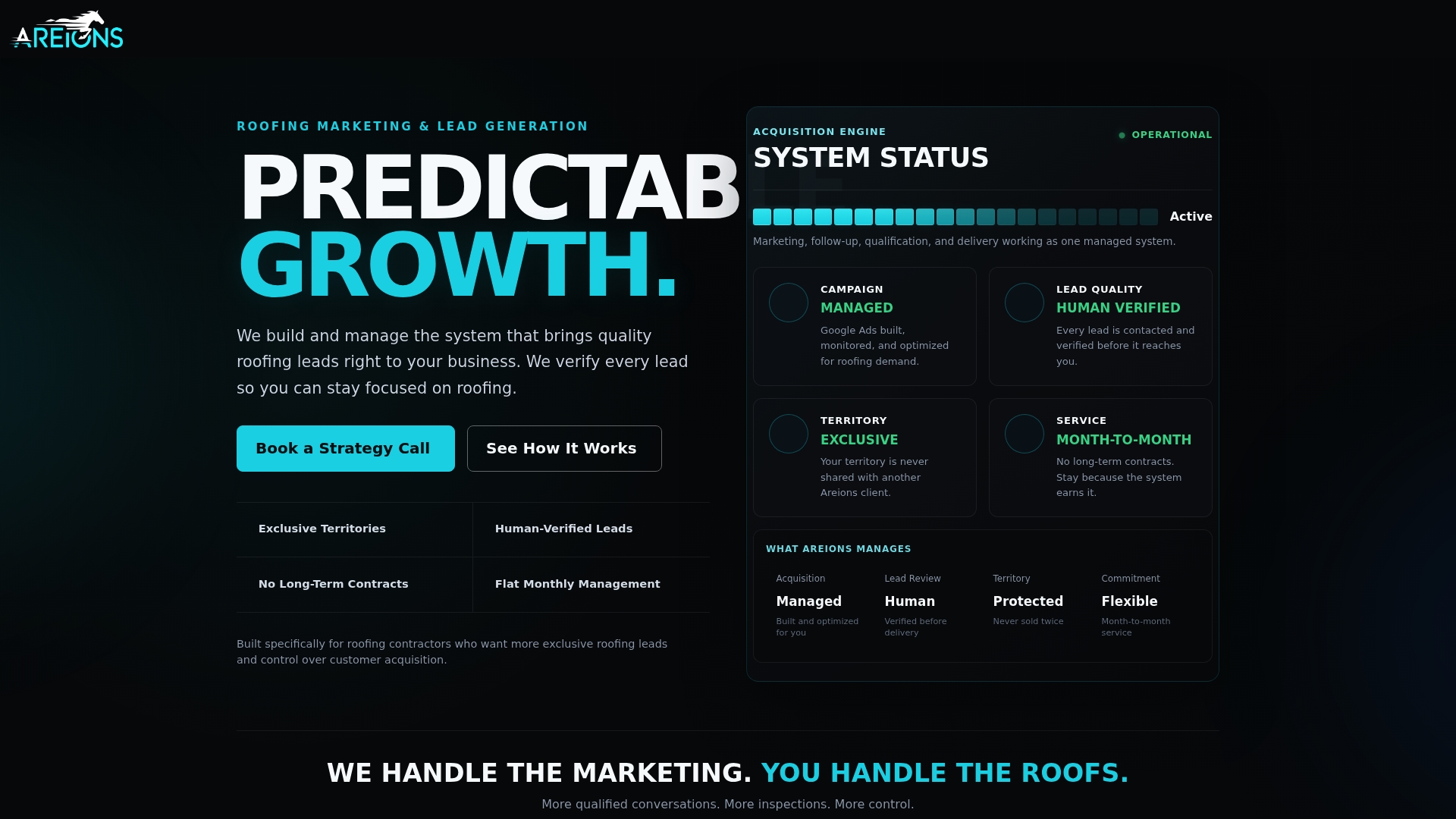
Areions is built around that exact gap: a proactive storm-response system that gets your ads, landing pages, and CRM routing ready before a storm hits, so you’re not scrambling to write copy while your competitors are already calling homeowners. Leads come human-verified for actual storm damage, tagged and delivered straight into your CRM, with territory exclusivity so you’re not bidding against three other roofers for the same homeowner. It runs month-to-month with no long-term contract, and guarantees qualified leads within 30 days of setup.
This fits best for roofing owners who want the storm-response playbook covered above running in the background, without hiring an in-house marketer or signing a year-long agency contract. If that’s where you are, book a strategy call to walk through your service area, current storm history, and what a 30-day launch would look like for your business.
Sources
FAQ
What Are the Best Roofing Ads to Run?
Free inspection offers, storm-triggered urgency ads, and insurance-claim assistance ads consistently perform best, especially on Facebook during active storm windows and on Google Search or Local Service Ads for homeowners already searching for repairs.
What Is the definition of a common roofing threshold that varies by region and building code, often used to determine when a partial roof repair requires a full roof replacement under local code? Check your specific state or municipal building code rather than relying on a general figure, since it is not a universal standard.
Definitions of this rule vary by region and building code, and it generally refers to a threshold used in some jurisdictions for determining when a partial roof repair requires a full roof replacement under local code. Check your specific state or municipal building code rather than relying on a general figure, since it’s not a universal standard.
Is The cost for a roof depends heavily on roof size, materials, and region. A large or complex roof with premium materials can be costly, while many standard asphalt shingle replacements on average homes typically cost less. Get two or three local quotes with itemized scope before judging any single number as too high.
It depends heavily on roof size, materials, and region, since a large or complex roof with premium materials can reasonably cost well into that range, while a standard asphalt shingle replacement on an average home typically costs less. Get two or three local quotes with itemized scope before judging any single number as too high.
What Is the Best Way to Advertise for Roofing?
The strongest approach combines a specific, time-boxed offer (free inspection, storm-response urgency) with a matching landing page and fast human follow-up, run through a mix of Google Search, Local Service Ads, and Meta for storm windows. A managed system like Areions handles that full loop, from ad copy through CRM-ready lead delivery, for roofing companies that want it running without building it in-house.