A Roof Replacement Leads Strategy That Fills Your Pipeline
Prioritize Google Local Services Ads, a targeted Google Ads storm campaign, Google Business Profile and local SEO, a structured referral system, and a prebuilt storm-response activation plan. That’s the channel mix. Now fix the one thing that wrecks conversion on all five: speed-to-lead. Leads contacted within 5 minutes convert at far higher rates than leads called even 30 minutes later, and automated SMS sent within 60 seconds compounds that effect.
Most roofing companies don’t have a lead problem. They have a response problem disguised as a lead problem.
Here’s the starting sequence:
- Launch Local Services Ads with review gating and fast verification
- Build one storm-intent Google Ads campaign with a dedicated landing page
- Claim and optimize Google Business Profile, then request reviews weekly
- Set up a referral ask at every job completion, with a real incentive
- Pre-stage a storm-response plan before the next hail event, not after
If you manage a book of business across Texas, Oklahoma, or the Midwest hail corridor, a managed system like Areions can handle the storm-activation piece specifically, intercepting homeowners with verified damage before your competitors’ phones even ring.
Key Takeaways
A roof replacement leads strategy succeeds when a diversified channel mix meets fast, disciplined follow-up, with storm-response readiness capturing the highest-value window before competitors react.
| Point | Details |
|---|---|
| Fix speed-to-lead first | Respond within 5 minutes and trigger automated SMS within 60 seconds before increasing ad spend. |
| Run 4 to 5 channels together | Combine LSA, Google Ads, GBP/local SEO, and referrals so no single channel carries the pipeline. |
| Cap aggregator spend | Keep shared marketplace leads under 10% of total pipeline given their lower close rates. |
| Stage storm assets in advance | Build zip landing pages, ad creative, and canvassing plans before hail season, not after. |
| Consider a managed storm system | Areions delivers verified storm-damage leads with territory exclusivity and a 30-day qualified-lead guarantee. |
Table of Contents
- Building a Roof Replacement Leads Strategy Around Channel Roles
- How Do You Set Up Paid Roofing Ads That Actually Convert?
- Turning Google Business Profile Into a Lead-Generating Asset
- What’s the Best Way to Build a Roofing Referral Program?
- How Fast Should You Respond to a New Roofing Lead?
- Why the 72-Hour Storm Window Decides Who Wins the Job
- Why Most Roofing Marketing Advice Gets the Order Wrong
- Let Areions Handle Your Storm-Response System
- Sources
Building a Roof Replacement Leads Strategy Around Channel Roles
Not every channel does the same job, and treating them as interchangeable is why most roofing marketing budgets get wasted. Some channels compound. Some channels convert immediately. You need both running at the same time.
Google Business Profile and local SEO are compounding channels. They cost effort up front and pay you back for years, but local SEO and GBP typically take 6 to 12 months to produce a steady stream of booked jobs. Local Services Ads, Google Ads, and Meta are immediate channels. You turn them on this week and calls start this week, but you pay for every one of them, every month, indefinitely.
Then there’s the gap-filler category: lead aggregators and marketplaces. They can plug a slow week, but shared leads sold to multiple contractors close at only 5 to 15%, against 15 to 40% for validated LSA leads. Cap aggregator spend to a small fraction of your pipeline. Anything more and you’re subsidizing a race to the bottom with three other roofers bidding on the same homeowner.
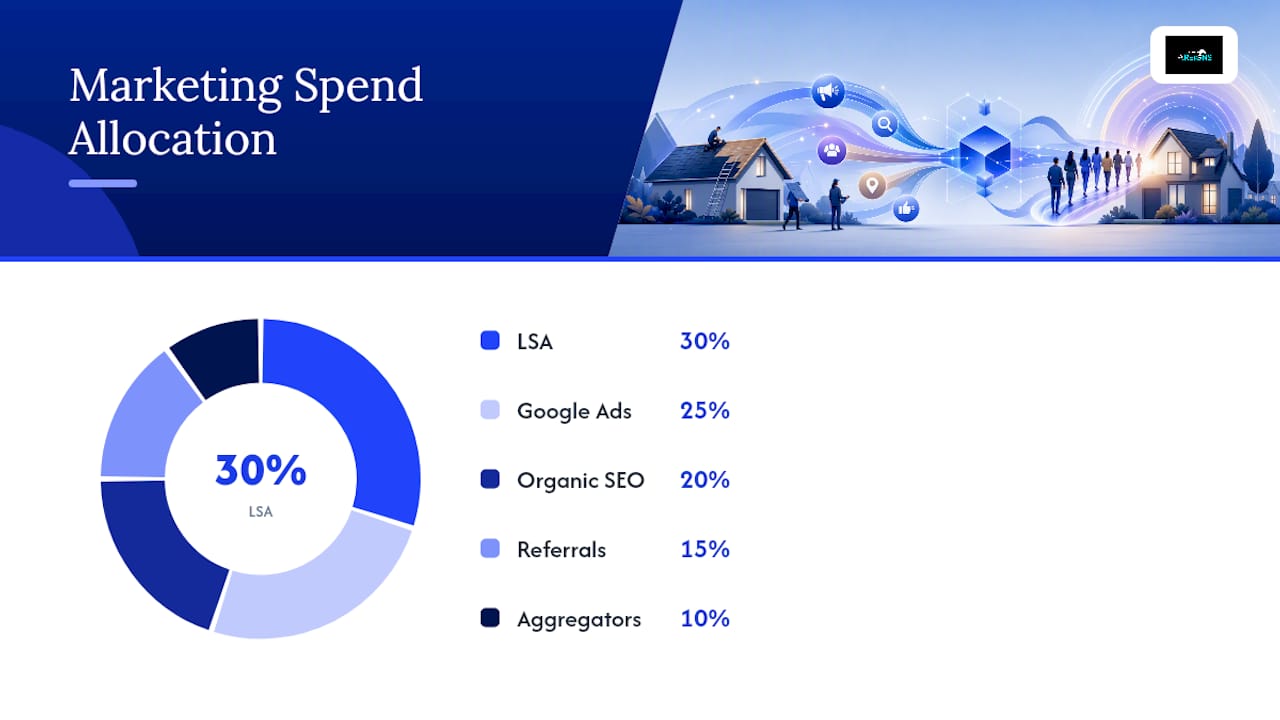
A sensible starting allocation for a company doing $2 to $5 million in annual revenue looks like this:
- 30% to Local Services Ads (immediate, high-intent, exclusive)
- 25% to Google Ads and storm campaigns (immediate, scalable during events)
- 20% to organic (GBP optimization, review generation, city pages)
- 15% to referral program administration and incentives
- 10% or less to aggregators, reserved for slow weeks
Shift that mix seasonally. Roofers running 4 to 5 channels in parallel outperform single-channel operators because each channel captures a different buying moment. The homeowner searching “roof replacement cost near me” is not in the same headspace as the one Googling “hail damage roof insurance claim” three days after a storm. One channel can’t serve both.
How Do You Set Up Paid Roofing Ads That Actually Convert?
Local Services Ads should be your first paid dollar, not your last. Google verifies your license and insurance, gates entry behind background checks, and requires a review threshold before you show up prominently, which filters out a lot of fly-by-night competition automatically. Expect CPL in the $45 to $150 range, with most markets clustering closer to $60 to $130. The payoff: these are pay-per-lead, not pay-per-click, and you only pay for calls that meet your service criteria.
Google Search Ads work differently and need more scaffolding. Bid on insurance and storm-intent keywords (“hail damage roof inspection,” “storm damage roof repair near me”) and send that traffic to a dedicated storm landing page, never your homepage. Every ad should include click-to-call, and every call needs call tracking so you know which keyword actually generated the booked job, not just the click. Non-branded roofing keywords on Google Ads average around $124 per lead, which puts them above LSA on cost but useful for volume during storm surges when LSA capacity caps out.
Meta ads earn their budget on creative, not targeting. Before-and-after photos and drone footage of full roof replacements outperform stock imagery by a wide margin, and a small daily budget with a retargeting sequence aimed at website visitors who didn’t convert usually beats a larger cold-audience budget. Install the Meta Pixel and Conversions API so you can actually measure which ad drove a form fill versus which one just got a like.
Pro Tip: Track cost per booked job, not just cost per lead. A $150 LSA lead that closes is cheaper than a $40 aggregator lead that doesn’t.
| Channel | Typical CPL | Close rate range | Best use |
|---|---|---|---|
| Local Services Ads | $45–$150 | 15%–40% | Exclusive, verified calls |
| Google Search Ads | ~$124 average | Varies by landing page | Storm-intent volume |
| Meta Ads | Varies by creative | Lower without retargeting | Awareness and retargeting |
| Aggregator leads | $20–$100 | 5%–15% | Gap-filler only, capped |
Turning Google Business Profile Into a Lead-Generating Asset
Your Google Business Profile is doing more selling than most people realize, and most roofing companies leave it half-finished. Set your primary category to “Roofing Contractor,” add every secondary category that applies (storm damage repair, gutter installation), and upload real jobsite photos weekly, not stock images.
Reviews are the engine here. Build a workflow that texts every completed customer a review link within 24 hours of final walkthrough, and respond to every single review, good or bad, within a day. Answer the recurring questions homeowners ask in your GBP Q&A section proactively, before someone else answers them incorrectly.
On the website side, three page types earn their keep:
- A roof replacement cost page that gives real ranges by material type
- An insurance claim guide walking homeowners through the adjuster process
- City-specific service pages for every town in your service area
Add an instant estimator to your site. Homeowners who get a rough number in 60 seconds are far more likely to fill out a full contact form than ones staring at a “request a quote” button with no context, and companies using photo-based instant estimating tools report faster time-to-quote and higher capture rates. Pair that with concise, direct FAQ answers on every service page, the kind that AI search tools can lift cleanly, since more homeowners now start their research in an AI chat interface before they ever open Google.
Set realistic expectations internally: local SEO takes 6 to 12 months to produce a steady flow of booked jobs. That’s not a reason to skip it. It’s a reason to start now instead of six months from now.
What’s the Best Way to Build a Roofing Referral Program?
Referrals close better than almost any other channel you’ll run, and they cost the least to maintain. Referral leads close at 30% to 60%, a number that makes most paid channels look expensive by comparison.
The ask has to be systematic, not accidental. Build the request into your job completion workflow. Send it within 48 hours of final walkthrough, while the new roof is still visible and the homeowner is still happy, and automate the text or email so it never depends on a crew member remembering.
Three partner types generate outsized referral volume once you approach them correctly:
- Real estate agents need reliable pre-listing inspection reports and fast turnaround on repairs before closing. Offer a rush-service tier specifically for their listings.
- Insurance adjusters respond to contractors who show up prepared, with documentation and photos that match their claim format, not contractors who make their job harder.
- Property managers juggle multiple roofs across a portfolio. A single reliable point of contact who handles bulk scheduling wins that relationship over any single-job bidder.
Track every referral source as its own attribution tag in your CRM. Without that, you’ll never know which relationship is actually producing, and you’ll keep spending time on partners who talk a good game but never send work.
Pro Tip: Offer a specific incentive, not a vague “thank you.” A $100 to $250 credit or gift card for every closed referral gives partners a concrete reason to keep sending names.
How Fast Should You Respond to a New Roofing Lead?
The single fastest way to raise your close rate without spending another marketing dollar is fixing your response time. Follow this sequence, in order:
- Trigger an automated SMS within 60 seconds of any form fill, call, or chat inquiry, confirming receipt and setting expectations for a callback.
- Route the call to a live person within 5 minutes. Leads contacted that fast convert at multiples of the rate you get from leads called 30 minutes or more later.
- Deliver a same-day itemized quote using photo-based estimating, so the homeowner has real numbers in hand before a competitor even calls back.
Set a hard internal SLA: every inbound lead gets a human response inside 5 minutes during business hours, no exceptions, with an after-hours automated text bridging the gap until morning.
Then measure three numbers weekly: average response time, inspection-to-contract percentage, and cost per booked job broken out by channel. Speed-to-lead automation often improves your close rate more than moderately increased ad spending, and costs much less to implement.
Why the 72-Hour Storm Window Decides Who Wins the Job
Search volume for storm damage terms spikes sharply within 48 hours of a major hail event, and the contractors who reach homeowners first capture the majority of those bookings in the critical time window before slower competitors even finish drafting an ad. That window closes fast, and by the time most roofing companies react to a storm, the best leads are already signed with someone else.
The assets that win this window have to exist before the storm, not after. Zip-targeted landing pages, pre-approved ad creative, an on-call canvassing plan staged to the hit zone, and an adjuster-ready inspection process all need to be live and ready to flip on within hours, not built from scratch once the hail stops.
A practical activation checklist:
- Pre-built storm landing pages for every zip code in your service territory
- Ad creative approved and ready to launch the moment a storm hits
- Canvassing crews staged and briefed on target neighborhoods
- SMS templates ready for immediate homeowner outreach
- Inspection documentation formatted for fast adjuster approval
This is the exact gap Areions is built to close. Its system pushes verified, storm-damage leads directly into your CRM with territory exclusivity, so you’re not competing against three other contractors for the same homeowner, and it runs month-to-month with no long-term contract locking you in if it underperforms.
Why Most Roofing Marketing Advice Gets the Order Wrong
The conventional advice tells roofers to pick a channel and pour money into it until it works. That’s backward. The math only works if you fix operations first, because a faster response time multiplies the return on every dollar you already spend, while a bigger ad budget on top of a slow response process just buys more missed calls.
Most owners also underweight referrals because the volume looks small next to paid channels. But a referral lead closing at 30 to 60% against an aggregator lead closing at 10% means ten referrals can outproduce fifty aggregator leads in actual signed contracts. Volume without close rate is a vanity metric.
The storm window is where this compounds hardest. Companies that treat storm response as reactive, scrambling to build a landing page after the hail falls, are competing for leftovers. The ones with assets staged in advance aren’t smarter. They just showed up first, and in a 72-hour window, first is nearly everything.
Prioritize speed and preparation over spend. The budget matters less than most owners think.
— Angel
Let Areions Handle Your Storm-Response System
If building zip-targeted landing pages, staging canvassing crews, and monitoring hail radar sounds like a full-time job on top of running your crews, that’s because it is. Areions exists specifically to carry that weight for roofing companies that want the post-storm window without hiring a marketing department to chase it.
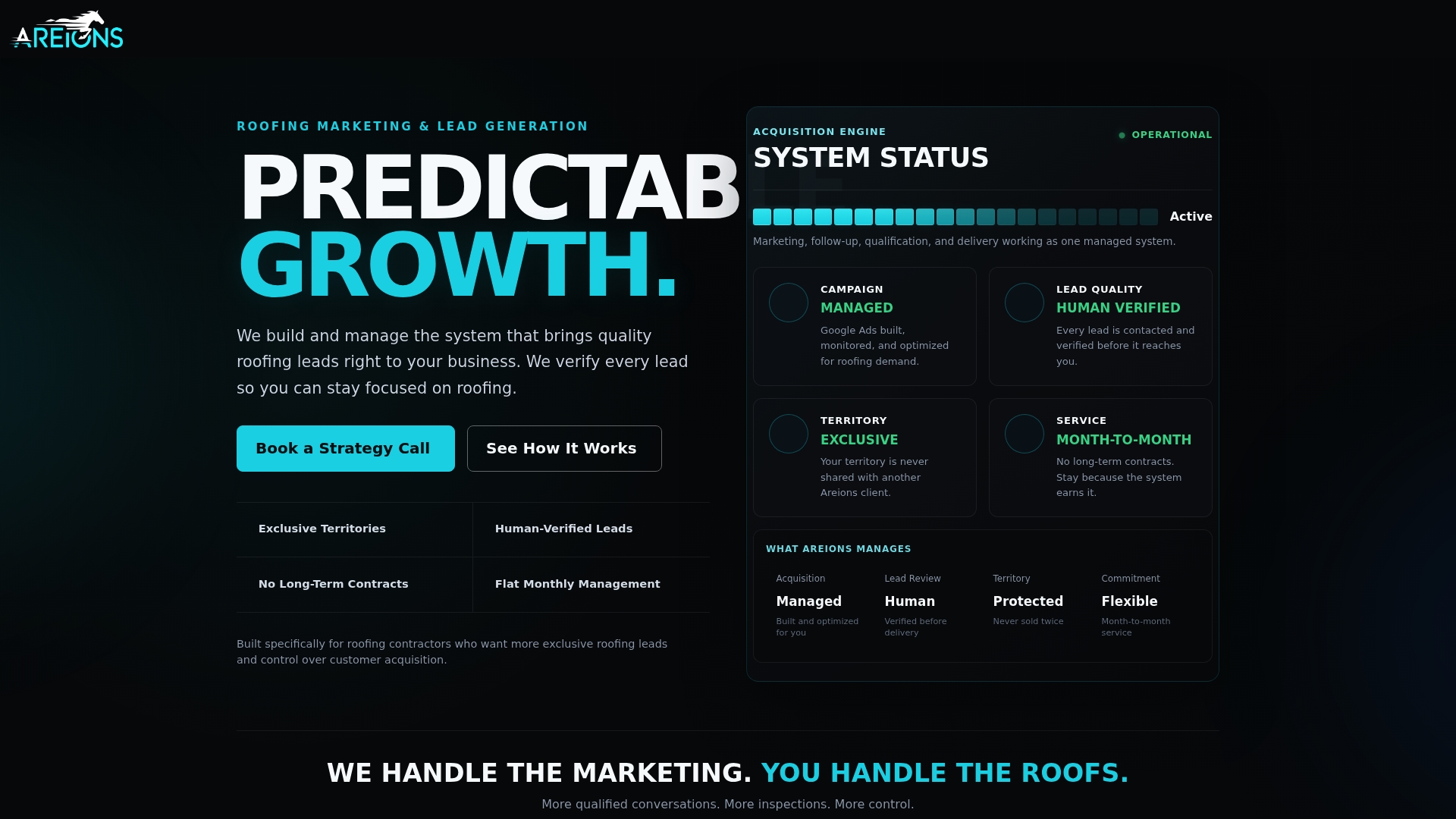
Areions manages the entire storm-activation pipeline: Google Ads campaigns built and optimized for you, storm landing pages ready before the weather hits, CRM and pipeline setup, automated lead routing with call tracking, and human-verified qualification so the leads landing in your inbox are homeowners with actual, confirmed storm damage. You also get territory exclusivity, meaning Areions isn’t selling the same lead to the roofer down the street.
The service runs month-to-month, with no long-term contract, and comes with a guarantee of qualified leads within 30 days. That structure lets you evaluate real performance against your own CPBJ math before committing further. If your team can execute fast on inspections and quotes, start with Areions and let the storm-response system feed leads your crews are ready to close.
Sources
- Roofing leads guide — PipelineOn
- How to Get More Roofing Leads in 2026 (12-Channel Playbook) — Elev8 Operations
- Complete Roofing Marketing Guide: 15 Lead Gen Strategies — Onwardcraft
- How to Generate Roofing Leads — Roofr