
Multi-Location Roofing Marketing: The Scalable System
The fastest path to predictable lead flow across multiple markets is a centralized system built on three pillars: standardized local presence (a fully built Google Business Profile and unique service pages for every city), a two-track paid media strategy that separates storm-response campaigns from planned-replacement campaigns, and centralized operations that route, verify, and report on every lead the same way regardless of which office it lands in. Roofers who try to run five, ten, or thirty branches on the same scattershot tactics that worked for one location almost always hit a wall: duplicate content across city pages, inconsistent review counts by office, and a call center that can’t tell which lead came from which storm.
Here’s the prioritized checklist to act on in the next 30 to 90 days:
- Claim and fully optimize Google Business Profile for every location, using “Roofing Contractor” as the primary category and loading each with local photos, weekly posts, and service line items.
- Turn on Local Services Ads (LSAs) for each market to capture homeowners ready to call right now, particularly in storm-affected zip codes.
- Set up call tracking and CRM routing so every lead, regardless of source, lands in a system that logs response time and territory.
- Build unique city pages for your top 10 to 15 markets first, each with local project photos, weather context, and real customer reviews from that specific office.
- Assign an internal owner (usually the marketing manager or a designated ops lead) to run a 30-day audit of current GBP status, page duplication, and lead response speed before spending another dollar on ads.
The immediate next step is a straightforward audit: pull every location’s GBP profile, site page, and average response time into one spreadsheet, and see how many gaps exist before you commit to a bigger rollout or a marketing partner.
Key Takeaways
A centralized system combining standardized local presence, two-track storm-response and planned-replacement paid media, and unified CRM operations is what lets multi-location roofers scale lead flow predictably instead of market by market.
| Point | Details |
|---|---|
| Standardize local presence | Claim and optimize Google Business Profile and build unique service pages for every location. |
| Run two paid tracks | Separate storm-response (LSAs plus rapid search) from planned-replacement campaigns with distinct messaging. |
| Centralize operations | Use one CRM with SLA-based routing and call tracking so no lead gets lost between branches. |
| Track cost-per-booked-job | Report this monthly by location, since it reflects marketing ROI more accurately than lead count alone. |
| Consider a managed system | Areions offers month-to-month, human-verified storm-response lead generation with a 30-day qualified-lead guarantee. |
Table of Contents
- Why Marketing Multiple Roofing Locations Is a Different Problem
- Core Assets Every Multi-Location Roofing Marketing System Must Standardize
- Site Architecture and SEO Patterns That Scale Across Dozens of Markets
- How to Structure Paid Campaigns for Storm Response vs Planned Replacement
- How Reputation Management and Review Generation Work at Scale
- How CRM, Routing, and Lead Qualification Prevent Leaks Across Territories
- What KPIs and Reporting Should Look Like Across Multiple Locations
- How to Vet and Choose a Multi-Location Roofing Marketing Partner
- What a Realistic Rollout Timeline and Budget Actually Look Like
- What Actually Moves the Needle When You Scale Roofing Marketing
- How Areions Builds a Storm-Response System for Multi-Location Roofers
- Useful Resources for Implementation
- Sources
Why Marketing Multiple Roofing Locations Is a Different Problem
Single-location roofing marketing is a local problem. Multi-location roofing marketing is an operations problem disguised as marketing. The tactics don’t change much, but the coordination required to execute them consistently across ten or twenty markets is where most companies fall apart.
Homeowner search behavior for roofers splits into two very different intents, and a multi-location company has to serve both simultaneously across every market it operates in. One homeowner is searching at 11 p.m. after a hailstorm ripped through their neighborhood, phone in hand, ready to call whoever answers first. Another is three weeks into researching a full roof replacement, comparing materials and reading reviews before requesting a single quote. Homeowner search behavior for roofers skews local and urgent, and a system built only for the research-driven buyer will miss the storm surge entirely, while a system built only for storm response will starve during calm weather.
Timing makes this harder to manage across regions. LSAs and search ads can start generating calls the same week they launch, but SEO and content take roughly six to twelve months to meaningfully scale organic lead volume. Run that math across ten markets with different storm histories and different competitive densities, and you get ten different ramp curves that a single, one-size-fits-all campaign can’t account for.
Statistic Callout: Businesses that appear in the Google 3-pack see a 34% higher click-through rate than standard organic listings, and 76% of nearby smartphone searches lead to a visit within a day. For a roofer with a dozen locations, that means a dozen separate local-pack battles, not one.
Picture two branches in the same regional footprint: one gets hit by a hailstorm and needs to flood the zone with call-tracking numbers and rapid-response ad copy within 48 hours. The other, thirty miles south, is in a quiet stretch and should be running steady replacement-focused content and nurture ads. A company managing both from one undifferentiated campaign will either overspend where there’s no urgency or underspend where the phone should be ringing off the hook.
-
Storm zones need same-day ad spend increases, not next-week adjustments.
-
Research-stage markets need consistent content and review-building, not urgency messaging.
-
Every market needs its own performance baseline; comparing a rural branch to a metro branch on the same CPL target is a fast way to misjudge success.
Core Assets Every Multi-Location Roofing Marketing System Must Standardize
Scaling roofing marketing across markets means deciding, once, what “good” looks like for every location, and then enforcing it. The alternative is a patchwork where some offices have five-star GBP profiles and others haven’t posted a photo in two years.
The asset checklist that needs to be identical in structure, if not in content, across every location:
- Google Business Profile: complete fields, correct category, weekly posts, and fresh photos for every branch.
- Location service pages: one unique page per city or service area, never a template with the city name swapped out.
- Citation management: consistent name, address, and phone number (NAP) across dozens of directories, including roofing-specific manufacturer locators.
- Paid media landing pages: location-aware pages that match ad copy to the specific market and urgency level.
- CRM and routing: a single system that captures every lead regardless of location and assigns it to the right territory.
- Review collection: an automated, branch-specific process that attributes reviews to the correct office.
- Local content: weather patterns, common roofing materials, and regional building codes relevant to that market.
- Reporting: one dashboard, broken out by location, not fifteen separate spreadsheets.
On the operational side, NAP consistency matters more than most owners assume. Maintaining consistent business information across 50 or more directories, including roofing-specific trade directories and manufacturer locators, reduces the ranking confusion that comes from Google seeing conflicting addresses or phone numbers for the same business. Photo sourcing and review requests should follow the same trigger (job completion) at every branch, and every location needs its own tracked phone number so call attribution doesn’t get muddy when a homeowner in one city calls a number tied to a completely different office.
Pro Tip: You don’t need a unique 1,500-word article for every city page. Instead, pair a consistent page structure (services offered, service area map, pricing range) with three genuinely local elements: a short note on regional weather risk, a gallery of actual completed jobs in that town, and two or three reviews from customers in that specific zip code. That’s enough to make the page pass as real, useful content instead of a templated shell.
Site Architecture and SEO Patterns That Scale Across Dozens of Markets
The biggest technical mistake multi-location roofers make is treating city pages like an afterthought, spinning up thin pages that are 90% identical and hoping Google won’t notice the duplication. It notices.
There are two common URL patterns for organizing location pages, and each has trade-offs:
- Service-first structure (example: /roof-replacement/springfield-il/): groups pages by service, which works well if your locations offer different service mixes.
- City-first structure (example: /locations/springfield-il/roof-replacement/): groups pages by market, which works better for companies expanding into new territories one city at a time.
Neither pattern is objectively superior. Service-first tends to scale cleaner for a company that offers the same five services everywhere. City-first tends to work better when you’re rapidly adding new branches and want each one to have a clear home base on the site.
Every location page needs a floor of local signals to avoid looking like a copy-paste job: real project photos from that town, testimonials attributed to actual customers in that service area, notes on local weather risk (hail frequency, wind exposure, snow load), and any service variants specific to that market, like metal roofing in areas with heavy snowfall versus asphalt shingle dominance in warmer regions. Building dedicated city pages that pair a service with a location multiplies keyword coverage far more effectively than a single “service areas” page listing forty towns in a bulleted list.
Schema markup matters here too, though it’s more about consistency than complexity. Every location page should carry LocalBusiness schema with the correct address and phone number for that branch, Service schema describing what’s offered at that location, and Review schema pulling in the actual reviews tied to that office. Skipping this doesn’t just cost you rich snippets in search results; it makes it harder for Google to understand which reviews and services belong to which physical location.
For rolling out the SEO build without triggering thin-content flags:
- Rank your markets by opportunity (search volume, competitive intensity, storm history) and build the top 10 to 15 pages first.
- Write each page brief individually, specifying the local details that must appear, rather than handing a writer a generic template.
- Audit for duplicate content across pages before publishing, checking for repeated paragraphs describing “why choose us” or generic service descriptions.
- Add unique photos, even if it means budgeting for a photographer to visit each market.
- Roll out five to ten pages per month rather than launching fifty at once, so you can gauge indexing and ranking behavior before scaling further.
How to Structure Paid Campaigns for Storm Response vs Planned Replacement
Paid media for multi-location roofers works best as two separate systems running in parallel, not one campaign trying to serve both intents. Storm-response campaigns exist to capture homeowners who need help this week. Planned-replacement campaigns exist to nurture homeowners who are three to six weeks out from a decision.
The storm-response track should combine Local Services Ads with high-priority search campaigns and rapid call extensions, because running LSAs and Search together increases click-through rate by 25 to 40 percent due to the double exposure at the top of the search results page. LSAs are pay-per-lead and appear above traditional search ads, and adding them to your campaign stack increases trust through the Google Guaranteed badge, which matters enormously to a homeowner deciding who to let onto their roof after a disaster.
The research-and-replacement track looks different: broader search campaigns, display retargeting for homeowners who visited a service page but didn’t convert, and content nurture sequences (email or SMS) that walk a prospective customer through material options, financing, and what to expect during a replacement.
Budget allocation should flex by market size and storm-risk profile. A branch in a high hail-frequency region like parts of Texas or Oklahoma should carry a larger reserve for rapid bid increases than a branch in a market with milder weather patterns. Expected cost-per-lead for LSAs varies significantly by market size and competition, and large metros will simply cost more per lead than smaller markets, which needs to be built into budget expectations from day one rather than treated as a surprise three months in.
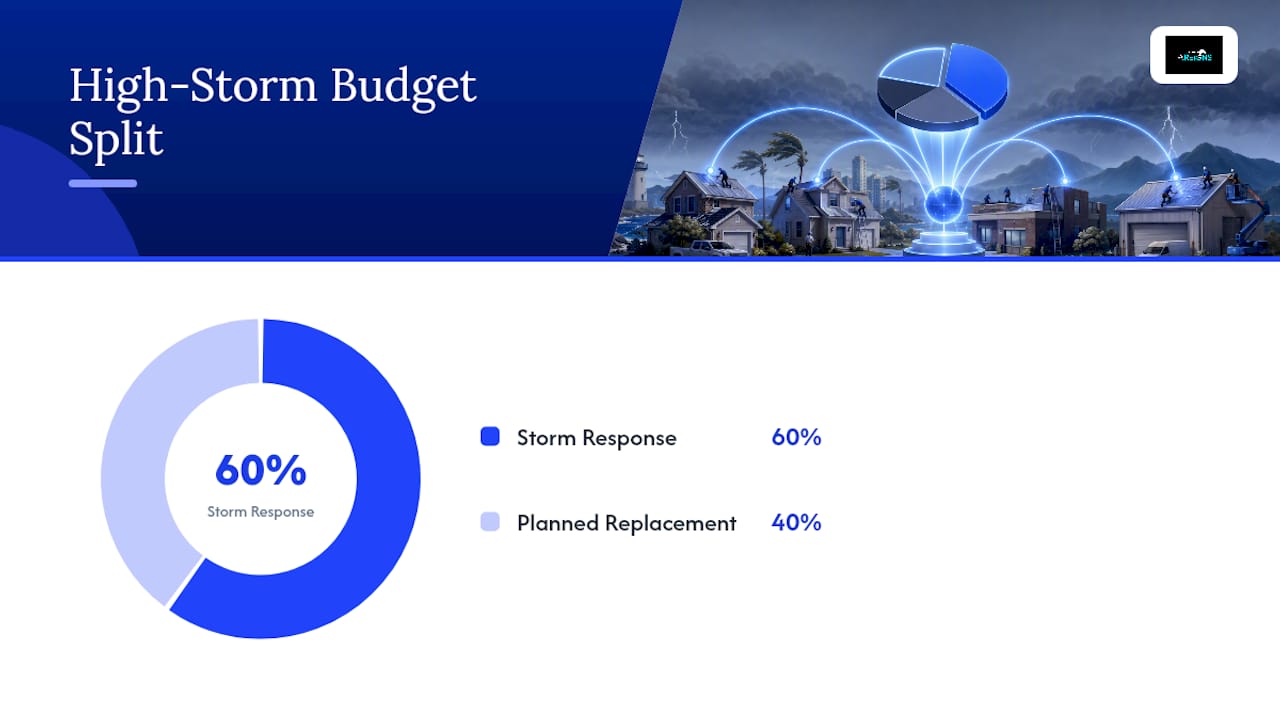
- Set a baseline budget split of roughly 60% storm-response, 40% planned-replacement in high-storm-risk markets, and flip that ratio in calmer markets.
- Build separate ad copy for each intent: “Emergency Roof Repair, Same-Day Response” for storm campaigns, “Free Roof Replacement Estimate, No Obligation” for planned-replacement campaigns.
- Match landing pages to the ad: a storm landing page should have a phone number above the fold and minimal form fields, while a planned-replacement page can afford a longer form and financing information.
Pro Tip: Set up storm-tracking alerts tied to National Weather Service data for each of your markets, and build a standing operating procedure to double LSA budgets and add emergency ad copy within hours of a confirmed hail or wind event, not days. The roofers who move fastest after a storm capture the largest share of the demand spike before competitors even notice it happened.
How Reputation Management and Review Generation Work at Scale
Reviews are the one asset that compounds without ongoing ad spend, and they’re also the easiest thing to let slide once you’re managing more than three or four locations. Free channels like reviews and referrals compound over time, while paid channels stop producing the moment you stop paying, which is exactly why review generation deserves a systemized, automated process rather than an occasional reminder to the crew.
A repeatable review workflow, applied identically at every branch:
- Trigger the review request automatically at job completion, logged in the CRM the moment the crew marks the job done.
- Send the first request via SMS within two hours of completion, followed by an email the next morning if there’s no response.
- Keep the message short and specific to the job just finished, not a generic “please review us” template.
- Automate a second follow-up three days later for anyone who hasn’t responded.
- Route every review, positive or negative, to a centralized reputation dashboard so no branch’s feedback gets lost.
A sample request message that works across SMS and email: “Hi [Name], thanks for choosing [Company] for your roof in [City]. If you have 60 seconds, a quick review would mean a lot to our [City] team. [Link]” Naming the city in the message isn’t cosmetic. It reinforces to Google that the review belongs to that specific location’s service area, and it makes the ask feel personal rather than corporate.
Surfacing reviews matters as much as collecting them. Pull the reviews attributed to each specific office onto that city’s landing page, and make sure the GBP profile for that branch reflects its own review count rather than a company-wide aggregate. Frequent GBP posts and detailed service listings help local-pack rankings, and reviews that mention specific neighborhoods or storm events add exactly the kind of local relevance signal that a generic five-star rating doesn’t provide.

Negative reviews need a consistent escalation policy across every location, not a case-by-case scramble. A good baseline: any review below three stars gets flagged to a centralized customer experience contact within 24 hours, a response is posted publicly within 48 hours acknowledging the issue without getting defensive, and if the complaint involves workmanship, it gets escalated to the branch manager for direct outreach. Letting branch managers freelance their own response style creates a brand voice mismatch, and it’s the first thing a homeowner comparing offices will notice when they read your reviews side by side.
How CRM, Routing, and Lead Qualification Prevent Leaks Across Territories
Every leaked lead across a multi-location footprint is money already spent on marketing walking out the door because nobody answered fast enough or the lead landed in the wrong inbox. Operations, not creative, is usually where multi-location roofing marketing quietly fails.
The CRM you use needs a specific feature set to handle multi-location complexity:
- API integrations with your ad platforms and call tracking so lead source data doesn’t get lost.
- SLA-based routing rules that assign leads to the correct territory automatically based on zip code or service polygon.
- Two-way SMS so office staff can text homeowners directly from the CRM instead of switching tools.
- Call tracking tied to unique numbers per location, per campaign.
- Lead scoring that flags high-intent leads (storm damage, insurance claim in progress) for immediate callback.
- An audit trail showing exactly when a lead came in, who it was routed to, and how fast it was contacted.
A workable routing rule looks like this: a lead comes in tagged to a zip code, the CRM assigns it to the closest branch by service polygon, and if that branch doesn’t log a contact attempt within 15 minutes, it automatically escalates to the next-closest branch or a centralized call center. Response speed determines who books the job more often than price or reputation, because homeowners comparing roofers after a storm tend to go with whoever calls back first with a confident, professional answer.
Human verification matters especially for storm-response leads, where lead quality varies wildly depending on the source. Areions builds its qualification process around verifying that the homeowner actually has documented storm damage before a lead ever reaches a roofing company’s CRM, which filters out the tire-kickers and duplicate submissions that plague shared-lead marketplaces.

Territory exclusivity needs clear definition before it becomes a source of internal conflict. Defining service areas by zip code is simpler to administer, but polygon-based territories (drawn around actual drive-time or population density) tend to produce more even lead volume across branches, especially in regions where zip codes vary wildly in size and population.
Pro Tip: Write your SLA in one sentence and post it where every office can see it: “Every lead gets a text confirmation within 5 minutes and a phone call attempt within 15 minutes, seven days a week.” Simple, measurable, and impossible to misinterpret.
What KPIs and Reporting Should Look Like Across Multiple Locations
A multi-location roofing company without a unified dashboard is flying on instinct, comparing branches using different metrics because nobody agreed on what “a good lead” means company-wide.
The core KPIs worth tracking, defined consistently across every location:
- Verified leads: total leads confirmed as real homeowner inquiries, not spam or duplicates.
- Qualified lead rate: the percentage of verified leads that meet your minimum criteria (real address, actual roofing need).
- Booked-job rate: the percentage of qualified leads that convert into a signed job.
- Cost-per-booked-job: total marketing spend divided by jobs booked, the metric that actually matters to ownership.
- LSA cost-per-lead vs. search cost-per-lead: tracked separately so you know which channel is more efficient by market.
- Time-to-contact: how fast a lead gets a response, measured in minutes.
- Closing rate by location: which branches convert leads into signed contracts most effectively, and which need sales coaching.
Reporting cadence should match the urgency of the data. Weekly operations reviews should cover lead flow and SLA compliance, because a branch missing its response-time target for two weeks straight is a fire that needs putting out now, not next quarter. Biweekly reviews are the right cadence for campaign optimization, adjusting bids and budgets based on what’s converting. Monthly executive summaries should roll everything up into cost-per-booked-job by location, the single number that tells ownership whether the marketing spend is actually working.
| KPI | How It’s Measured | Reporting Frequency |
|---|---|---|
| Verified leads | Count of confirmed real inquiries per location per week | Weekly |
| Qualified lead rate | Qualified leads divided by verified leads, by location | Weekly |
| Time-to-contact | Minutes from lead capture to first contact attempt | Weekly |
| Cost-per-booked-job | Total spend divided by signed jobs, by location and channel | Monthly |
| LSA CPL vs. Search CPL | Cost-per-lead compared across channels, by market | Biweekly |
Data sources that feed this dashboard include GBP Insights (for profile views and call clicks), your ad platforms (for spend and impression data), your CRM (for lead status and job value), and your call-tracking platform (for call volume and duration by campaign). A simple data-mapping checklist before building the dashboard: confirm every location has its own tracked phone number, confirm CRM fields match ad platform UTM parameters, and confirm every job in your job-management system links back to its originating lead.
How to Vet and Choose a Multi-Location Roofing Marketing Partner
The right partner for multi-location roofing marketing needs to prove they’ve operated at this scale before, not just run campaigns for a single-location contractor and assume the tactics transfer.
Core evaluation criteria worth weighing before you sign anything:
- Multi-location experience: ask for examples of managing five or more branches simultaneously, not a single flagship account.
- Storm-response capability: can they demonstrate a process for rapidly scaling ad spend and messaging when a storm hits a specific market?
- CRM integrations: do they connect directly to your existing CRM, or do they expect you to adopt theirs?
- Reporting transparency: will you get a dashboard you can log into, or a PDF once a month?
- Exclusivity terms: do they guarantee territory exclusivity, or will your competitor down the street get the same leads?
- Onboarding timeline: how long until the first campaigns are live in a new market?
Questions worth asking directly in an interview:
- “How do you verify a lead is legitimate before it reaches our CRM?”
- “What happens to our campaigns and data if we end the contract?”
- “Can you show us a reporting dashboard from an existing multi-location client?”
- “How fast can you stand up a new location’s GBP and ad campaigns?”
- “What’s your process the day after a storm hits one of our markets?”
Listen for specificity in the answers. A partner who can describe their exact verification process, down to how they confirm homeowner damage, is operating differently than one who says “we screen our leads” without elaborating.
Red flags worth walking away from: long-term contracts with no service-level agreement attached, vague or unexplained lead qualification processes, no evidence of actual GBP or citation work on past accounts, and an absence of call tracking, which usually means you’ll never know where your leads actually came from. A partner unwilling to commit to a pilot scope before asking for a year-long commitment is telling you something about how confident they are in their own results.
Contract negotiation should cover a defined pilot scope (one or two markets, 60 to 90 days), clear exclusivity geography spelled out by zip code or polygon, termination terms that don’t lock you in past a reasonable notice period, some form of lead-quality guarantee, and a set cadence for performance reviews, ideally monthly at minimum during the first six months.
What a Realistic Rollout Timeline and Budget Actually Look Like
Scaling multi-location roofing marketing happens in phases, and trying to compress the timeline usually means paying for mistakes twice.
This phased structure mirrors a foundation-to-expand-to-brand model that manages the feast-or-famine cycle common in roofing, where storm season creates demand spikes and calm stretches create lulls. Building the infrastructure in phase one means you’re ready to capture the surge instead of scrambling when the next storm hits.
Cost expectations vary by market size and number of locations, but the drivers that push spend up or down are consistent: LSA competition in dense metros costs more per lead than in smaller markets, storm season naturally pulls budgets higher as bids get competitive, and the sheer number of city pages you’re building affects both content production cost and the SEO timeline.
Sequencing spend matters more than the total budget. Start with LSAs, CRM setup, and call tracking, because those produce the fastest measurable return and give you the data infrastructure everything else depends on. Layer in SEO and content once the operational foundation is solid, since that channel takes months to mature but requires far less ongoing spend once it’s ranking.
What Actually Moves the Needle When You Scale Roofing Marketing
The single highest-leverage change most multi-location roofers can make isn’t a new ad platform or a redesigned website. It’s operationalizing storm response with a real SLA, because the marketing spend you already have becomes dramatically more efficient once every lead gets a fast, verified, tracked response.
I’ve seen the pattern repeat across roofing accounts scaling from three or four branches into double digits: the companies that pull ahead aren’t necessarily spending more, they’re leaking less. A branch running a five-star ad campaign with a two-hour callback window loses to a mediocre campaign paired with a five-minute response every time, because homeowners searching after a storm are calling three or four roofers at once and booking whoever answers first with confidence.
There’s a real trade-off between standardization and localization that nobody talks about enough. Push too hard toward identical templates across every branch, and your city pages start reading like duplicates, your review requests feel corporate, and homeowners can sense they’re dealing with a franchise rather than a local crew. Push too hard toward letting every branch do its own thing, and you lose the operational consistency that makes centralized reporting and lead routing possible in the first place. The right answer lies closer to standardized systems with localized content: identical CRM rules and SLA structure everywhere, but real local photos, real local reviews, and messaging that reflects each market’s actual weather risk and housing stock.
Speed versus coverage is the other tension worth naming directly. You can move fast in two or three pilot markets and prove the model before scaling further, or you can launch everywhere at once and accept a rougher first ninety days across the board. Most owners underestimate how much a tight pilot, run properly with SLA discipline and clean reporting, de-risks the bigger rollout that follows.
How Areions Builds a Storm-Response System for Multi-Location Roofers
Areions is built specifically for the operational problem this article has walked through: standardized local presence, two-track paid media, and centralized lead operations, run as one managed system rather than three disconnected vendors.
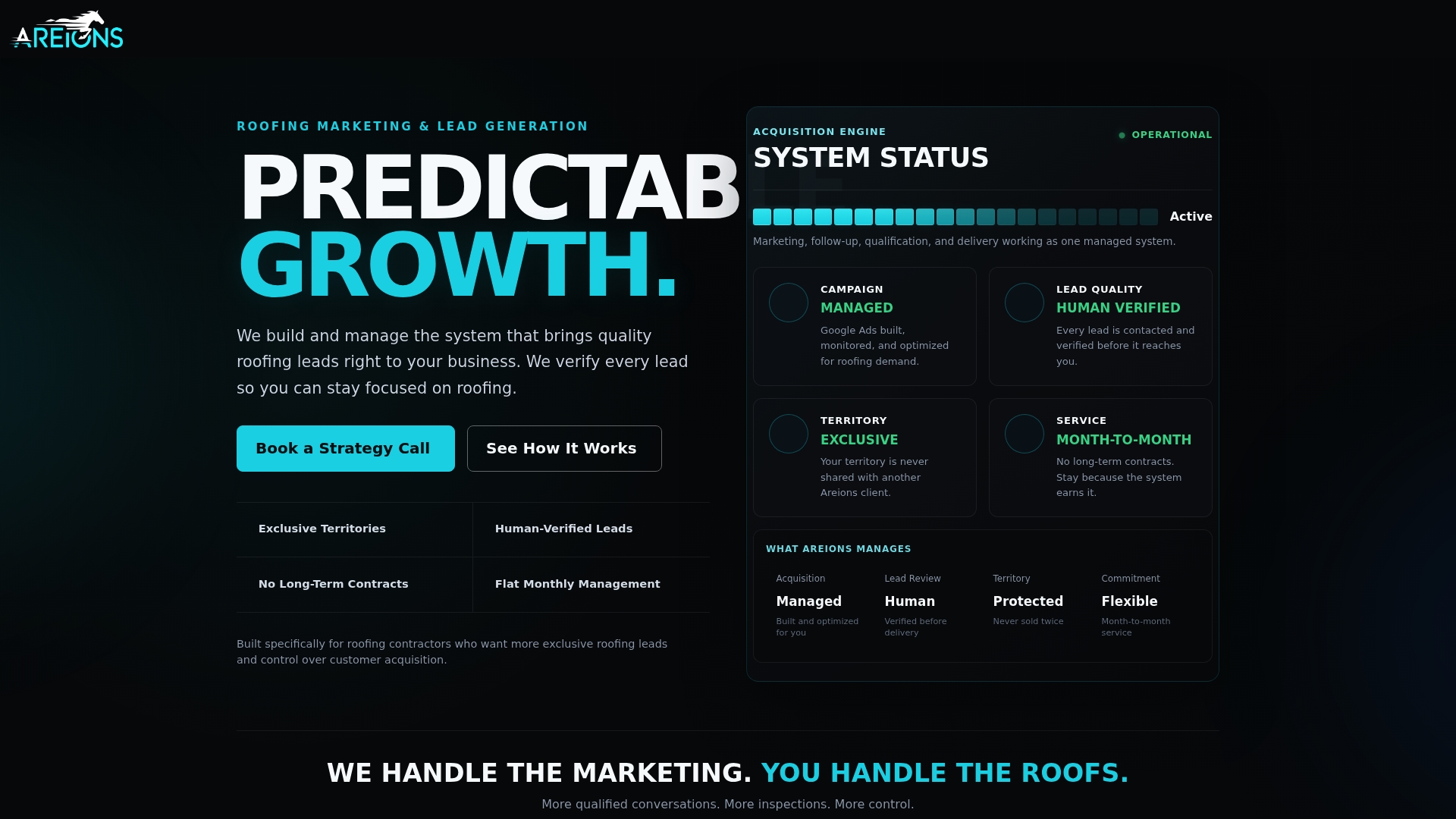
Areions manages Google Business Profile optimization and Local Services Ads across every one of your markets, pairs that with human-verified homeowner qualification so leads reaching your CRM have confirmed storm damage rather than guesswork, and sets up territory exclusivity so your branches aren’t competing against each other for the same leads. Every lead routes through automated CRM integration with call tracking already built in, which means your team spends time closing jobs instead of chasing down where a lead actually came from. The service runs month-to-month, with no long-term contract locking you in while you evaluate results, and Areions guarantees qualified leads within 30 days of launch, measured against the verification standard built into the qualification process itself.
If your current setup can’t tell you, right now, how fast a lead gets contacted after a storm hits one of your markets, that’s the gap worth closing first. Start a pilot audit with Areions to see what a properly operationalized storm-response system looks like across your specific footprint.
Useful Resources for Implementation
A few practical resources worth bookmarking as you build out your own multi-location system:
- Roofing Marketing Guide by Neil Patel covers foundational local SEO and GBP tactics specific to roofing, useful as a baseline reference before customizing for multiple markets.
- The Complete Guide to Roofing Marketing lays out the phased foundation-to-brand scaling model referenced throughout this guide, worth reviewing before setting your own rollout timeline.
- How to Rank Locally on Google offers a practical checklist of local SEO quick wins that apply cleanly to a multi-location city-page rollout.
- Local SEO Made Simple breaks down citation building and NAP consistency steps that scale well once you’re managing dozens of directory listings.
- Roofing Leads: 10 Sources That Book Jobs digs into response-time benchmarks worth using when you set your own SLA targets.
- Areions provides a managed, month-to-month implementation path if you’d rather have the storm-response system built and run for you than assemble it piece by piece internally.