Fix Site Friction and 5 Min Lead Response to Boost Roofing Conversions
The fastest way to improve your roofing conversion rate is fixing landing-page friction and guaranteeing sub-five-minute lead response, before spending another dollar on ads. Most roofing sites lose homeowners to slow mobile pages, buried phone numbers, and long forms, then let a fresh lead sit in an inbox for hours. Fix those two things and you can see measurable gains in booked inspections within 30 to 90 days.
TL;DR:
- Improving mobile load times under three seconds and placing key contact info above the fold can significantly boost homeowner engagement and conversion rates.
- Responding to leads within five minutes through automation and real-time routing dramatically increases the chance of booking inspections and closing deals.
- Tracking and optimizing each stage of the funnel—from session to contact, contact to qualified, and qualified to booked—helps identify where to focus improvement efforts.
- Building verified storm-damage leads with pre-qualification and territory exclusivity results in higher close rates and reduces wasted drive time.
- Focusing on quick website fixes, effective follow-up cadences, and localized landing pages yields better ROI than simply increasing traffic volume.
Table of Contents
- Where Do You Stand? Roofing Conversion Rate Benchmarks and Diagnostics
- Website and Landing-Page Fixes That Actually Convert
- Why Speed-to-Lead Determines Whether a Lead Ever Books
- Sales Process and Closing Tactics That Raise Your Close Rate
- The KPIs That Prove Your Fixes Are Working
- How a Proactive Storm-Response System Changes the Conversion Math
- What I’d Fix in the Next 72 Hours
- Get a Roofing Lead System Built Around Speed and Verification
- Sources
Where Do You Stand? Roofing Conversion Rate Benchmarks and Diagnostics
Before touching your website or your sales script, run the numbers you already have. Your current conversion rate tells you whether the problem is traffic, the page, or your operations, and each band points to a different fix.
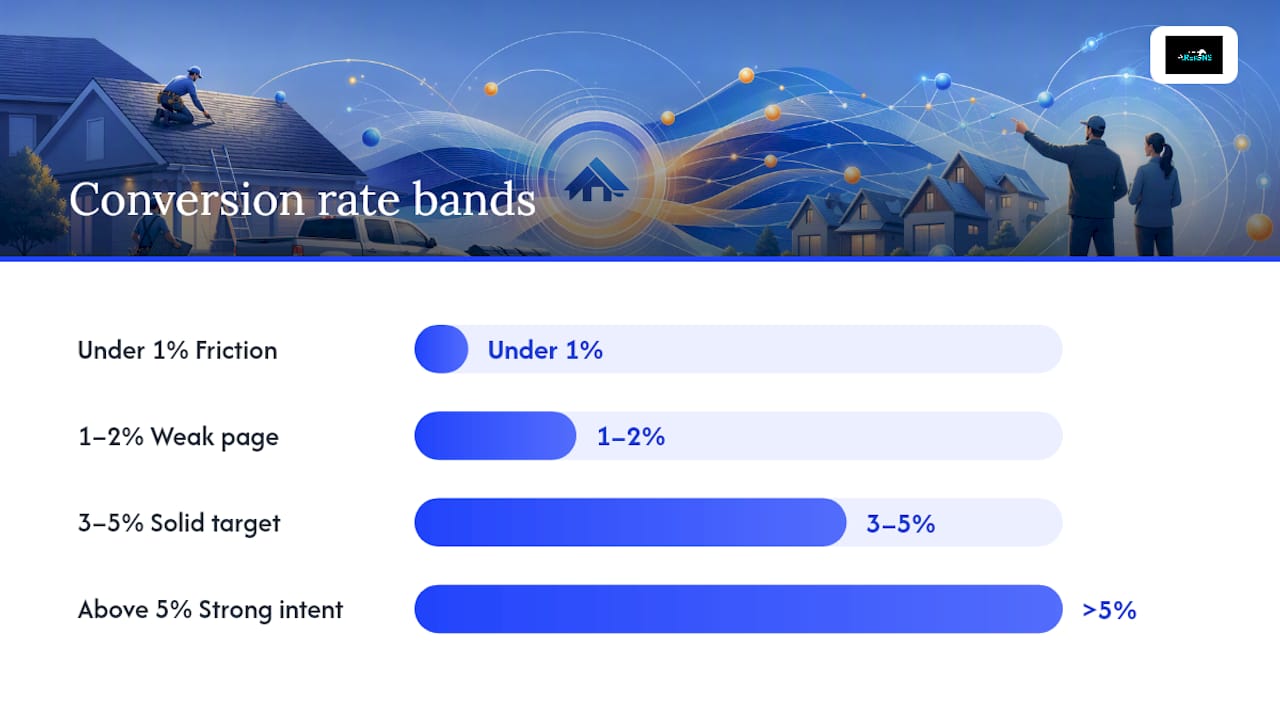
Roofing sites converting under 1% of visitors have a severe friction problem, usually a slow mobile experience or a hidden call-to-action. A rate between 1% and 2% is weak but fixable with copy and layout changes. Landing pages pulling 3% to 5% are hitting a solid working target for qualified traffic, and anything above 5% signals either strong buyer intent (think storm season) or an exceptionally tight page, according to GhostRep’s roofing benchmark data.
Once you know your band, trace the full funnel instead of guessing:
- Session to contact: what percentage of visitors call, text, or submit a form
- Contact to qualified: how many of those are real jobs, not tire-kickers or out-of-area requests
- Qualified to booked: how many agree to an inspection
- Booked to closed: how many sign a contract
Pull each ratio separately for at least 30 days of data. A weak session-to-contact rate points at your website. A weak qualified-to-booked rate points at your intake speed. A weak booked-to-closed rate points at your sales process, which is a very different fix than a slow page load.
Website and Landing-Page Fixes That Actually Convert
Your website’s job is to get a phone call or a form fill in under 10 seconds of a homeowner deciding you look credible. Here’s the priority order for fixing it.
- Hit mobile load times under 3 seconds. Google’s own research, cited by JobNimbus in its 2026 breakdown of high-converting roofing sites, shows bounce probability rises sharply as load time climbs past that mark. Run your homepage and top landing pages through PageSpeed Insights or GTmetrix and fix whatever flags red: oversized hero images, unoptimized fonts, and bloated plugins are the usual culprits.
- Put your value proposition, phone number, and CTA above the fold. A homeowner should see what you do, where you work, and how to reach you without scrolling. Click-to-call buttons need to be thumb-sized and high-contrast, not a gray link buried in the header.
- Shorten your forms and give people more than one way in. A five-field form (name, phone, address, roof issue, photo upload) converts better than anything asking for insurance carrier or budget range upfront. Offer a phone number, a short form, and a “schedule now” option side by side.
- Place trust signals right next to your CTA, not in a footer nobody scrolls to. Reviews, licensing badges, and manufacturer certifications work harder when they sit inches from the button you want clicked.
- Build service-plus-location pages instead of one generic contact page. A page targeting “roof replacement in [city]” outperforms a single catch-all page for local search visibility and matches how homeowners actually search. For deeper tactics on structuring these local pages, Honey Badger SEO’s approach to service-area SEO translates directly to roofing, even though it was built for a different trade.
Why Speed-to-Lead Determines Whether a Lead Ever Books
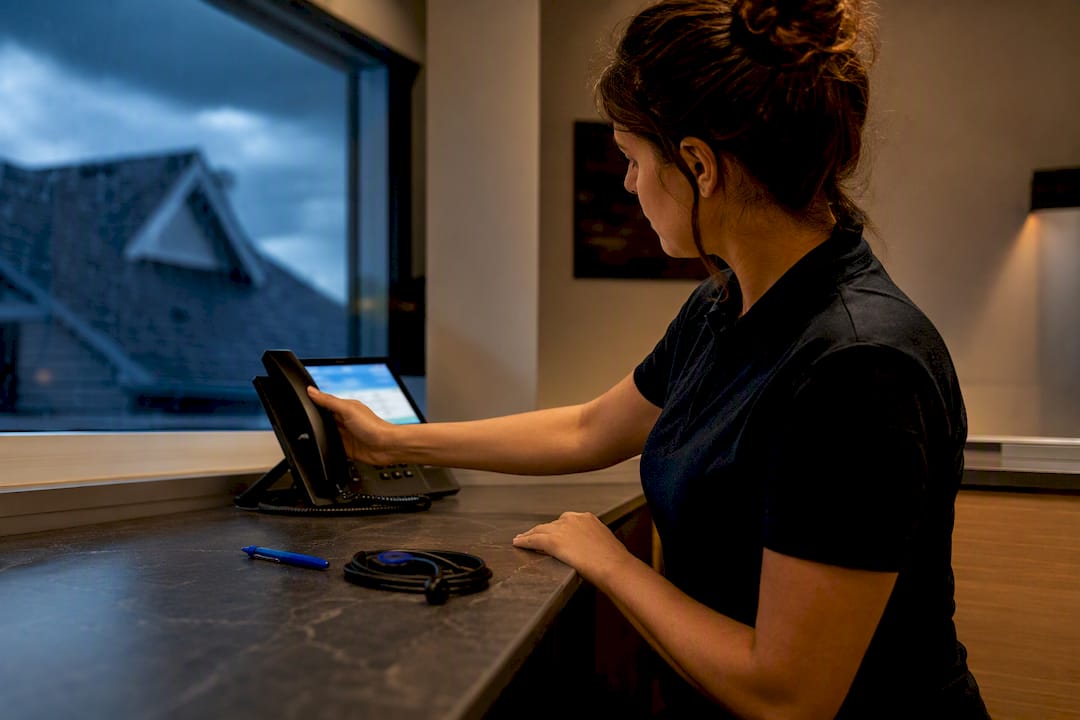
A lead that sits unanswered for 30 minutes is a lead that’s already called two of your competitors. Responding inside five minutes dramatically increases the odds a lead qualifies and books, according to RevRing’s research on speed-to-lead, and that window shrinks fast once a homeowner has other roofers on the phone.
Here’s how to build automation around that window instead of relying on someone checking a shared inbox:
- Trigger an instant text confirmation the moment a form submits. Something as simple as “Thanks, [Name] — a roofing specialist will call you within 5 minutes” buys you goodwill while a human gets on the phone.
- Route calls and form leads to whichever rep is actually available, not the top of a static list. Auto-assignment based on real-time availability beats round-robin every time.
- Set CRM rules for duplicate detection and source tagging so you’re not double-dialing the same homeowner from two ad campaigns and losing track of which channel actually produced the job.
- Build a 7-touch follow-up cadence that mixes call, text, and email over the first 10 days, since PipelineOn’s sales process research shows this structured cadence recovers deals that a single call-and-done approach loses.
- Write fast disqualification rules (out of service area, renter not owner, cosmetic-only requests) so your estimators aren’t burning drive time on leads that were never going to close.
Pro Tip: Set your CRM to flag any lead untouched after five minutes with an escalation text to a manager, not just the assigned rep. That single rule catches more missed leads than any dashboard review ever will.
Sales Process and Closing Tactics That Raise Your Close Rate
Getting a homeowner to book an inspection is only half the job. What happens in that living room, or on that video call, decides whether the lead turns into revenue.
- Present good, better, best options every time, even when you expect the homeowner to pick the middle tier. Anchoring against a premium option makes your standard package look like the reasonable choice.
- Ask for the signature on the spot and take a deposit. Homeowners who say “let me think about it” convert at a fraction of the rate of those who sign during the same visit, because competing bids and cold feet creep in overnight.
- Offer financing on every quote above a few thousand dollars, not just when a homeowner asks. Buyers anchor on the monthly payment rather than the total price, which PipelineOn’s data on financing presentation ties directly to higher close rates.
- Use a digital measurement tool and a written proposal with photos during the walkthrough. Homeowners trust what they can see, and a same-visit proposal beats “I’ll email that to you tonight” almost every time.
- Track close rate by individual rep, not just company-wide, and run roleplay drills on your three most common objections: price, timing, and “I want to get other quotes.”
Pro Tip: Run a monthly lost-deal review where every rep explains why a specific quote didn’t close. Patterns show up fast, usually around one objection nobody’s actually trained to handle.
The KPIs That Prove Your Fixes Are Working
Track five numbers, every week, broken out by channel and by rep: landing sessions, contact attempts, qualified leads, booked inspections, and closed jobs. Anything less and you’re guessing whether a change worked or you just had a lucky week.
- Session-to-contact rate tells you if your website is doing its job
- Contact-to-qualified rate tells you if your intake speed and screening are working
- Qualified-to-booked rate tells you if your follow-up cadence is holding leads
- Booked-to-closed rate tells you if your sales process is converting
Here’s the math that makes this worth doing: if you run 500 monthly sessions at a 2% conversion rate and average job value of $10,000, a single one-point lift to 3% adds five more booked leads a month. At even a 30% close rate, that’s roughly $15,000 in added monthly revenue, which is usually far cheaper to capture than buying equivalent traffic, a point GhostRep’s conversion research makes about fixing conversion before scaling spend.
How a Proactive Storm-Response System Changes the Conversion Math
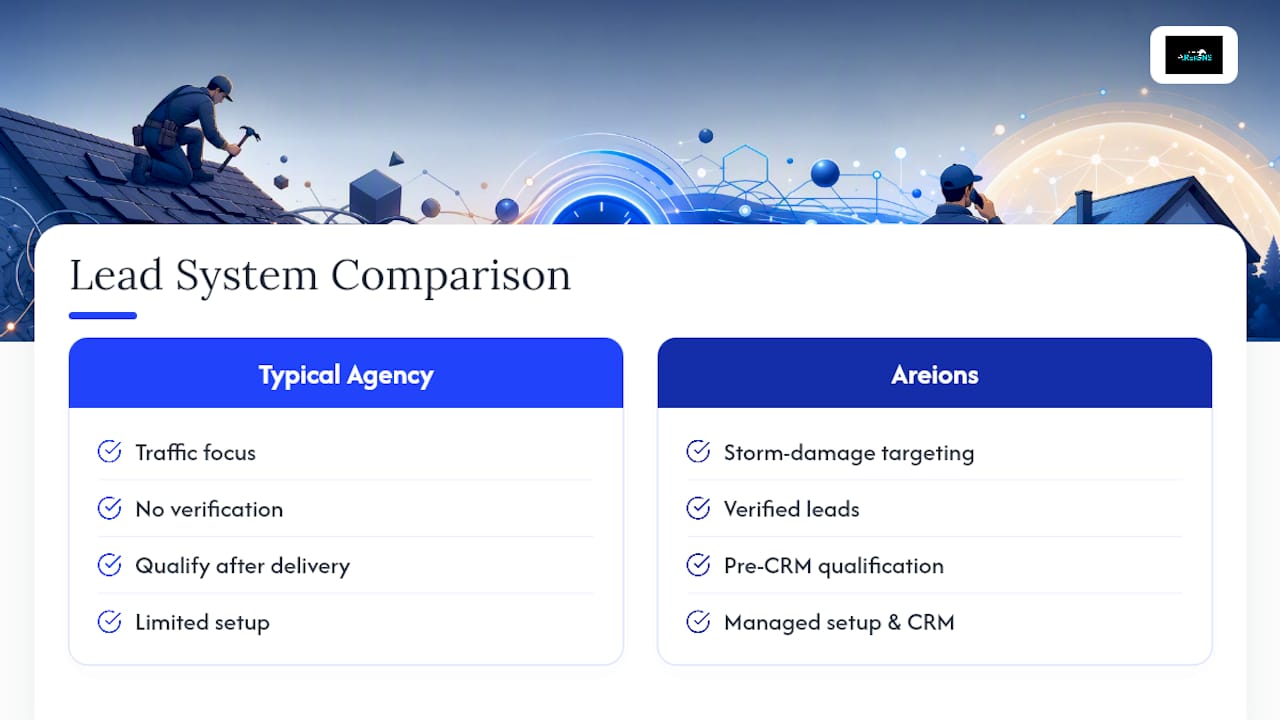
Anonymous pay-per-lead traffic hands you a name and a phone number, then leaves the qualifying to you. A storm-response system built specifically to intercept active demand works differently, because the qualification happens before the lead ever reaches your CRM.
Areions verifies actual storm damage against a homeowner’s address, confirms the person requesting an estimate is qualified to move forward, then routes the lead into your CRM with that context already attached. That verification step matters because storm-response leads carry higher close rates to begin with, driven by real urgency and insurance coverage, but only when the homeowner behind the lead is genuine and the claim workflow is ready to move.
- Verified damage means your estimator isn’t driving to a cosmetic complaint
- Pre-qualification means your intake team spends less time screening and more time booking
- CRM delivery with context means your 7-touch cadence starts from a warmer position than a cold form fill
- Territory exclusivity and a month-to-month structure mean you’re not competing for the same lead against three other roofers
What I’d Fix in the Next 72 Hours
Immediate: run your homepage through a speed test tonight, turn on an instant text auto-response for every new lead, and cut your main form down to five fields. Mid-term: start rep roleplay drills, add a financing partner if you don’t have one, and build city-specific landing pages for your top three service areas. Recheck your session-to-contact and booked-to-closed rates in 30 days. If both moved, you fixed the right things.
— Angel
Get a Roofing Lead System Built Around Speed and Verification
Most roofing marketing agencies sell you traffic and let you sort out the rest. Areions works differently: it’s built specifically to intercept homeowners with verified storm damage, qualify them before they hit your CRM, and hand your team a lead that’s already warmer than a typical form fill.
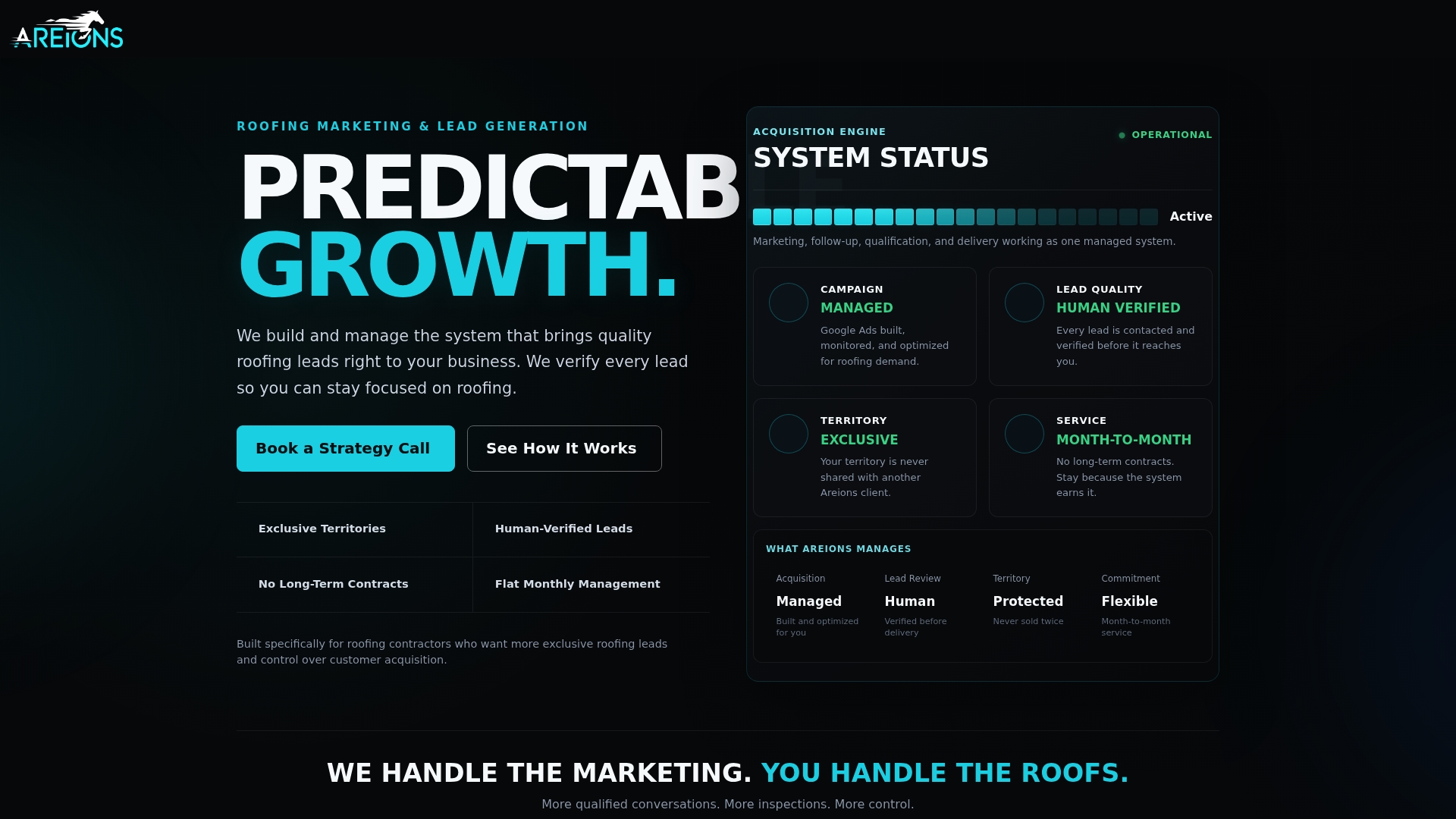
The service runs month-to-month and includes managed campaign setup, CRM and pipeline configuration, call tracking, and territory exclusivity. The service aims to deliver qualified leads promptly, giving you a real window to test the fixes covered above, tighter forms, faster response times, and a sharper sales cadence, against a lead source built for higher intent from the start.
If your close rate is solid but your lead flow is inconsistent, or you’re tired of paying for anonymous leads that go nowhere, book a strategy call with Areions and walk through what a proactive storm-response system would look like for your service area.
Sources
Not every lead source converts the same way, and chasing volume without checking close rate is how marketing budgets quietly leak. Organic search, your Google Business Profile, referrals, and even YouTube tend to close at higher rates because the homeowner already trusts you before the first call, a pattern Kihan Marketing’s channel breakdown backs up across multiple roofing markets.
Local Service Ads and pay-per-lead platforms deliver more predictable volume, but at a higher cost per lead and typically a lower close rate than organic or referral traffic, since LSA leads require review depth and fast responsiveness to perform well. Storm-triggered leads behave differently again: urgency and insurance coverage tend to push close rates higher, but only when your team runs an actual insurance-claim workflow behind them.
A few rules of thumb for allocating budget:
- Why Speed-to-Lead Is the #1 Metric Your Sales Team Should Be Obsessing Over | RevRing Blog
- What a high-converting roofing website actually looks like in 2026 | JobNimbus
- Roofing website conversion rate: 2026 benchmarks & fixes | GhostRep
- Roofing sales process in 2026 | PipelineOn