
Exclusive Roofing Territories: 8 Questions to Vet Storm Lead Vendors
Exclusive lead territories for roofing companies are available now, and the most direct route is a managed storm-response provider that verifies homeowners and locks your area against internal competition. We recommend going with a provider built specifically for this: proactive storm-response targeting, human-verified leads, true territory exclusivity, month-to-month terms, and a 30-day qualified lead guarantee.
TL;DR:
- Define exclusivity by ZIP code or mapped boundary, and verify that contract language and CRM routing prevent another contractor from receiving leads in your territory.
- Match Foundation to one location, Professional to growing crews needing priority routing and CRM automation, and Enterprise to operators protecting multiple markets.
- Request a two to four week pilot to test homeowner verification, routing speed, and early conversion before increasing spend or expanding territory coverage.
- Require the agreement to identify the seller homeowners see and provide clear disclosure language, since lead source details affect Do Not Call compliance.
- Check that the guarantee defines a qualified lead and covers delivery within 30 days after launch, while confirming you can cancel each month.
Table of Contents
- Comparing service tiers for exclusive roofing territories
- Questions to ask before signing a territory agreement
- Why proactive storm response changes the math for roofers
- Get exclusive territory protection with a strategy call
- FAQ
- Sources
- Primary regulatory and guidance sources cited
Comparing service tiers for exclusive roofing territories
Not every roofing business needs the same level of territory protection or lead volume. We built three tiers so a single-crew operation and a multi-market company can both get coverage that matches their capacity, starting with Foundation, our entry-level managed storm-response package.
Each tier carries the same core protections. What changes is scale: how many territories you hold, how much lead volume flows through them, and how much routing and reporting depth your team needs.
- Foundation fits a single-location roofing business testing exclusive territories for the first time.
- Professional fits a growing contractor running multiple crews who needs priority routing and fuller CRM automation.
- Enterprise fits multi-location operators or franchise-style networks that need exclusivity enforced across several markets at once.
Operators managing several locations often find the gap isn’t lead volume, it’s visibility across markets. A platform like JobOS Pro handles multi-location benchmarking and dispatch for home service networks, which can complement territory-based lead delivery once you’re running more than one market.
Questions to ask before signing a territory agreement
Choosing a provider for exclusive lead territories comes down to a short list of hard questions. Run through these before you sign anything:
- Ask where leads originate. Request a plain description of the campaign source, whether it’s storm-triggered search ads, landing pages, or referral partnerships.
- Ask how homeowners get verified. A real verification step, not just a name and phone number, separates qualified leads from raw form fills.
- Ask exactly what “exclusive” covers. Get the territory defined by ZIP codes or a mapped boundary, not a vague “your area” promise.
- Ask for a volume estimate tied to your territory’s storm history. A provider should be able to explain how recent weather activity in your region shapes expected lead flow.
- Ask how leads route into your CRM. Confirm whether routing is automatic, how fast leads land, and what follow-up sequence triggers.
- Ask about reporting cadence. Weekly or monthly reporting on lead counts, conversion, and cost per lead should be standard, not an add-on.
- Ask what the guarantee actually covers. A 30-day qualified lead guarantee only means something if the contract spells out what counts as “qualified.”
- Ask about cancellation terms. Month-to-month should mean exactly that: no multi-year lock-in disguised as a “pilot period.”
Pro Tip: Before committing to a full contract, ask whether the provider will run a short pilot, two to four weeks, so you can check lead verification, routing speed, and early conversion before scaling up spend.
Vendor agreements should also name the specific entity contacting homeowners. FTC staff guidance on lead generation notes that a buyer generally avoids Do Not Call and established business relationship problems only when the lead source gives consumers clear, prior disclosures and identifies the matched seller. Ask any provider to show you the disclosure language homeowners actually see.

Why proactive storm response changes the math for roofers

Most roofing marketing waits for a homeowner to search after the damage is visible and the competition is already calling. Intercepting demand earlier, while storm damage is fresh and verification is still happening, tends to raise close rates because the homeowner hasn’t been pitched by five other crews yet.
Month-to-month terms and verified leads also protect cash flow. You’re not paying for a raw list and hoping it converts; you’re paying only when the system is actually producing leads worth working.
— Angel
Get exclusive territory protection with a strategy call
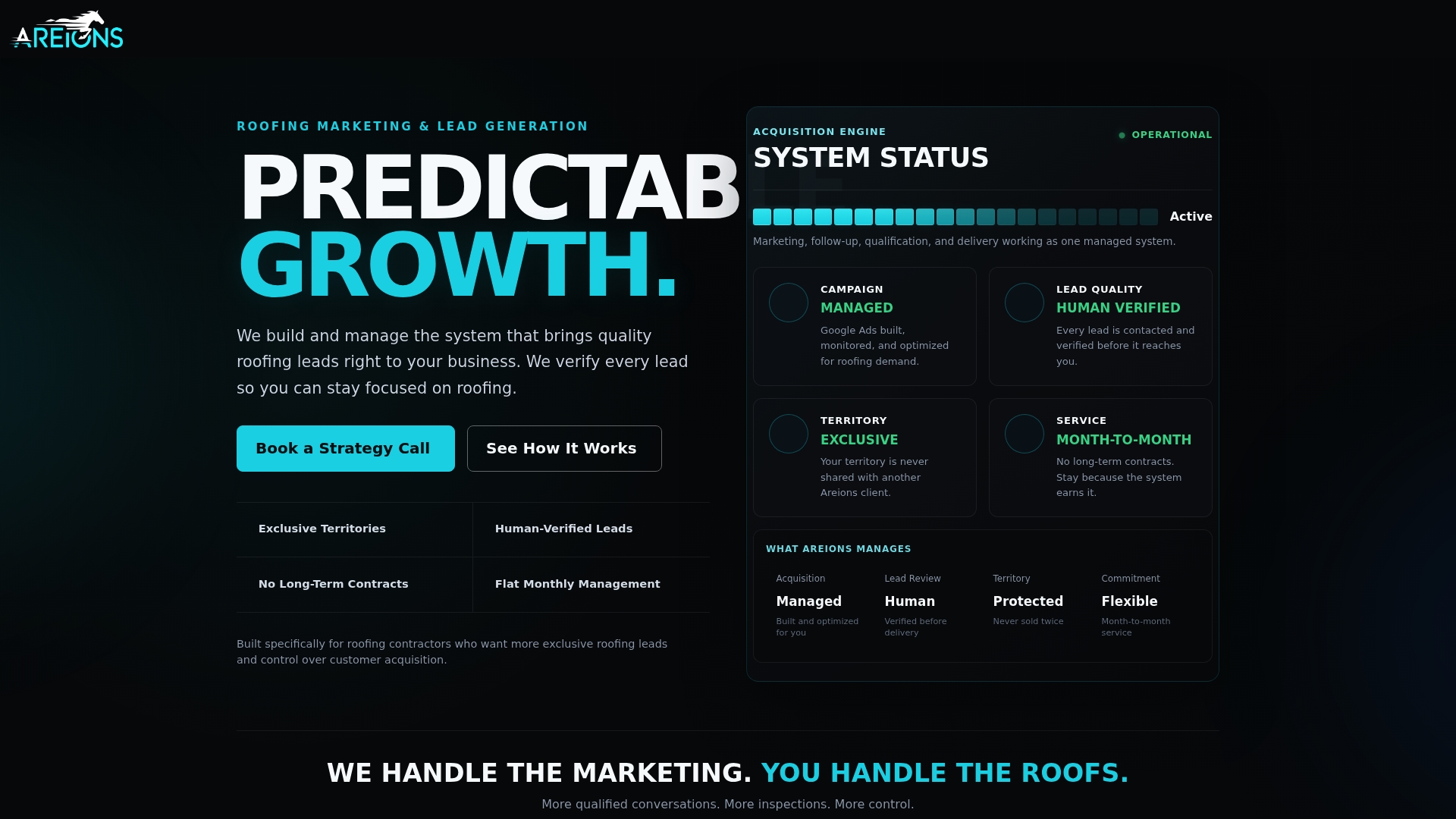
Our model combines human-verified, storm-driven leads with real territory exclusivity: once your area is assigned, the provider does not sell it to a competing crew. Every plan runs month-to-month, and a qualified lead guarantee applies within 30 days of launch.
A strategy call covers:
- Reviewing storm activity and demand patterns in your target territory.
- Mapping which plan, Foundation, Professional, or Enterprise, fits your current crew capacity.
- Walking through CRM integration and how routing will work from day one.
- Setting a timeline for your first qualified leads.
Book a strategy call to check territory availability in your area and see what onboarding looks like for your business.
FAQ
What does “exclusive territory” mean for a roofing lead provider?
It means your business is the only roofing company receiving leads generated for that assigned area, typically defined by ZIP codes or a mapped boundary. Internal competition is blocked by contract and enforced through lead routing rules, so a second crew in the same system can’t buy into your zone.
How is territory exclusivity actually enforced?
Providers enforce it through geo-fenced routing in their CRM and through contract language that prevents reselling the same territory to another business. Ask to see the specific boundary definition and the routing setup before signing, not just a verbal assurance.
What should a roofing contract include regarding Do Not Call compliance?
Agreements should identify the specific seller by legal name and disclose how homeowners were contacted and by whom, which FTC Telemarketing Sales Rule materials tie to recordkeeping and seller identification requirements. Keeping these records protects both the lead provider and your business if a complaint arises.
How much do exclusive roofing lead plans cost?
Our plans run from an entry-level price for Foundation up to higher tiers for Professional and Enterprise, each covering a different scope of territory and lead volume. All three are month-to-month with no long-term contract required.
How long does onboarding take before leads start arriving?
Onboarding typically includes campaign setup, tracking integration, and test leads before full routing goes live, with a qualified lead guarantee set at 30 days. Most of that window covers verification and routing checks rather than waiting on the leads themselves.
Sources
- FTC staff advisory opinion on EBR and lead generation (Hudson Cook, LLP letter response)
- Telemarketing Sales Rule – proposed/final materials (FTC)
Primary regulatory and guidance sources cited
Compliance claims in this guide draw on FTC staff advisory guidance on lead generators and Telemarketing Sales Rule final rule materials, both cited above near the relevant claims.